- 366 pages
- English
- ePUB (mobile friendly)
- Available on iOS & Android
eBook - ePub
About this book
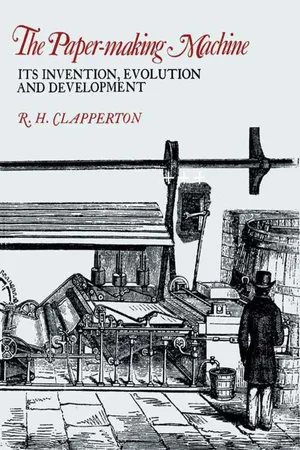
The Paper-making Machine: It's Invention, Evolution and Development covers the history of the paper-making machine and its origin and how it developed. This book is organized into 15 chapters, and starts with the discussion of the origin of the first paper-machine way back from A.D. 105 in China. The subsequent chapter deals with the development of the paper-machine where the British improved the machine and were then widely used by people. This topic is followed by discussions on the progress of paper making in 1830-1835 where an advanced type of Fourdrinier machine was introduced by Matthew Towgood and Leapidge South. Other chapters describe further improvements on the Fourdrinier machines and the paper-makings on the late 1800's. The last chapter considers the standardization of the paper-making machine during 1870-1890. This book will be of value to machine inventors and those who work in printing presses.
Information
1
The First Paper-making Machine
Publisher Summary
This chapter describes the first paper-making machine. The paper-making machine of today is something that is taken for granted and about the origin or the tremendous amount of work and ingenuity of which little is known. The man who first put into practice the idea of making paper mechanically in long lengths and who produced a machine on which to do it was a Frenchman named Nicolas Louis Robert. He worked in the office of a paper-mill. An idea captured his imagination, and he began to give a great deal of attention to the problems involved. His intelligence and the encouragement of his employer from time to time eventually enabled him to create a machine destined to revolutionize the art and practice of paper-making. After much experimental work, which occupied several years, and many improvements indicated through practical use, his machine made paper. It is certain, however, that this crude machine had a short life and was never able to make paper continuously on a commercial scale. There was no continuous paper-making machine working commercially in France until many years after Louis Robert’s invention, in fact not till 1816, when a machine was installed at the mill of Messrs.
THE paper-making machine of today is something that we take for granted. Little is known of its origin or of the tremendous amount of work and ingenuity which was put into the making of a machine which would produce paper in a continuous web, as compared with the single sheets which had always been made by hand.
Paper was invented in the year A.D. 105 in China, and from that time up to the end of the eighteenth century all paper throughout the world was made one sheet at a time on a mould by a vatman. He dipped his mould into the vat of stuff and drew out the fibres mixed with water which drained away through the meshes of the mould and left him with a wet sheet of pulp. This product was afterwards couched off onto a piece of cloth or felt before having the water squeezed out of it and was then finally dried by being hung in the open air.
The man who first put into practice the idea of making paper mechanically in long lengths, and who produced a machine on which to do it, was a Frenchman named Nicolas Louis Robert,* who worked in the office of a paper-mill owned by Leger Didot† at Essonnes in France. Louis Robert was born in Paris in 1761. He began work as a lawyer’s clerk, and later became a proof-reader in a printing office after having served for some years in the French Army.
During the Revolution, after his return from service in North America, he was employed by Leger Didot in the counting-house of the Essonnes Paper Mill. His previous occupations hardly seemed to prepare him for the task of inventing a paper-making machine, but this idea captured his imagination and he began to give a great deal of attention to the problems involved. His intelligence, and the encouragement of his employer from time to time, eventually enabled him to create a machine destined to revolutionize the art and practice of paper-making. After much experimental work, which occupied several years, and many improvements indicated through practical use, his machine made paper.
It is certain, however, that this crude machine had a short life and was never able to make paper continuously on a commercial scale. There was no continuous paper-making machine working commercially in France until many years after Louis Robert’s invention, in fact not till 1816, when a machine was installed at the mill of Messrs. Berte and Grevenich, at Saint-Roch, Commune de Sorel Moussel, Eure-et-Loir. This machine, made by Calla, proved to be a failure, and it was not until 1822 that a Fourdrinier machine, built by Bryan Donkin and installed in a French mill, became the first commercially successful paper-making machine. Great credit is undoubtedly due to Robert, for not only did he solve the problem of working a long and broad flexible endless mould by mechanical means, using an endless running wire, but he also foresaw that paper in long lengths would find special uses. Initially, it occurred to him that it would be more useful if wallpaper could be made in rolls, instead of in panels. In his time this appeared to be the only purpose to which a long strip of paper could be put. In Paris at that time there was a very great demand for wallpapers of every description for decorating the rooms of the larger houses. It is due almost entirely to this demand that paper on rolls was ready in time for rotary printing, a need which stimulated the inventive genius of Louis Robert.
A French authority has this to say about Robert’s machine: “As to the manufacture of paper mechanically, the first idea was formed in 1798. Robert, working at a paper-mill at Essonnes, inventor, helped by Leger Didot, proprietor of the factory, made one machine which did not work.”
Although Robert’s original idea was not brought to fruition in France, possibly chiefly on account of the disturbed political situation at the time, he was granted a patent by the French Government for fifteen years.
Shortly after Robert had started to work as an accountant in the offices of the paper-mill at Essonnes, he was promoted to a post which involved his being a kind of clerk inspector of the workers. This was probably due to the experience he had gained as a soldier, because there was a great deal of trouble with workers in French factories at this time. It was the trouble experienced in managing about three hundred men in a mill making paper by hand which determined Robert to try to produce some means by which paper could be made mechanically and by only a few men, so as to be independent of the large numbers required in a hand-made paper mill. A French account states that he was vividly struck by the grave difficulties presented in directing three hundred workers, who were influenced and made truculent by the Revolution.
At Didot’s mill at Essonnes they manufactured the paper used in the making of the assignats, or paper money used by the Government, and lack of discipline of the workers had often caused serious troubles. Robert told his employer, Leger Didot, of his idea and was authorized by him to make use of material and workmen in the factory to carry out his project of designing and erecting a machine that would make paper by mechanical means. The first model made was by no means perfect and did not come up to Robert’s own expectations, although the results obtained were satisfactory enough to encourage him in the hope that he would eventually succeed. For some years after his initial attempt, Robert did nothing further towards perfecting the work until Didot took him to task about this, and encouraged him to continue and make a success of it by offering to help him and to enter into an agreement with him about financing it. Robert, thus encouraged, turned again to the work and, after many experiments which occupied him about three years, succeeded in constructing a model of the machine which realized his hopes and made paper continuously, but of very narrow width.
Robert and Didot tried out the machine secretly together, and this was so satisfactory that Didot gave him the necessary authority to make a large machine on the lines of the model which had been so successful.
It is fortunate that there is an account in English by Didot’s brother-in-law, John Gamble. At the time of the invention of this paper-making machine by Robert, Gamble, an Englishman, was employed by the British Government in the office of Captain James Coates, of the Royal Navy, in Paris, who was a councillor for the exchange of prisoners of war in France. The following account is given by John Gamble:
Louis Robert, a native of France, is the person to whom we are indebted for the paper-making machine. I had frequent opportunities of seeing him at work on his first model, in 1796, 1797 and 1798, at the Paper Manufactory at Essonnes, eight leagues from Paris, Département de Seine-et-Oise (which at that period belonged to Monsieur Leger Didot, my brother-in-law), where Louis Robert was employed as book-keeper. His first model was no larger than a bird organ, and the slips of paper he made with it were not wider than a piece of common tape, but of various lengths. Robert possessed a natural mechanical genius, and was never so happy as when employed in inventing or improving some piece of machinery, but unfortunately, the only time he could devote to his favourite pursuit was in the evening, after the counting-house business was over, and many a time I have heard him blamed and reproached by his employer, Leger Didot, for wasting so much time on an invention that would never be brought to perfection. However, Robert persevered, and in about two years produced a model which performed so satisfactorily that M. Didot was, at last, induced to afford him the means of making a machine upon a larger scale, which was called the working-model. Orders were given to the carpenters, smiths, millwrights and other workmen employed at the manufactory to take directions from, and execute any work, that Robert might require for his paper-making machine. In a few months from that time a machine was completed capable of making paper of the width of Colombier (24 in.), and of various lengths, being the kind of paper usually employed for paper hangings of which the consumption in France was immense. Owing to the great difficulty, at that time, of sizing and pressing sheets of paper of great length with the presses usually employed in paper-mills, the length was generally limited to twelve yards, but a fresh difficulty arose in the process of drying it; it was suspended on lines in the drying loft, but from its weight when in the wet state it contracted so much in the middle, during the drying, that it was rendered unfit for the use of the paper stainers; the next attempt was by laying these long sheets horizontally on the lines; and by adjusting several of the frames or trebles on a level line, the inconvenience of the partial shrinking of the paper when suspended in a vertical direction was remedied. Many of these long sheets were sold to the paper stainers of Paris. After a series of experiments and improvements, Louis Robert applied to the French Government for a patent, or brevet d’invention.
Robert, however, was unable to raise the £30 necessary to obtain a French patent, so he wrote to the French Government and pointed this out, asking if they would be willing to grant him a patent without payment of any money. His letter is as follows:
9th September, 1798
To the Minister of the Interior,
Citizen Minister,
After many years, during which I have been employed in one of the principal paper factories of the Republic, I have given thought to simplifying the methods of manufacture of paper and making it infinitely less expensive, and above all in making a paper of extraordinary length without the help of a single workman and by purely mechanical means. I have at last succeeded by hard work, experience and expense, in manufacturing a machine which fulfils perfectly the purpose I proposed. With the greatest economy in time and labour it makes an exceptional paper twelve to fifteen metres long if one wishes. Here, in a few words, are the advantages which I obtain by my machine constructed at the factory of citizen Didot at Essonnes. I say of a truth and this is the place to say it, that I have received from citizen Didot the greatest help in the making of this machine; his works, his workers and his purse have been at...
Table of contents
- Cover image
- Title page
- Table of Contents
- Inside Front Cover
- Copyright
- ACKNOWLEDGEMENTS
- INTRODUCTION
- Chapter 1: The First Paper-making Machine
- Chapter 2: The First British Paper-making Machine Patent
- Chapter 3: The Paper-making Machine of 1807
- Chapter 4: The Fourdriniers’ Struggle for Development
- Chapter 5: The Chain-mould Paper-making Machine
- Chapter 6: The Dickinson Cylinder-mould Machine
- Chapter 7: The Chain-mould and Fourdrinier Machines combined
- Chapter 8: The Invention of the Dandy-roll or Riding-roller
- Chapter 9: The Dickinson Suction-roll and other Developments
- Chapter 10: Progress in Paper-making, 1830–35
- Chapter 11: Improvements to Fourdrinier Machines
- Chapter 12: Early Victorian Paper-making Machines: Modifications and Inventions
- Chapter 13: The Bryan Donkin Company
- Chapter 14: Paper-making in the 1860’s
- Chapter 15: Standardization of the Paper-making Machine, 1870–90
- APPENDIXES
- Index
Trusted by 375,005 students
Access to over 1.5 million titles for a fair monthly price.
Study more efficiently using our study tools.
Frequently asked questions
Yes, you can cancel anytime from the Subscription tab in your account settings on the Perlego website. Your subscription will stay active until the end of your current billing period. Learn how to cancel your subscription
No, books cannot be downloaded as external files, such as PDFs, for use outside of Perlego. However, you can download books within the Perlego app for offline reading on mobile or tablet. Learn how to download books offline
Perlego offers two plans: Essential and Complete
- Essential is ideal for learners and professionals who enjoy exploring a wide range of subjects. Access the Essential Library with 800,000+ trusted titles and best-sellers across business, personal growth, and the humanities. Includes unlimited reading time and Standard Read Aloud voice.
- Complete: Perfect for advanced learners and researchers needing full, unrestricted access. Unlock 1.5M+ books across hundreds of subjects, including academic and specialized titles. The Complete Plan also includes advanced features like Premium Read Aloud and Research Assistant.
We are an online textbook subscription service, where you can get access to an entire online library for less than the price of a single book per month. With over 1.5 million books across 990+ topics, we’ve got you covered! Learn about our mission
Look out for the read-aloud symbol on your next book to see if you can listen to it. The read-aloud tool reads text aloud for you, highlighting the text as it is being read. You can pause it, speed it up and slow it down. Learn more about Read Aloud
Yes! You can use the Perlego app on both iOS and Android devices to read anytime, anywhere — even offline. Perfect for commutes or when you’re on the go.
Please note we cannot support devices running on iOS 13 and Android 7 or earlier. Learn more about using the app
Please note we cannot support devices running on iOS 13 and Android 7 or earlier. Learn more about using the app
Yes, you can access The Paper-making Machine by R. H. Clapperton in PDF and/or ePUB format, as well as other popular books in Technology & Engineering & Engineering General. We have over 1.5 million books available in our catalogue for you to explore.