eBook - ePub
Smart Grid
Integrating Renewable, Distributed and Efficient Energy
- 568 pages
- English
- ePUB (mobile friendly)
- Available on iOS & Android
eBook - ePub
Smart Grid
Integrating Renewable, Distributed and Efficient Energy
About this book
The creation of a flexible, efficient, digitized, dependable and resilient power grid may well be the best route to increasing energy efficiency & security, as well as boosting the potential of renewable & distributed power sources. This book covers smart grids from A-Z, providing a complete treatment of the topic, covering both policy and technology, explaining the most recent innovations supporting its development, and clarifying how the smart grid can support the integration of renewable energy resources. Among the most important topics included are smart metering, renewable energy storage, plug-in hybrids, flexible demand response, strategies for offsetting intermittency issues, micro-grids for off-grid communities, and specific in-depth coverage of wind and solar power integration. The content draws lessons from an international panel of contributors, whose diverse experiences implementing smart grids will help to provide templates for success.
- Provides critical information on the technological, design and policy issues that must be taken into account to ensure that the smart grid is implemented successfully
- Demonstrates how smart grids can help utilities adhere to increased renewable portfolio standards
- Provides examples of successful microgrid/smart metering projects from around the world that can act as templates for developers, operators and investors embarking upon similar projects
Information
Topic
Scienze fisicheSubtopic
EnergiaChapter 1. Smart Grid is a Lot More than Just “Technology”
Steve G. Hauser and Kelly Crandall
Chapter Outline
Introduction 3
An Inevitable Evolution 5
Envisioning the Smart Grid: What Do We Want From It? 8
We Would Want the Smart Grid to Be Affordable 8
We Would Want the Smart Grid to Be Clean 16
We Would Want the Smart Grid to Be Reliable 19
We Would Want the Smart Grid to Continue to Support Our Economy and Society 21
The Path to the Smart Grid 22
Conclusions 25
References 26
A new vision of the “smart grid” is needed to drive the twenty-first-century economy much as the grid of the twentieth century drove the economy of the past century. This chapter provides an assessment of its potential impacts, including a discussion of the challenges and obstacles to achieving this vision. Included is a description of the evolution of the smart grid concept from its inception to the present, and views of how it may transform the power sector over the next decade. The chapter sets the context of the transformational changes the smart grid represents and provides brief answers to the what, why, how, if, and when of the smart grid. As with transformations in other industries, the changes are more organic and inevitable than legislated and engineered. While technology is a key driver, it is only the seed for the eventual outcome.
Smart grid, technological innovation, electric power sector
Introduction
The electricity industry has arguably been the primary driver for the world's growing economy from the early twentieth century to the present. The correlation between electricity use and availability with standard of living is strong, as shown in Figure 1.1 and it continues to be a critical element in developing economies around the world. Nevertheless, critical barriers are emerging that may prevent or challenge the continuation of the business-as-usual trends in the future. While the mandate of the power industry in the twentieth century was to provide any amount of power consumers required, anywhere, anytime, and at an affordable price—as eloquently described in Chapter 2 by Healy and MacGill—the mandate as we enter the second decade of the twenty-first century is much more complex, demanding not only reliable power, but cleaner and more efficient power with increasingly diverse consumer requirements.
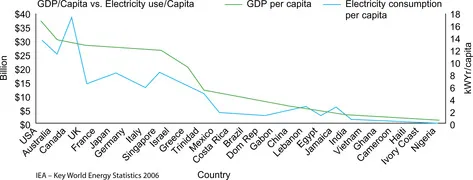 |
| Figure 1.1 Global electricity consumption vs. gross domestic product. |
As highlighted by Bartels in the book's Preface, one clear and common theme animates the vision of the twenty-first-century grid: Information. Hence, the smart grid is often used as the term for the twenty-first-century grid. Over the past two decades, we've seen almost every industry change radically. From package delivery, to consumer banking, to retail sales, to airline travel, all have seen substantial changes in their infrastructure—the way they deliver services, the way they interact and engage consumers, and the way they conduct business. The changes in these industries rely not just on more information, but on better information—more accurate, more timely, and two-way communication that allows the “system operator” at the enterprise level to plan, design, and operate faster, smarter, and more efficiently. The end result is improved services, more convenience, lower costs, and happier customers. Customers’ engagement with the service provider—whether it is the bank, the airline, the shipping company, the online retailer—frequently results in improved relationships that are win-win. The result is a stronger, more productive, and more robust economy. Despite the occasional misuse of information, whether intentional or inadvertent, the basic underlying changes have been a driving force fueling economic growth and prosperity.
The same principles apply to the electric power sector. With better information comes the opportunity for rapid innovation in utility operations. As described in other chapters of this volume, utilities can plan future requirements much more accurately, can design the system more efficiently and with closer tolerances, and can operate it in entirely new and more efficient ways. It also enables the option of empowering consumers by providing information on when and how they use energy, and gives them the ability to align their use with optimal system performance and diverse personal preferences.
Of course with greater information comes the need for a massive new information infrastructure to collect, transport, manage, store, analyze, and display this information. Such a nontrivial undertaking and investment require new thinking and new processes, raising issues that the power industry has only begun to understand and appreciate. Fortunately, other industries have already addressed and solved much of these issues for their own purposes, and the power industry can build on this experience.
This chapter offers a brief overview of the changes we can expect to see in the power industry over the next decade or two. The section “An Inevitable Evolution” provides a glimpse at the current state of the grid followed by the section “Envisioning the Smart Grid: What Do We Want From It?” laying out a vision of what a smart grid should include. The section “Path to the Smart Grid” describes some of the key efforts that are enabling the change and discusses efforts going forward. The “Conclusion” provides a final view of the expected changes.
An Inevitable Evolution
The electricity industry has done a superb job of building, operating, and maintaining a complex infrastructure that transports trillions of kWh of electricity across thousands of miles at the speed of light. Adequate and reliable electricity has been essential to creating economic prosperity. Worldwide, it has made us healthier, safer, and more comfortable by supporting innovations like indoor lighting and refrigeration [1]. The National Academy of Engineering named electrification of the United States the greatest twentieth-century engineering achievement—above the airplane, the internet, the computer, and television [2]. The same is true across the globe where economies and societies have prospered in large part due to the availability of electricity.
It's difficult to argue for a fundamental change to a system that has served so many so well for so long. Yet for decades, grid operators have run the system based on good estimates from years of experience, rather than on real-time information. This is not a criticism—it is the practical and economic reality of operating such a complex yet delicate system. Estimates of demand are often based on surrogate measurements of production, accurate in the aggregate but with little detail. At best consumer-level information was, and in many places still is, measured monthly by manual readings on the dials of analog meters.
Many studies over the last few years have described the need to transform the electricity industry. These studies often talk about the lack of investment in basic infrastructure, including the transmission and distribution network, the need for innovation, the aging equipment and workforce, the cost of power interruptions, the need for emission reductions, and more. All paint a dire picture in the hope that a “burning platform” argument will create a mandate for action among politicians and industry leaders. Undoubtedly, our needs for electricity are shifting in certain ways. We rely on electricity to fuel our increasingly digital economy and society—our massive data centers, our industrial processes, our gadgets, and the way we communicate with each other. Our demand for energy is increasing worldwide [3] as shown in Figure 1.2 and that energy must be reliable to a higher degree than ever before to meet our manufacturing, information and communication needs [4]. However, when the lights, heat, air conditioning, and television all come on nearly 100% of the time, it's hard to feel a sense of urgency for change.
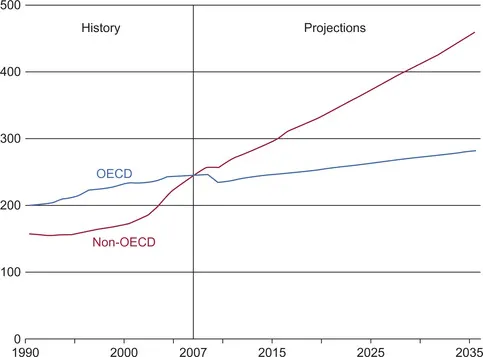 |
| Figure 1.2 World energy consumption 1990–2035 (Quads). Source: International Energy Outlook, 2010 |
In fact, we are at a stage where the global movement toward a smarter grid has already begun. Change is coming, perhaps not so much by national mandates and policy changes as by focused technology evolution and market forces. While various forms of government mandates have forced technology changes, they are often short-lived and can have unintended negative effects. Technological progress continues apace—entrepreneurs and researchers are eager to transform the power sector with innovation [5]. Technology and manufacturing advances are now making it cheaper and easier to install sensors throughout the electricity infrastructure with inherent communication capabilities—providing more, better, and closer to real-time information. The energy efficiency of household appliances like refrigerators and air conditioners has increased considerably in the last few decades [6]. The cost per watt of installed photovoltaics (PV) continues to fall—as shown in Figure 1.3—in many locations approaching grid parity with traditional power sources [7].
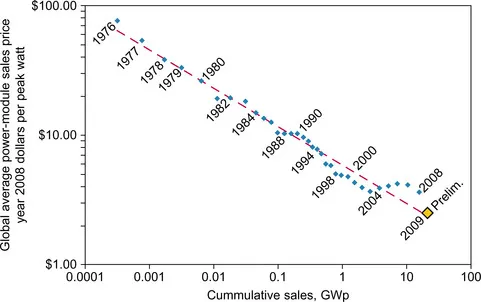 |
| Figure 1.3 Decrease in PV module price and cumulative manufactured capacity, 1976–2009. Source: Mints 2009 and Mints 2010 |
These incremental improvements in the efficiency and cost effectiveness of using electricity are bolstered by rare but influential disruptive technologies—and occasionally new business models—that change markets and expectations, sometimes meeting unknown needs and creating entirely new markets [8]. Electric vehicles might be considered a disruptive innovation, and cost-effective, large-scale energy storage—when commercially viable—most certainly will be. 1 The combination of incremental and radical improvements will lead to sweeping changes across the power sector. Moore's Law [9] and the Law of Accelerating Returns [10] both predict exponential growth in evolutionary processes, as the products of each stage contribute to the next. In other words, innovations like microgrids, covered in Chapter 8, by Platt et al., and electric vehicles, Chapter 18 and Chapter 19, may be only the beginning. Our power ecosystem is evolving, inevitably, to offer us more information, more options, and more choice. We can only dimly see the future state from where we are now.
1Chapter 5 by Wang and Wang covers storage in more detail.
In the coming yea...
Table of contents
- Cover image
- Table of Contents
- Front Matter
- Copyright
- Foreword
- Preface
- Author Bios
- Introduction
- Chapter 1. Smart Grid is a Lot More than Just “Technology”
- Chapter 2. From Smart Grid to Smart Energy Use
- Chapter 3. The Ethics of Dynamic Pricing
- Chapter 4. The Equity Implications of Smart Grid
- Chapter 5. Prospects for Renewable Energy
- Chapter 6. The Smart Grid Vision and Roadmap for California
- Chapter 7. Realizing the Potential of Renewable and Distributed Generation
- Chapter 8. What Role for Microgrids?
- Chapter 9. Renewables Integration Through Direct Load Control and Demand Response
- Chapter 10. Riding the Wave
- Chapter 11. Software Infrastructure and the Smart Grid
- Chapter 12. How Large Commercial and Industrial Customers Respond to Dynamic Pricing—The California Experience
- Chapter 13. Smart Pricing to Reduce Network Investment in Smart Distribution Grids—Experience in Germany
- Chapter 14. Succeeding in the Smart Grid Space by Listening to Customers and Stakeholders
- Chapter 15. Customer View of Smart Grid—Set and Forget?
- Chapter 16. The Customer Side of the Meter
- Chapter 17. Demand Response Participation in Organized Electricity Markets
- Chapter 18. Perfect Partners
- Chapter 19. Impact of Smart EVs on Day-Ahead Prices in the French Market
- Epilogue
- Index
Trusted by 375,005 students
Access to over 1.5 million titles for a fair monthly price.
Study more efficiently using our study tools.
Frequently asked questions
Yes, you can cancel anytime from the Subscription tab in your account settings on the Perlego website. Your subscription will stay active until the end of your current billing period. Learn how to cancel your subscription
No, books cannot be downloaded as external files, such as PDFs, for use outside of Perlego. However, you can download books within the Perlego app for offline reading on mobile or tablet. Learn how to download books offline
Perlego offers two plans: Essential and Complete
- Essential is ideal for learners and professionals who enjoy exploring a wide range of subjects. Access the Essential Library with 800,000+ trusted titles and best-sellers across business, personal growth, and the humanities. Includes unlimited reading time and Standard Read Aloud voice.
- Complete: Perfect for advanced learners and researchers needing full, unrestricted access. Unlock 1.5M+ books across hundreds of subjects, including academic and specialized titles. The Complete Plan also includes advanced features like Premium Read Aloud and Research Assistant.
We are an online textbook subscription service, where you can get access to an entire online library for less than the price of a single book per month. With over 1.5 million books across 990+ topics, we’ve got you covered! Learn about our mission
Look out for the read-aloud symbol on your next book to see if you can listen to it. The read-aloud tool reads text aloud for you, highlighting the text as it is being read. You can pause it, speed it up and slow it down. Learn more about Read Aloud
Yes! You can use the Perlego app on both iOS and Android devices to read anytime, anywhere — even offline. Perfect for commutes or when you’re on the go.
Please note we cannot support devices running on iOS 13 and Android 7 or earlier. Learn more about using the app
Please note we cannot support devices running on iOS 13 and Android 7 or earlier. Learn more about using the app
Yes, you can access Smart Grid by Fereidoon Sioshansi,Fereidoon P. Sioshansi in PDF and/or ePUB format, as well as other popular books in Scienze fisiche & Energia. We have over 1.5 million books available in our catalogue for you to explore.