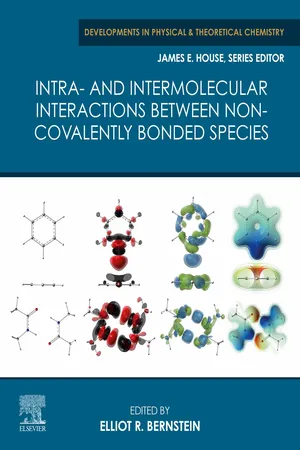
eBook - ePub
Intra- and Intermolecular Interactions between Non-covalently Bonded Species
- 308 pages
- English
- ePUB (mobile friendly)
- Available on iOS & Android
eBook - ePub
Intra- and Intermolecular Interactions between Non-covalently Bonded Species
About this book
The study of gases, clusters, liquids, and solids as units or systems, eventually focuses on the properties of these systems as governed by interactions between atoms, molecules, and radicals that are not covalently bonded to one another. The stereo/spatial properties of molecular species themselves are similarly controlled, with such interactions found throughout biological, polymeric, and cluster systems and are a central feature of chemical reactions. Nevertheless, these interactions are poorly described and characterized, with efforts to do so, usually based on a particular quantum or even classical mechanical procedure, obscuring the fundamental nature of the interactions in the process.
Intra- and Intermolecular Interactions Between Noncovalently Bonded Species addresses this issue directly, defining the nature of the interactions and discussing how they should and should not be described. It reviews both theoretical developments and experimental procedures in order to explore interactions between nonbonded entities in such a fundamental manner as to elucidate their nature and origins.
Drawing attention to the extensive experience of its editor and team of expert authors, Intra- and Intermolecular Interactions Between Noncovalently Bonded Species is an indispensable guide to the foundational knowledge, latest advances, most pressing challenges, and future directions for all those whose work is influenced by these interactions.
- Comprehensively describes the nature of interactions between nonbonded species in biological systems, liquids, crystals, clusters, and in particular, water.
- Combines fundamental, theoretical, background information based on various approximations with the knowledge of experimental techniques.
- Outlines interactions clearly and consistently with a particular focus on frequency and time-resolved spectroscopies as applied to these interactions.
Information
Topic
Physical SciencesSubtopic
Physical & Theoretical Chemistry1: Sterics, the core of intermolecular interactions
Justin P. Joycea; Mardi M. Billmana; Shreya Chandorkarb; Anthony K. Rappéa a Department of Chemistry, Colorado State University, Fort Collins, CO, United States
b IIIT-Hyderabad, Hyderabad, India
b IIIT-Hyderabad, Hyderabad, India
Abstract
Energy decomposition schemes such as SAPT, LED, and ALMO emphasize analyses of coulombic, correlative, induction, and dispersion interactions and provide useful descriptions of the attractive branch of nonbonded interactions, but these attractive interactions do not fully describe the a spherical shape of intermolecular contacts.
Kinetic energy, a separable term in the quantum mechanical energy expression complementary to potential energy, describes of exchange repulsion that is free of the challenges associated with electron density partitioning schemes. Kinetic energy-derived exchange repulsion is found to reproduce the observed angular-dependence of nonbond contacts for alkanes and halogen bonds. In addition, it can conclude that nonbond contacts/sterics is a complex interplay between kinetic energy-derived exchange repulsion and electron penetration—not simply a spherical exponential function.
Parallel spin/αα/dispersion, which survives inside the van der Waals contact distance contributes significantly to the medium-range correlation that provides stability to geminal contacts in hydrocarbons, coordination complexes, and halogen bonding.
Keywords
Sterics; Exchange repulsion; Kinetic energy; Halogen bonding; Geminal contacts
1: Introduction
From Kekulé forward chemists have used limiting diabatic representations to explain and extend our understanding of chemical processes. The simplified diabatic representations provide a framework for describing the complete, coupled model. Examples of diabatic models include LEPS potential surfaces [1], Marcus theory electron transfer coupling elements [2], resonance [3], and the van der Waals attractive and repulsive model of intermolecular interactions [4]. Perhaps the most significant diabatic model is the interplay between potential and kinetic energy in Bohr's model of hydrogen atom and his subsequent discussion of complementarity: “we are not dealing with contradictory but with complementary pictures of the phenomena, which only together offer a natural generalization of the classical mode of description” [5].
In the study of noncovalently bonded interactions, attention tends to focus on the attractive branch of the interaction (coulombic, correlative, induction, and dispersion interactions)—the attractive branch is after all the source of the forces that bring molecules together. The shape of the curve at the bottom of the well accrues from an equal admixture of both attractive and repulsive forces.
The r...
Table of contents
- Cover image
- Title page
- Table of Contents
- Copyright
- Contributors
- Preface
- 1: Sterics, the core of intermolecular interactions
- 2: Insights into the nature of non-covalent bonds accessible by quantum calculations
- 3: Using molecular simulations to investigate how intermolecular interactions dictate liquid structure
- 4: The role of the intramolecular interactions in the structural behavior of biomolecules: Insights from rotational spectroscopy
- 5: Noncovalent interactions in isolated molecular aggregates: From single molecules to nanostructures
- 6: Exploring intra- and intermolecular interactions between non-covalently bound species through investigations of clusters: past, present, and future
- 7: From gas phase to condensed phases: The mutable behavior of the Br2-water interaction
- 8: Self-preservation phenomenon in gas hydrates and its application for energy storage
- Index
Trusted by 375,005 students
Access to over 1.5 million titles for a fair monthly price.
Study more efficiently using our study tools.
Frequently asked questions
Yes, you can cancel anytime from the Subscription tab in your account settings on the Perlego website. Your subscription will stay active until the end of your current billing period. Learn how to cancel your subscription
No, books cannot be downloaded as external files, such as PDFs, for use outside of Perlego. However, you can download books within the Perlego app for offline reading on mobile or tablet. Learn how to download books offline
Perlego offers two plans: Essential and Complete
- Essential is ideal for learners and professionals who enjoy exploring a wide range of subjects. Access the Essential Library with 800,000+ trusted titles and best-sellers across business, personal growth, and the humanities. Includes unlimited reading time and Standard Read Aloud voice.
- Complete: Perfect for advanced learners and researchers needing full, unrestricted access. Unlock 1.5M+ books across hundreds of subjects, including academic and specialized titles. The Complete Plan also includes advanced features like Premium Read Aloud and Research Assistant.
We are an online textbook subscription service, where you can get access to an entire online library for less than the price of a single book per month. With over 1.5 million books across 990+ topics, we’ve got you covered! Learn about our mission
Look out for the read-aloud symbol on your next book to see if you can listen to it. The read-aloud tool reads text aloud for you, highlighting the text as it is being read. You can pause it, speed it up and slow it down. Learn more about Read Aloud
Yes! You can use the Perlego app on both iOS and Android devices to read anytime, anywhere — even offline. Perfect for commutes or when you’re on the go.
Please note we cannot support devices running on iOS 13 and Android 7 or earlier. Learn more about using the app
Please note we cannot support devices running on iOS 13 and Android 7 or earlier. Learn more about using the app
Yes, you can access Intra- and Intermolecular Interactions between Non-covalently Bonded Species by Elliot R. Bernstein in PDF and/or ePUB format, as well as other popular books in Physical Sciences & Physical & Theoretical Chemistry. We have over 1.5 million books available in our catalogue for you to explore.