eBook - ePub
Viscoelasticity and Rheology
Proceedings of a Symposium Conducted by the Mathematics Research Center, the University of Wisconsin–Madison, October 16–18, 1984
- 456 pages
- English
- ePUB (mobile friendly)
- Available on iOS & Android
eBook - ePub
Viscoelasticity and Rheology
Proceedings of a Symposium Conducted by the Mathematics Research Center, the University of Wisconsin–Madison, October 16–18, 1984
About this book
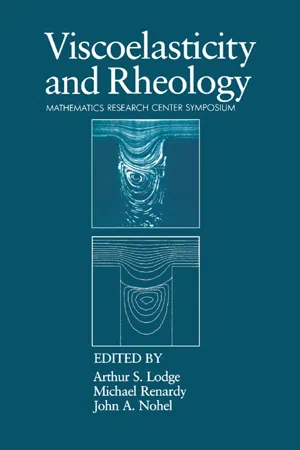
Viscoelasticity and Rheology covers the proceedings of a symposium by the same title, conducted by the Mathematics Research Center held at the University of Wisconsin-Madison on October 16-18, 1984. The contributions to the symposium are divided into four broad categories, namely, experimental results, constitutive theories, mathematical analysis, and computation. This 16-chapter work begins with experimental topics, including the motion of bubbles in viscoelastic fluids, wave propagation in viscoelastic solids, flows through contractions, and cold-drawing of polymers. The next chapters covering constitutive theories explore the molecular theories for polymer solutions and melts based on statistical mechanics, the use and limitations of approximate constitutive theories, a comparison of constitutive laws based on various molecular theories, network theories and some of their advantages in relation to experiments, and models for viscoplasticity. These topics are followed by discussions of the existence, regularity, and development of singularities, change of type, interface problems in viscoelasticity, existence for initial value problems and steady flows, and propagation and development of singularities. The remaining chapters deal with the numerical simulation of flow between eccentric cylinders, flow around spheres and bubbles, the hole pressure problem, and a review of computational problems related to various constitutive laws. This book will prove useful to chemical engineers, researchers, and students.
Information
Subtopic
Ingegneria generaleTHE MOTION OF VISCOELASTIC FLUIDS AROUND SPHERES AND BUBBLES
Ole Hassager, Danmarks Tekniske HØjskole, Lyngby, Denmark and Mathematics Research Center and Chemical Engineering Department, University of Wisconsin, Madison, Wisconsin
Publisher Summary
This chapter discusses the translation of bubbles and solid spheres in a viscoelastic fluid. The motion is assumed to be caused by a gravitational field or an imposed force. The chapter presents some experimental observations of bubble shapes, velocity fields, and friction coefficients. One of the most striking features of translating air bubbles in viscoelastic fluids is that they develop a cusp at the rear pole. Often this effect may be observed in an almost full shampoo bottle by rapidly turning it upside down and watching an air bubble rise. More controlled experiments by Astarita and Apuzzo with a series of bubbles of increasing volume show a transition from a spherical bubble shape to an elongated ellipsoidal shape and the development of the cusp at the rear pole. They also measured the rise velocity of the bubbles as a function of the volume, and showed that for some viscoelastic fluids there is a critical volume at which the rise velocity appears to have a discontinuous increase when plotted as function of the volume.
INTRODUCTION
This paper is concerned with the translation of bubbles and solid spheres in a viscoelastic fluid. The motion is assumed to be caused by a gravitational field or an imposed force, and we will consider the situations in which the motion takes place in an unbounded fluid, quiescent far from the object as well as the situation in which the motion takes place in a finite container (a cylinder). First we will review some experimental observations of bubble shapes, velocity fields and friction coefficients. In the next section we then consider perturbation solutions for motions that are so slow...
Table of contents
- Cover image
- Title page
- Table of Contents
- Inside Front Cover
- Copyright
- Contributors
- Preface
- Chapter 1: THE MOTION OF VISCOELASTIC FLUIDS AROUND SPHERES AND BUBBLES
- Chapter 2: WAVE PROPAGATION IN VISCOELASTIC SOLIDS
- Chapter 3: OVERVIEW OF MACROSCOPIC VISCOELASTIC FLOW
- Chapter 4: NECKING PHENOMENA AND COLD DRAWING
- Chapter 5: POLYMERIC LIQUIDS: FROM MOLECULAR MODELS TO CONSTITUTIVE EQUATIONS
- Chapter 6: ON SLOW-FLOW APPROXIMATIONS TO FLUIDS WITH FADING MEMORY
- Chapter 7: A COMPARISON OF MOLECULAR AND NETWORK-CONSTITUTIVE THEORIES FOR POLYMER FLUIDS
- Chapter 8: ON USING RUBBER AS A GUIDE FOR UNDERSTANDING POLYMERIC LIQUID BEHAVIOR
- Chapter 9: ON VISCOPLASTIC MODELS
- Chapter 10: DISSIPATION IN MATERIALS WITH MEMORY
- Chapter 11: HYPERBOLIC PHENOMENA IN THE FLOW OF VISCOELASTIC FLUIDS
- Chapter 12: ABSORBING BOUNDARIES FOR VISCOELASTICITY
- Chapter 13: RECENT DEVELOPMENTS AND OPEN PROBLEMS IN THE MATHEMATICAL THEORY OF VISCOELASTICITY
- Chapter 14: EVALUATION OF CONSTITUTIVE EQUATIONS: MATERIAL FUNCTIONS AND COMPLEX FLOWS OF VISCOELASTIC FLUIDS
- Chapter 15: FINITE ELEMENT METHODS FOR VISCOELASTIC FLOW
- Chapter 16: CONSTITUTIVE EQUATIONS FOR THE COMPUTING PERSON
- Index
Trusted by 375,005 students
Access to over 1.5 million titles for a fair monthly price.
Study more efficiently using our study tools.
Frequently asked questions
Yes, you can cancel anytime from the Subscription tab in your account settings on the Perlego website. Your subscription will stay active until the end of your current billing period. Learn how to cancel your subscription
No, books cannot be downloaded as external files, such as PDFs, for use outside of Perlego. However, you can download books within the Perlego app for offline reading on mobile or tablet. Learn how to download books offline
Perlego offers two plans: Essential and Complete
- Essential is ideal for learners and professionals who enjoy exploring a wide range of subjects. Access the Essential Library with 800,000+ trusted titles and best-sellers across business, personal growth, and the humanities. Includes unlimited reading time and Standard Read Aloud voice.
- Complete: Perfect for advanced learners and researchers needing full, unrestricted access. Unlock 1.5M+ books across hundreds of subjects, including academic and specialized titles. The Complete Plan also includes advanced features like Premium Read Aloud and Research Assistant.
We are an online textbook subscription service, where you can get access to an entire online library for less than the price of a single book per month. With over 1.5 million books across 990+ topics, we’ve got you covered! Learn about our mission
Look out for the read-aloud symbol on your next book to see if you can listen to it. The read-aloud tool reads text aloud for you, highlighting the text as it is being read. You can pause it, speed it up and slow it down. Learn more about Read Aloud
Yes! You can use the Perlego app on both iOS and Android devices to read anytime, anywhere — even offline. Perfect for commutes or when you’re on the go.
Please note we cannot support devices running on iOS 13 and Android 7 or earlier. Learn more about using the app
Please note we cannot support devices running on iOS 13 and Android 7 or earlier. Learn more about using the app
Yes, you can access Viscoelasticity and Rheology by Arthur S. Lodge,Michael Renardy,John A. Nohel in PDF and/or ePUB format, as well as other popular books in Tecnologia e ingegneria & Ingegneria generale. We have over 1.5 million books available in our catalogue for you to explore.