- 308 pages
- English
- ePUB (mobile friendly)
- Available on iOS & Android
eBook - ePub
Division of Labor in Cells
About this book
Division of Labor in Cells, Second Edition focuses on cytological techniques used in studies related to the complexities of cell structure and function. The publication first elaborates on the structure of cell membrane and cytoplasm, including the endoplasmic reticulum, nature of microsomes, differential centrifugation, and permeability of cell membranes. The book then takes a look at the mitochondria and Golgi apparatus. Topics include metabolic substances found in the mitochondria, plant cells, protein and fat metabolism, lysosomes, metabolism of carbohydrates, plastids and chloroplasts, and chemical nature of the mitochondria. The manuscript elaborates on gland cells, muscle fibers, and nerve fibers and the nucleus and nucleic acids. Discussions focus on the striated muscle fiber, nucleocytoplasmic relationships, nucleic acids of the nucleus, DNA, RNA, and genes, chromosomes, and spindle fibers. The publication is a vital reference for researchers interested in cell structure and function.
Information
ONE
Introduction
Publisher Summary
The fundamental materials necessary for life are protein on the one hand and nucleic acids on the other. In living organisms, proteins are formed more gently but much more subtly by building up the amino acid polymers on templates called nucleic acids. Nucleic acids are made up of organic bases, sugar molecules, and phosphate groups. One other molecule is needed to link up the phosphorylated bases to form nucleic acids that is a sugar known as ribose and its related form deoxyribose. The secret of the complex activity of the living cell lies in the isolation or partial isolation or even the timed isolation of its various activities. This is achieved by the presence of various membranes. The nuclear membrane guards the activity of the nucleus. The essential step in the evolution of the cell was the formation around a chemical system of what is described as a relatively impermeable envelope in the beginning.
FAR away in the distant past, when the primeval seas bubbled and steamed, when ultraviolet light of great intensity streamed onto the surface of the earth, molecules of polypeptides, of long-chain fatty acids, steroids of various sorts, and purines and pyrimidines ultimately to form part of the nucleic acids, went through the seething pangs of synthesis. Both purines and pyrimidines have recently been found in the interior of meteorites—thus they are not unique to this world and indicate that nucleic acid synthesis may be occurring elsewhere in space.
These compounds, floating free in a warm soup, performed no organized activity. They reacted indiscriminately with each other, blindly, with no form or purpose.
How these complex molecules normally formed only by living organisms came to be synthesized originally without life is a real detective story—parts of which are just now beginning to be filled in. The conception that living things were necessary for the formation of organic compounds was a dogma only a little over one hundred and fifty years ago. One of the best-known organic compounds at that time was urea, found to be excreted by nearly all life forms, but in 1828 the chemist Wöhler duplicated one of life’s processes by synthesizing urea in a test tube. Since then of course myriads of organic compounds have been made in the laboratory, including some highly complex compounds.
The fundamental materials necessary for life are protein on the one hand and nucleic acids on the other. The synthesis of these compounds in the laboratory, if it is to be a feasible method for their formation in nature, must be by a method that could in fact have occurred at some time in the earth’s history. There is no doubt that in the early stages of earth’s development the atmosphere differed greatly in composition from the present atmosphere. Methane, ammonia, and water vapour were present. There was also a high temperature and frequent high-tension electrical discharges through this mixture in the form of lightning. Dr. Stanley L. Miller who, in 1953, was working in the laboratory of Nobel Prize winner Dr. Harold Urey in the University of California, assumed that this is what actually happened and exposed mixtures of methane, ammonia, and water to lengthy periods of electrical discharge. As a result he produced mixtures of amino acids, sugars, and vegetable acids. Since then many laboratories throughout the world have confirmed and extended his experiments.
Further consideration of the composition of the primeval atmosphere has resulted in the conclusion that in addition to methane and ammonia it almost certainly contained hydrogen, hydrogen sulfide, and hydrogen cyanide. It should also be considered that in addition to electrical discharges this atmosphere may have also been subjected to intensive radiation of various forms. As a result of using atmosphere of this type various workers have now produced amino acids, nucleic acid bases, and sugars. It is a long step, however, from producing amino acids to producing proteins. Theorists in this area have included such distinguished personages as J. B. S. Haldane and A. I. Oparin who have conceived of life having developed in the primeval seas. This concept has been criticized recently by various authors who have pointed out that the amount of these essential compounds formed from gases is very small and their dilution in the seas would make it impossible for the polymerization necessary for the production of proteins and nucleic acids to occur. They believe life is much more likely to have arisen in small pools that were continuously drying out. In this way concentrations of molecules could be formed that could initiate polymerization. From these pools that probably were situated near the sea, the primitive groups of active molecules that could be described at this stage as life forms would have been washed into the sea where they could develop further (see Fig. 1).
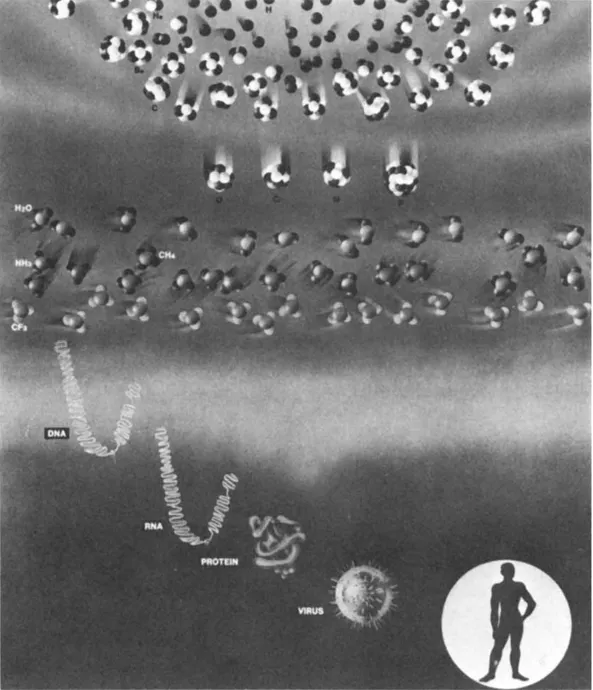
Matthews and Maser [Nature, 215, 1230 (1968)] have pointed out the key role played by hydrogen cyanide in the primeval atmosphere. They found in their laboratory that the condensation products of hydrogen cyanide and ammonia plus water were capable of forming up to 14 different amino acids, the essential building blocks of protein. They also found something even more important, that many of these amino acids were already joined together in chains (polymerized)—the first step in protein formation. Some of the amino acids necessary for building up proteins contain sulfur and aromatic side chains and, of course, none of the amino acids produced by Matthews and Maser contained either sulfur or aromatic side chains. However, it is fairly certain that if the gas mixture used had contained hydrogen sulfide and acetylene, some of these types of amino acids would have been reproduced as well. In fact, one of the sulfur-containing amino acids—methionine—was synthesized last year (1968) from an aqueous solution of ammonium thiocyanate irradiated with ultraviolet light. Ammonium cyanate (a solid material) is itself formed by passing an electrical discharge through a gaseous mixture of ammonia, water, methane, and hydrogen sulfide. It is possible that fairly large chains of amino acids (polypeptides) could have been formed directly from the gas mixtures. In fact Dr. Philip Abelson, director of the Geophysical Laboratory of the Carnegie Institution of Washington believes that it would be easy for simple proteins (which would be simply fairly long polypeptide chains) to be formed directly. He quotes as an example the enzyme protein “ferredoxin,” which has only 55 amino acids. Since the complex chemistry of the cell depends upon the action of proteins in the form of enzymes, it is obviously of great importance that some of the simpler enzymes might have been formed directly from gaseous mixtures. Dr. Sydney Fox of the Institute for Molecular Evolution in Miami has suggested that the heat of volcanoes or streams of lava reacting with gas mixtures may well have provided the energy that resulted in amino acids being formed. He has produced many of these compounds in the laboratory using high temperatures.
In the living organism, as we will see later, proteins are not produced by the same drastic processes that gave birth to them sometime prior to 3 billion years ago. It is of interest that fossil evidence has indicated that biochemically complex organisms were in fact in existence that long ago. In living organisms proteins are formed more gently but much more subtly by building up the amino acid polymers on templates called nucleic acids. Nucleic acids are made up of organic bases, sugar molecules, and phosphate groups; and presumably the components of the first nucleic acids were formed from components that were born in the same violent manner as the first amino acids. The organic bases that form the nucleic acids are adenine, guanine, cytosine, and uracil, and recently Ferris, Orgel, and Sonchez [J. Molec. Biol. 33, 693 (1968)] have been able to produce all of them by subjecting a gaseous mixture of nitrogen and methane and other gas mixtures to an electrical discharge.
However, before these bases can link together to form a nucleic acid they need to have phosphate attached to them—a process known as phosphorylation. Most inorganic phosphates will not react with such bases to transfer their phosphate but, under the influence of heat, such simple phosphates will combine to form polyphosphates, which will transfer phosphates to the bases described above.
One other molecule is needed to link up the phosphorylated bases to form nucleic acids. This is a sugar known as ribose and its related form deoxyribose. By means of chemical reactions using formaldehyde, ribose has been made in the laboratory by chemical methods compatible with those that might have occurred originally in nature. From ribose the production of deoxyribose presents no problems. We are well on the path, therefore, to demonstrating that both protein and nucleic acids could have been produced in the primeval waters of the earth. It is possible that the synthesis of these products could only have been possible at one stage in the earth’s evolution—a time of great heat, an atmosphere with just the right combination of gases and water vapor when great sheets of lighting swept constantly through the clouds they formed. Maybe Venus is in a stage today similar to that through which the earth passed when the first molecules necessary for life were forged.
Before protein there could be no life—as Engels once remarked, “Life is the mode of existence of albuminous bodies.”
At some stage following this or possibly coincidental with it, chlorophyll was developed. This is a pigment that can use directly the energy of light to synthesize chemical substances; in present-day plants starches and sugars are formed in this way. Whether chlorophyll development occurred before or after the first living organism we cannot say for certain, although its synthesis was probably subsequent to their development.
The formation of proteins, nucleic acids, etc., was not in itself enough to produce living organisms—as J. D. Bernal has said, there has to be a “passage” from a mere living area of metabolizing material without specific limitations into a closed organism which separates one part of the continuum from another, the living from the nonliving. In other words groups of molecules responding to electrical and surface forming forces became oriented in a way that produced a membrane.
Presumably these membranes that were forming on the surface of the water were at first simply flat structures, but “one day” through interreaction of the various molecules a membrane formed a little vesicle. Many other vesicles became formed, and here we had for the first time the potentialities for the development of living structures, for the membrane cut off the contents of the bag from the environment. What could have been the composition of such membranes? Perhaps the amino acids were formed into proteins at the time that this happened. Proteins, in general, have a remarkable property of spreading in a very thin film upon the surface of water—even when they are themselves in solution they are capable of forming these thin films. Compounds such as steroids and fats, i.e., compounds that have a preponderance of hydrocarbon groupings, which makes them only slightly soluble in water, also have the ability to spread on surfaces and to have a particular orientation so that their polar groups will, in general, be in contact with water or with other polar groups, and those parts that have hydrocarbon groups will be out of contact with the water. Furthermore, lipoprotein films which combine both these two types of compounds, can even be formed artificially, for instance cholesterol and the protein gliadin have been used to produce such a film. These films have considerable elasticity and a good deal of strength.
Within the little vesicles we have mentioned, the reorganization of the molecules went on, and eventually a vesicle formed within the parent vesicle, which formed a structure similar to the nucleus. In this a substantial percentage of the nucleic acids became concentrated. Combinations between proteins and nucleic acids formed a basis for inheritance of some of the characters of the cell in a way we do not yet understand fully. By a slow and gradual process of evolution, a complicated structure we now know to be a cell was built up and fr...
Table of contents
- Cover image
- Title page
- Table of Contents
- Copyright
- Preface to the second edition
- Preface to the first edition
- Chapter One: Introduction
- Chapter Two: The structure of the cell membrane
- Chapter Three: The cytoplasm
- Chapter Four: Mitochondria
- Chapter Five: The Golgi apparatus
- Chapter Six: The nucleus and the nucleic acids
- Chapter Seven: Specialized cells: gland cells, muscle fibers, and nerve fibers
- Chapter Eight: Conclusion
- Subject Index
Trusted by 375,005 students
Access to over 1.5 million titles for a fair monthly price.
Study more efficiently using our study tools.
Frequently asked questions
Yes, you can cancel anytime from the Subscription tab in your account settings on the Perlego website. Your subscription will stay active until the end of your current billing period. Learn how to cancel your subscription
No, books cannot be downloaded as external files, such as PDFs, for use outside of Perlego. However, you can download books within the Perlego app for offline reading on mobile or tablet. Learn how to download books offline
Perlego offers two plans: Essential and Complete
- Essential is ideal for learners and professionals who enjoy exploring a wide range of subjects. Access the Essential Library with 800,000+ trusted titles and best-sellers across business, personal growth, and the humanities. Includes unlimited reading time and Standard Read Aloud voice.
- Complete: Perfect for advanced learners and researchers needing full, unrestricted access. Unlock 1.5M+ books across hundreds of subjects, including academic and specialized titles. The Complete Plan also includes advanced features like Premium Read Aloud and Research Assistant.
We are an online textbook subscription service, where you can get access to an entire online library for less than the price of a single book per month. With over 1.5 million books across 990+ topics, we’ve got you covered! Learn about our mission
Look out for the read-aloud symbol on your next book to see if you can listen to it. The read-aloud tool reads text aloud for you, highlighting the text as it is being read. You can pause it, speed it up and slow it down. Learn more about Read Aloud
Yes! You can use the Perlego app on both iOS and Android devices to read anytime, anywhere — even offline. Perfect for commutes or when you’re on the go.
Please note we cannot support devices running on iOS 13 and Android 7 or earlier. Learn more about using the app
Please note we cannot support devices running on iOS 13 and Android 7 or earlier. Learn more about using the app
Yes, you can access Division of Labor in Cells by Geoffrey H. Bourne in PDF and/or ePUB format, as well as other popular books in Biological Sciences & Biology. We have over 1.5 million books available in our catalogue for you to explore.