- 490 pages
- English
- ePUB (mobile friendly)
- Available on iOS & Android
eBook - ePub
Cell Structure and Function by Microspectrofluorometry
About this book
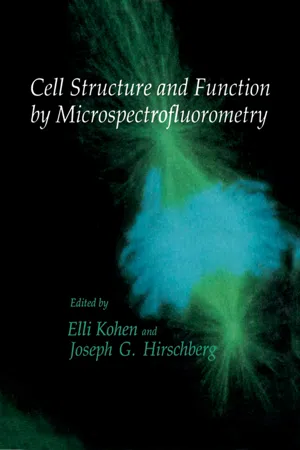
Cell Structure and Function by Microspectrofluorometry provides an overview of the state of knowledge in the study of cellular structure and function using microspectrofluorometry. The book is organized into six parts. Part I begins by tracing the origins of modern fluorescence microscopy and fluorescent probes. Part II discusses methods such as microspectroscopy and flow cytometry; the fluorescence spectroscopy of solutions; and the quantitative implementation of fluorescence resonance energy transfer (FRET) in the light microscope. Part III presents studies on metabolism, including the mechanism of action of xenobiotics; biochemical analysis of unpigmented single cells; and cell-to-cell communication in the endocrine and the exocrine pancreas. Part IV focuses on applications of fluorescent probes. Part V deals with cytometry and cell sorting. It includes studies on principles and characteristics of flow cytometry as a method for studying receptor-mediated endocytosis; and flow cytometric measurements of physiologic cell responses. Part VI on bioluminescence discusses approaches to measuring chemiluminescence or bioluminescence in a single cell and measuring light emitted by living cells.
Information
PART I
HISTORY
1
The Origins of Modern Fluorescence Microscopy and Fluorescent Probes
FREDERICK H. KASTEN, Department of Anatomy, Louisiana State University Medical Center, New Orleans, Louisiana
This review of the history of fluorescence microscopy and fluorescent probes emphasizes the roots of modern work in the field and contemporary lines of research. It centers on significant accomplishments and the pioneers involved. The contribution is presented as a survey rather than an exhaustive review. To conserve space, bibliographic citations are restricted largely to a small number of significant articles and reviews. Further details and references are given in “The Development of Fluorescence Microscopy up through World War II” (21). Other fundamental sources of information are De Ment’s volume on Fluorochemistry (5) and Radley and Grant’s Flourescence Analysis in Ultra-Violet Light (34). The volumes by Wang and Taylor (41a, 42c) give a modern perspective of fluorescence microscopic technology applied to living cells.
I INTRODUCTION
The description of the phenomenon of fluorescence dates back to 1838. At that time, David Brewster, a Scottish preacher and experimentalist in the field of optics, observed “internal dispersion” from the mineral fluorspar, a natural fluoride of calcium, and from solutions of quinine and chlorophyll. The term fluorescence was coined by George Stokes, a physicist and professor of mathematics at Cambridge. Fluorescence is ordinarily considered to be light emission induced during excitation. The related term phosphorescence refers to light that persists after the exciting light is turned off. In his famous monograph of 1852, Stokes described the results of his pioneering and ingenious experiments to reveal “refrangible radiations” from many biological materials. He used mirrors to direct sunlight, the source of ultraviolet (UV) light, through a solution of cuprammoniam (cupric hydroxide in ammonia water) as the primary filter, onto the specimen, and then through a yellow barrier filter created by a potassium dichromate solution. What is known today as Stokes’s law states that the fluorescent light is always of a longer wavelength than the exciting light. This law was extended in 1875 by Eugen Lommel, a physics professor from Munich, who stated that a body must first absorb radiation in order to exhibit fluorescence.
Other nineteenth century physicists who contributed to the emerging field were Edmond Becquerel and Eilhart Wiedemann. By 1868, it was clear that fluorescent spectra were characteristic of specific substances. The term Fluoreszenzanalyses was devised at this time by F. Goppelröder, and spectral characterization by fluorescence analysis was quickly accepted by organic chemists. Two important volumes that contributed to the adoption of the technique were those by Peter Pringsheim, Fluoreszenz und Phosphoreszenz im Lichte der neueren Atom-theorie, and P. W. Danckwortt, Lumineszenz-Analyse im Filtrierten Ultravioletten Licht, both of which went through numerous editions.
With the startup of the synthetic dye industry by the English teen-aged chemist William Perkin in 1856, new fluorescent dyes were synthesized as well (22). Listed in Table I are the biologically important fluorochromes, dates when they were first synthesized, and applications in fluorescence microscopy and biology.
Table I
FLUOROCHROMES USED IN BIOLOGICAL MICROSCOPYa
| Fluorochrome | C. I. no. | Chemical group | Acidic or Basic | Investigator and date of dye synthesis | Biological applications |
| Acid fuchsin | 42685 | Arylmethane | A | Caro (1877) | Counterstain, elastic fi... |
Table of contents
- Cover image
- Title page
- Table of Contents
- ANALYTICAL CYTOLOGY SERIES
- Copyright
- Dedication
- Contributors
- Preface
- Tomas Hirschfeld—In Memoriam
- PART I: HISTORY
- PART II: METHODS
- PART III: METABOLISM
- PART IV: FLUORESCENT PROBES
- PART V: CYTOMETRY AND CELL SORTING
- PART VI: BIOLUMINESCENCE
- Index
Trusted by 375,005 students
Access to over 1.5 million titles for a fair monthly price.
Study more efficiently using our study tools.
Frequently asked questions
Yes, you can cancel anytime from the Subscription tab in your account settings on the Perlego website. Your subscription will stay active until the end of your current billing period. Learn how to cancel your subscription
No, books cannot be downloaded as external files, such as PDFs, for use outside of Perlego. However, you can download books within the Perlego app for offline reading on mobile or tablet. Learn how to download books offline
Perlego offers two plans: Essential and Complete
- Essential is ideal for learners and professionals who enjoy exploring a wide range of subjects. Access the Essential Library with 800,000+ trusted titles and best-sellers across business, personal growth, and the humanities. Includes unlimited reading time and Standard Read Aloud voice.
- Complete: Perfect for advanced learners and researchers needing full, unrestricted access. Unlock 1.5M+ books across hundreds of subjects, including academic and specialized titles. The Complete Plan also includes advanced features like Premium Read Aloud and Research Assistant.
We are an online textbook subscription service, where you can get access to an entire online library for less than the price of a single book per month. With over 1.5 million books across 990+ topics, we’ve got you covered! Learn about our mission
Look out for the read-aloud symbol on your next book to see if you can listen to it. The read-aloud tool reads text aloud for you, highlighting the text as it is being read. You can pause it, speed it up and slow it down. Learn more about Read Aloud
Yes! You can use the Perlego app on both iOS and Android devices to read anytime, anywhere — even offline. Perfect for commutes or when you’re on the go.
Please note we cannot support devices running on iOS 13 and Android 7 or earlier. Learn more about using the app
Please note we cannot support devices running on iOS 13 and Android 7 or earlier. Learn more about using the app
Yes, you can access Cell Structure and Function by Microspectrofluorometry by Elli Kohen in PDF and/or ePUB format, as well as other popular books in Biological Sciences & Biology. We have over 1.5 million books available in our catalogue for you to explore.