- 746 pages
- English
- ePUB (mobile friendly)
- Available on iOS & Android
eBook - ePub
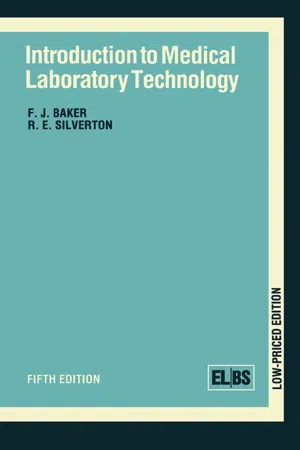
Introduction to Medical Laboratory Technology
About this book
Introduction to Medical Laboratory Technology presents the development in the medical laboratory science. It discusses the general laboratory glassware and apparatus. It addresses a more specialized procedure in mechanization, automation, and data processing. Some of the topics covered in the book are the composition of glass; cleaning of glassware; the technique of using volumetric pipettes; technique for centrifugation; the production of chemically pure water; principal foci of a converging lens; micrometry; magnification; setting up the microscope; and fluorescence microscopy. The precautions against infection are covered. The storage of chemicals and treatment of accidents are discussed. The text describes the collection and reporting of specimens. A study of the fundamentals of chemistry and endocrine systems is presented. A chapter is devoted to the elementary colorimetry and spectro-photometry. Another section focuses on the introduction to clinical chemistry and blood gas analysis. The book can provide useful information to scientists, physicists, doctors, students, and researchers.
Information
SECTION TWO
CLINICAL CHEMISTRY
5
Some Fundamentals of Chemistry
Publisher Summary
This chapter discusses some fundamentals of chemistry. It discusses the four fundamental laws of chemistry, that is, Law of Conservation of Mass, Law of Constant Composition, Law of Multiple Proportions, and Law of Reciprocal Proportions. It also describes the gas laws: (1) Boyle’s Law, (2) Charles’ Law, and (3) Avogadro’s Law. There are several definitions of acids and bases, but the one that is particularly helpful is that of Bronstead–Lowry, who defined acids and bases in terms of proton exchange. An acid is a substance existing as molecules or ions that can donate a proton, that is, a proton donor. A base is a molecule or ion that can accept a proton, that is, a proton acceptor. The chapter further presents the dissociation of water. Pure water is a bad conductor of electricity. The presence of small amounts of dissolved substances, however, increases the conductance considerably. Neutralization indicators are substances that dissociate in solution into two (or more) differently coloured forms, the nature of the form present being governed by the pH of the solution.
The student should have previous knowledge of the following-elements, atoms, isotopes and formulas; chemical units such as atomic weight, molecular weight, gram-atom and gram-molecule. Familiarity with the four fundamental laws of chemistry is also assumed but they have been included because of their importance.
1 Law of Conservation of Mass
Mass can neither be created nor destroyed. This means that in a chemical reaction, there are the same number of atoms of each element in the products as there were in the reactants.
2 Law of Constant Composition
A given chemical compound always contains by weight the same elements in the same proportions.
Note–Many compounds do not obey this law, e.g. ferrous sulphide has variable composition and rarely has the precise formula FeS. Such compounds are called non-stoichiometric or Berthollide compounds.
3 Law of Multiple Proportions
When two elements, A and B, combine to form more than one compound, the masses of element B, which combine with a fixed mass of element A, are in simple numerical proportion to one another.
4 Law of Reciprocal Proportions (or equivalent proportions)
The masses of two elements A and B which combine separately with a fixed mass of element C are in a simple ratio to the mass ratio in which A and B combine with each other.
Equivalents
The law of reciprocal proportions means that to every element may be assigned a number representing the mass of element which will combine with a fixed mass of the substance of reference. This number is called the equivalent weight. The equivalent weight expressed in grams is called the gram-equivalent.
THE GAS LAWS
Although an ideal gas is purely hypothetical, the usefulness of the laws is that they are obeyed very closely by gases under normal conditions.
1 Boyle’s Law
The volume of a given mass of gas at constant temperature is inversely proportional to its pressure, i.e.

where p is the pressure and v is the volume of a fix...
Table of contents
- Cover image
- Title page
- Table of Contents
- Inside Front Cover
- Copyright
- Preface
- Introduction
- SECTION ONE: GENERAL
- SECTION TWO: CLINICAL CHEMISTRY
- SECTION THREE: HISTOLOGY
- SECTION FOUR: MICROBIOLOGY
- SECTION FIVE: HAEMATOLOGY
- SECTION SIX: BLOOD TRANSFUSION TECHNIQUE
- Bibliography
- Appendix
- Glossary
- Index
Trusted by 375,005 students
Access to over 1.5 million titles for a fair monthly price.
Study more efficiently using our study tools.
Frequently asked questions
Yes, you can cancel anytime from the Subscription tab in your account settings on the Perlego website. Your subscription will stay active until the end of your current billing period. Learn how to cancel your subscription
No, books cannot be downloaded as external files, such as PDFs, for use outside of Perlego. However, you can download books within the Perlego app for offline reading on mobile or tablet. Learn how to download books offline
Perlego offers two plans: Essential and Complete
- Essential is ideal for learners and professionals who enjoy exploring a wide range of subjects. Access the Essential Library with 800,000+ trusted titles and best-sellers across business, personal growth, and the humanities. Includes unlimited reading time and Standard Read Aloud voice.
- Complete: Perfect for advanced learners and researchers needing full, unrestricted access. Unlock 1.5M+ books across hundreds of subjects, including academic and specialized titles. The Complete Plan also includes advanced features like Premium Read Aloud and Research Assistant.
We are an online textbook subscription service, where you can get access to an entire online library for less than the price of a single book per month. With over 1.5 million books across 990+ topics, we’ve got you covered! Learn about our mission
Look out for the read-aloud symbol on your next book to see if you can listen to it. The read-aloud tool reads text aloud for you, highlighting the text as it is being read. You can pause it, speed it up and slow it down. Learn more about Read Aloud
Yes! You can use the Perlego app on both iOS and Android devices to read anytime, anywhere — even offline. Perfect for commutes or when you’re on the go.
Please note we cannot support devices running on iOS 13 and Android 7 or earlier. Learn more about using the app
Please note we cannot support devices running on iOS 13 and Android 7 or earlier. Learn more about using the app
Yes, you can access Introduction to Medical Laboratory Technology by F. J. Baker,R. E. Silverton in PDF and/or ePUB format, as well as other popular books in Medicine & Diseases & Allergies. We have over 1.5 million books available in our catalogue for you to explore.