eBook - ePub
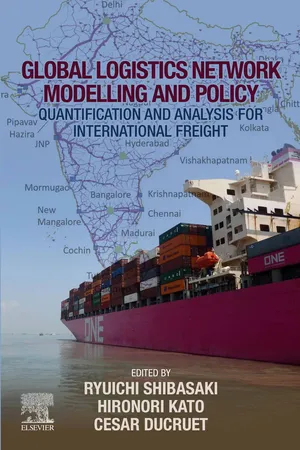
Global Logistics Network Modelling and Policy
Quantification and Analysis for International Freight
- 370 pages
- English
- ePUB (mobile friendly)
- Available on iOS & Android
eBook - ePub
Global Logistics Network Modelling and Policy
Quantification and Analysis for International Freight
About this book
Global Logistics Network Modelling and Policy provides guidelines on quality policy, covering investments, management and planning for port and hinterland infrastructure, roads, railways and inland waterway ports. The book first describes the authors' concept and formulation models, followed by a description and analysis of the applied data. As shipping companies fiercely compete in an effort to achieve greater efficiency and impact infrastructure policy and plan for the entire supply chain, they need tactics that drive quality transportation policy and new ways to model and simulate worldwide cargo movements, all while estimating demand and capacity of systems.
This book provides quantitative tools for modeling, analysis, and simulation of worldwide, inter-modal cargo movement – helping forecast the impacts of logistics and related policies in each region of the world. It covers useful applications for every region of the world, allowing policymakers to tailor results for their own specific uses.
- Delivers sophisticated quantitative tools for modeling simulations, providing powerful analysis of global intermodal cargo movements
- Features examples of tools applied to logistical policy situations in every region of the world
- Serves as a bridge between theory and practice in the field of freight transportation research
- Provides detailed, data-supported case studies and real-world examples for transportation modelers, planners and policymakers
Information
Topic
Scienze socialiSubtopic
SociologiaPart One
General introduction
1: Introduction to global container shipping market
César Ducrueta; Hidekazu Itohb a Centre National de la Recherche Scientifique
b Kwansei Gakuin University
b Kwansei Gakuin University
Abstract
This chapter recalls and demonstrates deep changes in the way maritime transport had been reorganised with the ongoing advent of containerisation in the past decades up to the present time. This multifaceted approach to containerisation is not so common as often, specific aspects are well covered and analysed by scholars and professionals but without offering an all-encompassing view. A review of the complex and changing relationships between containerisation (technological change) and economic development, port and shipping line operations, and related impacts on former ways of doing things is necessary before widening the approach to other segments of the global value and supply chain, such as hinterlands and shipping networks, as described in the other chapters.
Keywords
Containerisation; Liner shipping; Ports
Introduction: Containerisation and global logistics
In 26 April 1956, an American land transporter named Malcom McLean started competing with freight railway companies on interstate long distance transport in the United States. He first navigated a hopped-up container ship from Newark, New Jersey, to Houston, Texas, along the US East Coast by his shipping company (later named Sea-Land). Maritime containers were acquired for two main purposes: (1) to reduce port handling costs by the unitisation (container ‘box’) of cargo and (2) to reduce truck transport cost on long-distance delivery. Indeed, the container ships are permitted to deliver cargo through intermodal transport on land and sea (Levinson, 2006).
The strongest advantage of containerisation is that cargo handling on the docks could be managed in a more efficient way. At this time, a container was mounted on a wagon for land transport, or current roll-on/roll-off (Ro-Ro) shipping. However, because the system was initially inefficient due to the weight and space of wagons, container ships used cranes to handle the box between the ship and the yard. Finally, the Sea-Land company launched a modern full-container ship without crane onboard in 1966 to cross the Atlantic, as European ports such as Antwerp became able to handle containers in the late 1960s (Morel and Ducruet, 2015). After certain technological progress, gantry cranes were placed on berths to carry containers between the ship and the terminal, whilst chassis and trailer moved containers inside the...
Table of contents
- Cover image
- Title page
- Table of Contents
- Copyright
- Contributors
- Preface_ Globalisation and global logistics
- Part One: General introduction
- Part Two: Model & Data
- Part Three: Application to the developing world
- Conclusion
- Author Index
- Subject Index
Trusted by 375,005 students
Access to over 1.5 million titles for a fair monthly price.
Study more efficiently using our study tools.
Frequently asked questions
Yes, you can cancel anytime from the Subscription tab in your account settings on the Perlego website. Your subscription will stay active until the end of your current billing period. Learn how to cancel your subscription
No, books cannot be downloaded as external files, such as PDFs, for use outside of Perlego. However, you can download books within the Perlego app for offline reading on mobile or tablet. Learn how to download books offline
Perlego offers two plans: Essential and Complete
- Essential is ideal for learners and professionals who enjoy exploring a wide range of subjects. Access the Essential Library with 800,000+ trusted titles and best-sellers across business, personal growth, and the humanities. Includes unlimited reading time and Standard Read Aloud voice.
- Complete: Perfect for advanced learners and researchers needing full, unrestricted access. Unlock 1.5M+ books across hundreds of subjects, including academic and specialized titles. The Complete Plan also includes advanced features like Premium Read Aloud and Research Assistant.
We are an online textbook subscription service, where you can get access to an entire online library for less than the price of a single book per month. With over 1.5 million books across 990+ topics, we’ve got you covered! Learn about our mission
Look out for the read-aloud symbol on your next book to see if you can listen to it. The read-aloud tool reads text aloud for you, highlighting the text as it is being read. You can pause it, speed it up and slow it down. Learn more about Read Aloud
Yes! You can use the Perlego app on both iOS and Android devices to read anytime, anywhere — even offline. Perfect for commutes or when you’re on the go.
Please note we cannot support devices running on iOS 13 and Android 7 or earlier. Learn more about using the app
Please note we cannot support devices running on iOS 13 and Android 7 or earlier. Learn more about using the app
Yes, you can access Global Logistics Network Modelling and Policy by Ryuichi Shibasaki,Hironori Kato,Cesar Ducruet in PDF and/or ePUB format, as well as other popular books in Scienze sociali & Sociologia. We have over 1.5 million books available in our catalogue for you to explore.