eBook - ePub
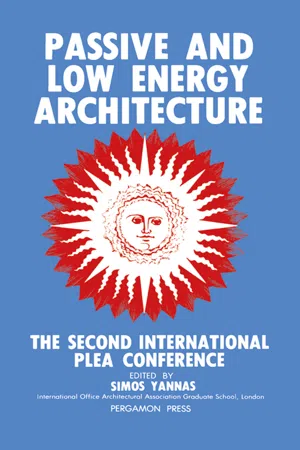
Passive and Low Energy Architecture
Proceedings of the Second International PLEA Conference, Crete, Greece, 28 June-1 July 1983
- 872 pages
- English
- ePUB (mobile friendly)
- Available on iOS & Android
eBook - ePub
Passive and Low Energy Architecture
Proceedings of the Second International PLEA Conference, Crete, Greece, 28 June-1 July 1983
About this book
Passive and Low Energy Architecture contains the proceedings of the Second International PLEA Conference held in Crete, Greece, on June 28 to July 1, 1983. The book is organized into four parts as the topics of the conference. The first part brings together papers dealing with case studies of individual buildings or groups of buildings, completed or to be built, and of community planning. The case studies cover examples from 13 countries in Europe, North and Latin America, North Africa, the Middle East, and Asia. The second part contains papers on experimental work and technical developments with passive and low energy systems and components. The third section focuses on the ill-defined but crucial to designers, area of design aids. The fourth section centers on implementation and management of these energy systems, including topics of international programs, education, and training of design professionals. The book will be useful to energy conscious designers, architects, engineers, and planners in this field of interest.
Information
Part I
Case Studies
Outline
Chapter 1: New Buildings
Chapter 2: Rehabilitation and Retrofit
Chapter 3: Vernacular Architecture
Chapter 4: Planning and Urban Design
Chapter 1
New Buildings
Outline
BIOCLIMATIC ARCHITECTURE UNDER MEDITERRANEAN CLIMATE
PASSIVE AND LOW ENERGY DESIGN
TOWARDS A BETTER UNDERSTANDING OF CLIMATE RESPECTING DESIGN
THREE SOLAR BUILDINGS: PASSIVE AND LOW ENERGY ARCHITECTURE IN SOUTHERN FRANCE
44 BIOCLIMATIC FLATS AT RIGNANO SULL’ ARNO IN TUSCANY
PERFORMANCE EVALUATION OF A “COCOONED” OFFICE BUILDING IN A COLD CLIMATE INTEGRATING PASSIVE SOLAR TECHNIQUES WITH MODERN TECHNOLOGY
PASSIVE AND LOW ENERGY RESIDENTIAL/OFFICE BUILDING FOR USE AS A SOLAR DEMONSTRATION FACILITY AT ARIZONA STATE UNIVERSITY
THREE SOLAR AIR HEATED HOUSES AT PETERBOROUGH WITH SUNSPACES
SOLAR HOUSE FOR HOT AND HUMID CLIMATE
PHOTOVOLTAIC EQUIPPED PARKING AND SHADE STRUCTURE KING ABDULAZIZ INTERNATIONAL AIRPORT JEDDAH, SAUDI ARABIA
LYKOVRYSSI - A SOLAR VILLAGE NEAR ATHENS
A PASSIVELY HEATED, COOLED AND LIT NURSERY SCHOOL IS COMPLETED FOR THE CHILDREN OF THE BANK OF GREECE
SOLAR ENERGY: A NEED FOR A NEW MENTALITY
A MEDITERRANEAN LATENT HEAT SOLAR HOUSE IN “LE TIGNET”
THE CONCEPTUAL PROCESS OF PASSIVE SOLAR DESIGN: BALANCING CONTEMPORARY TECHNOLOGY WITH A LOW TECHNOLOGY APPROACH
A PASSIVE SOLAR RESIDENCE IN PORTUGAL
HUNGARIAN EXPERIMENTAL PASSIVE SOLAR HOUSE
DESIGN OF A LOW ENERGY HOUSE NEAR CHANIA, CRETE, EMPLOYING PASSIVE DESIGN PRINCIPLES
A BIOCLIMATIC MULTI-STOREY BUILDING IN SICILY
RESIDENCES USING PASSIVE SOLAR SYSTEMS AT DRAPANIAS, CRETE
BIOCLIMATIC ARCHITECTURE UNDER MEDITERRANEAN CLIMATE
Architect. Michel Gerber, CLEA, Climat-Energie-Architecture, Les Perdrigals, 11510 FITOU FRANCE
ABSTRACT
Our work started in 1976 with the rehabilitation of an ancient building in mediterranean climate. At that time, the main concern was to integrate the passive solar architecture in the socio-cultural context, e.g., Les Perdrigals. Another aspect of our work is designing greenhouses for new buildings or retrofits. In a mountain climate, a two storey greenhouse will be presented. The use of sun as natural lighting and energy source is demonstrated in a partly underground single family dwelling. First example of a low cost housing program is described. Our project for the new Préfecture in Montpellier focused on extensive utilization of daylighting systems. The approach of this project will be presented.
KEYWORDS
Bioclimatic
passive solar architecture
greenhouses
low cost housing
daylighting systems
INTRODUCTION
New technology has freed man from the constraints of his environment. He has been able to take advantage of the technological advances to improve not only his living conditions but also to escape the restrictions imposed by the environment. The result has been modern architecture which totally neglects problems of energy. Its aim has been mainly to develop standardized industrial techniques which can be applied anywhere to create an international type of architecture. Rising costs of energy may lead us to a salutary reexamination of this trend. Faced by such problems, we took a look at vernacular architecture. In the beginning, when the function of shelter was to serve only the very basic needs of life, environment was the overuling factor of the morphology of a dwelling. Physical, geographical, climatic and geological parameters were the determining factors in the choice of the type of shelter with the materials available for its construction. These various factors associated with the socio-economic and cultural characteristics of an area produced what is recognized now as regional architecture. Our first work was strongly influenced by the vernacular architecture of our region (Languedoc), and we will show then how it evolved.
LES PERDRIGALS
Our approach for the first house, Les Perdrigals, was to take into consideration environmental and socio-economical factors. To these, we added our concern for energy conservation by looking in depth at geographic and climatic factors, (insolation, wind, temperature), including a priority for solar energy collection in our design. Analysis of the regional architecture demonstrated the following main characteristics: a- protection against the prevailing wind by the choice of orientation and morphology of the building, b- organization of outside protected areas, c- use of natural cool air systems by cross ventilations, d- seasonal internal migrations. These components were applied together with devices to optimize solar gains and minimize heat losses. The architectural result is actually very close to the regional architecture (fig. 1).

Fig. 1 Les Perdrigals. View from East.
THE SOLAR GREENHOUSE
Another aspect of our work is designing greenhouses for new buildings or retrofits. We shall attempt to show constraints and needs to be taken into consideration when constructing a solar greenhouse by describing the steps followed in the planning and the construction of retrofit greenhouses. Our approach is based on 3 main aspects: function, architecture and thermal control. Of these the most important is the first.
The conditions required by plants are different from those of man. Temperature and hygrometry will vary as a function of whether the greenhouse will be semi-habitable or strictly for horticulture. Therefore the first step is to clearly define the function of the greenhouse since this will greatly influence its conceptualization. Architectural design is the next important factor, because the greenhouse must be adapted to the existing building while still facing south. The morphology and aspect of the building will influence those of the greenhouse. Moreover, the choice of...
Table of contents
- Cover image
- Title page
- Table of Contents
- Other Pergamon Titles of Interest
- Copyright
- SECOND INTERNATIONAL PLEA CONFERENCE
- PREFACE
- INTRODUCTION
- Part I: Case Studies
- Part II: Research and Development
- Part III: Design Aids
- Part IV: Management
- AUTHOR INDEX
- SUBJECT INDEX
Trusted by 375,005 students
Access to over 1.5 million titles for a fair monthly price.
Study more efficiently using our study tools.
Frequently asked questions
Yes, you can cancel anytime from the Subscription tab in your account settings on the Perlego website. Your subscription will stay active until the end of your current billing period. Learn how to cancel your subscription
No, books cannot be downloaded as external files, such as PDFs, for use outside of Perlego. However, you can download books within the Perlego app for offline reading on mobile or tablet. Learn how to download books offline
Perlego offers two plans: Essential and Complete
- Essential is ideal for learners and professionals who enjoy exploring a wide range of subjects. Access the Essential Library with 800,000+ trusted titles and best-sellers across business, personal growth, and the humanities. Includes unlimited reading time and Standard Read Aloud voice.
- Complete: Perfect for advanced learners and researchers needing full, unrestricted access. Unlock 1.5M+ books across hundreds of subjects, including academic and specialized titles. The Complete Plan also includes advanced features like Premium Read Aloud and Research Assistant.
We are an online textbook subscription service, where you can get access to an entire online library for less than the price of a single book per month. With over 1.5 million books across 990+ topics, we’ve got you covered! Learn about our mission
Look out for the read-aloud symbol on your next book to see if you can listen to it. The read-aloud tool reads text aloud for you, highlighting the text as it is being read. You can pause it, speed it up and slow it down. Learn more about Read Aloud
Yes! You can use the Perlego app on both iOS and Android devices to read anytime, anywhere — even offline. Perfect for commutes or when you’re on the go.
Please note we cannot support devices running on iOS 13 and Android 7 or earlier. Learn more about using the app
Please note we cannot support devices running on iOS 13 and Android 7 or earlier. Learn more about using the app
Yes, you can access Passive and Low Energy Architecture by Simos Yannas,Arthur Bowen in PDF and/or ePUB format, as well as other popular books in Technology & Engineering & Construction & Architectural Engineering. We have over 1.5 million books available in our catalogue for you to explore.