eBook - ePub
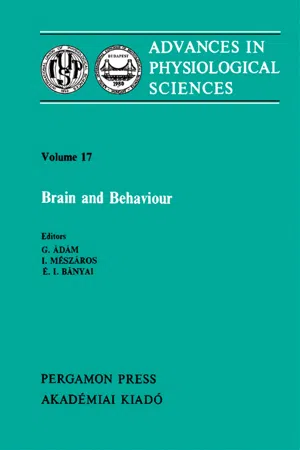
Brain and Behaviour
Proceedings of the 28th International Congress of Physiological Sciences, Budapest, 1980
- 554 pages
- English
- ePUB (mobile friendly)
- Available on iOS & Android
eBook - ePub
Brain and Behaviour
Proceedings of the 28th International Congress of Physiological Sciences, Budapest, 1980
About this book
Advances in Physiological Sciences, Volume 17: Brain and Behaviour documents the proceedings of the 28th International Congress of Physiological Sciences, held in Budapest 1980. This volume begins by discussing learning in isolated neuronal structures, and then explains the developmental plasticity of central nervous system. The mechanisms of conditioning, learning, and memory are then examined, which is followed by a topic on visceral learning. This book then introduces cortical sensory-motor integration, and then elaborates on this subject by explaining related topics such as caudato-cortical interrelations and functional organization of conditioned placing reaction. This text concludes with three parts examining the functions of mammalian associative cortex; psychophysiology of motivation; and electrophysiological basis of verbal and cognitive behavior. This book will be invaluable to students and experts in the fields of physiology and medicine.
Information
INTRODUCTION TO VISCERAL LEARNING
G. Ádám, Department of Comparative Physiology, Eötvös Loránd University, Budapest, Hungary
Publisher Summary
This chapter focuses on the concept of visceral learning. The instrumental feedback is one of the principal methods of human operant visceral learning— the whole trend is known as biofeedback. The clinical attempts involve the influencing of about a dozen diseases by visceral learning, from the controllable cardiovascular changes to the modification of epileptic convulsions. Comparing the trend of biofeedback with the corticovisceral one, several similarities and points of contact may be established such as the theoretical basis of both trends are originating from principal learning theories. Both the theories were strongly supported by clinical arguments; the two trends were highly motivated by the case histories of so-called vegetative diseases.
In the history of biology and medicine and in the development of our contemporary philosophy, the concept inherited by us from the 19th century about the separation of mental and autonomous functions was a retrograde tendency. Why is it only in the last two decades that the concept of psycho-visceral unity is beginning to be accepted? Why was it necessary to “discover” the progressive aspects of Eastern philosophy to support the principle on the mental control of circulation, digestion, excretion, etc.?
The idea about the unity of mental and vegetative functions was not incorporated into the way of thinking neither in medicine, nor in biology because of the following reasons:
Modern medicine, conceived in the middle of the last, and expanded in our century, became exclusively cell and organ oriented. This organ centric view was strengthened by the peculiarly parallel and almost hermetically separate lines of development of neurobiology, experimental psychology and medicine. E.g. dramatic discoveries in neurobiology, such as that of the physiological rhythms of sleep and dreams, or of the role of reticular activing system was barely reflected in our theoretical and clinical conception about the function of internal organs! Or, the psychophysiological data on the nature of emotions had only sporadic consequences in the clinical theories and in practice. Unfortunately the integration of these three separate lines of science is still to be accomplished.
This separation was deepened even further by the fact that, contrary to the somatic functions, the autonomous system is not represented in the so-called conscious sphere. In other words, the regulative processes of the internal organs are usually non-conscious, therefore the cerebro-visceral interactions outside the homeostasis are not accompanied by subjective experience. Thus, this covert, hidden area of research was simply ignored.
Finally, although the idea of cerebro-visceral unity is penetrating into the main line of medicine only lately, different hypotheses were circulating already in the 1930’s. Unfortunately these had nothing but phenomenology in common, theoretically they were contradicting each other. Even their terminologies were different. Let me mention here only the three most influencing tendencies: the psychosomatic medicine conceived by Freudian principles the cortico-visceral medicine based on Pavlov’s work and the “biofeedback” principle based on Thorndike’s “law of effect”. These 3 theories have been contradicting each other; the interference prevented the psycho-visceral conception from getting into accepted ideology of medicine.
As an introduction to our symposium, I would like to review briefly these 3 general trends in order to emphasize some critical and unresolved issues.
In chronological order, the psychosomatic trend must be mentioned first. It had been developed in the first half of this century, based on the psychoanalytical theory. For the majority of clinicians the notion “psychosomatics” is identical with the psycho-visceral relationships. Unfortunately the trem “soma” in itself is disturbing, since when it was conceived, it meant the whole body, implying this way the autonomous sphere beside the somatic in the pysiological sense. Somatic function, however, is, according to physiology and medicine since Bichat, the nervous activity related to the external environment as opposed to the vegetative function regulating internal environment. Thus the term “psychosomatics” itself is already incorrect, misleading and out of date! In connection with the mental control of internal organs, the terms psychovegetative, psychovisceral or perhaps cerebro-visceral would express the two components of the interacting systems. Nevertheless, the term “psychosomatics” at the same time is informative and characteristic, it shows that originally “soma” in the Freudian sense was rather a symbol than a definition of concrete physiological functions. No wonder, since from the viewpoint of physiology the absurdity of the psychosomatic trends is concealed in its symbolic nature! Flanders Dunbar and Franz Alexander list symbolically 7 or 8 diseases as psychosomatic, among which diabetes and bone fracture can be found as well. Bronchial asthma is the symbol of fear from losing the mother, gastric ulcer is that of the desire for love, thyreotoxicosis is that of fear of death and so on. Thus the rational medical principle of “locus minoris resistentiae” became distorted to a peculiar system of myths. This extreme trend disqualified the serious approaches in the research of the psychovegetative sphere and prevented the cerebrovisceral principles from getting into the main line of medicine. The autobiographical book of Stunkard is very instructive in this respect.
Nevertheless, the psychosomatic theory was a pioneering and impressive one at the time, first pointing to the manifold connections between mind and internal organs and so to the non-conscious character of these processes. Mbreover, it recognized the importance of personal traits in the manifestation of psychovegetative processes. In my opinion, psychosomatics must be regarded nowadays as an important historical category.
Most trends outside the schools of psychosomatics approach the problem of cerebral control of visceral processes from the aspect of learning. Interestingly enough, similarly to psychosomatics, these theories of visceral conditioned reflexes were inspired by the vast clinical experience. As early as in 1918, conditioned vascular reflexes were elaborated upon acoustic stimuli as CS by Citovich, one of Pavlov’s colleagues. This was the first documented experiment of the important experimental and clinical line which was continued by Konstantin Bykov and his colleagues, culminating in the 1950’s.
Bykov and his coworkers attempted to analyse the learned psychovisceral effects with the seemingly exact methods of those days; they proceeded as physiologists and tried to outline at least the pathways and cerebral structures of learned visceral functional changes. Unfortunately they could not avoid the simplifications and the schematic trends of those days, thus they labelled this trend as “cortico-visceral” physiology and pathology, always looking for and presuming only cortical mechanisms in the conditioned visceral changes and were satisfied with the rough description of many visceral mechanisms without analysing the exact cerebral processes in detail. Unfortunately this very suggestive and at the same time superficially extensive trend of psychophysiology became the tool of a peculiar socio-political fashion in medicine. There was a time when great medical departments and institutes in Eastern Europe attempted to transform every research to corticovisceral ones.
Sooner or later it will be necessary to review the history of Bykov’s theory of visceral learning and to analyse it critically since it attracted a great number of scientists and clinicians. The era of overpupularization and vulgarization was followed by disappointment and disillusion, as it had happened many times in the history of science. Thus unfortunately “the baby was spilt with the bath-water” – now only fragmentary problems are dealt with, and only by a few scientists. Nevertheless, it is worthwhile to study the monographs of Bykov, Pshonik, Kurzin or Chernigovskiy; they are full of actual ideas of exciting questions which are not, or only partly answered.
After the rather stormy three decades of activity /1926-1955/, the “corticovisceral” trend is now a half-finished construction. Its elements and observations are, however, widely utilized for example by the Westerr. so-called behaviour-therapeutic trend. Its representatives applied successfully classical conditioning techniques in the therapy of neurotic diseases.
The episodes of the history of science are often repeated. A new line of research into psychovegetative learning was inspired indirectly by Pavlov’s and Bykov’s trend, and it became widespread mainly in the Western countries. Its pioneers attempted to refute the behaviourist “dogma” of Skinner and his followers according to whom the laws of instrumental or operant learning are valid only in the somatic sphere, thus do not concern the vegetative apparatus which is to say “autonomous” hence free from mental influences.
The fundamental experiments of this trend were based on Thorndike’s law of effect. E.g. changes of galvanic skin reflex were “rewarded” by Herbert Kimmel by instrumentally feedbacking to the subject the change in the skin resistance which otherwise did not cause the subjective experience. Pioneer experiments were undertaken by Neal Miller in animals too. The insrumental feed-back is one of the principal methods of human operant visceral learning – the whole trend is called by a somewhat distorted and unfortunate term: “biofeedback”. As far as I know, up to the end of the last year more than 100 articles of animal experiments and more than 200 on clinical “biofeedback” have been published, together with some monographs, but presently at the top of its popularity only the trend’s foundations are laid. According to Neal Miller...
Table of contents
- Cover image
- Title page
- Table of Contents
- ADVANCES IN PHYSIOLOGICAL SCIENCES
- Copyright
- FOREWORD
- PREFACE
- Learning in isolated neuronal structures
- Developmental plasticity of CNS
- Mechanisms of conditioning, learning and memory
- Visceral learning
- Cortical sensory-motor integration
- Functions of mammalian associative cortex
- Psychophysiology of motivation
- Electrophysiological basis of verbal and cognitive behaviour
- Psychophysiology of altered states of consciousness
- Psychophysiology today and tomorrow
- INDEX
Trusted by 375,005 students
Access to over 1.5 million titles for a fair monthly price.
Study more efficiently using our study tools.
Frequently asked questions
Yes, you can cancel anytime from the Subscription tab in your account settings on the Perlego website. Your subscription will stay active until the end of your current billing period. Learn how to cancel your subscription
No, books cannot be downloaded as external files, such as PDFs, for use outside of Perlego. However, you can download books within the Perlego app for offline reading on mobile or tablet. Learn how to download books offline
Perlego offers two plans: Essential and Complete
- Essential is ideal for learners and professionals who enjoy exploring a wide range of subjects. Access the Essential Library with 800,000+ trusted titles and best-sellers across business, personal growth, and the humanities. Includes unlimited reading time and Standard Read Aloud voice.
- Complete: Perfect for advanced learners and researchers needing full, unrestricted access. Unlock 1.5M+ books across hundreds of subjects, including academic and specialized titles. The Complete Plan also includes advanced features like Premium Read Aloud and Research Assistant.
We are an online textbook subscription service, where you can get access to an entire online library for less than the price of a single book per month. With over 1.5 million books across 990+ topics, we’ve got you covered! Learn about our mission
Look out for the read-aloud symbol on your next book to see if you can listen to it. The read-aloud tool reads text aloud for you, highlighting the text as it is being read. You can pause it, speed it up and slow it down. Learn more about Read Aloud
Yes! You can use the Perlego app on both iOS and Android devices to read anytime, anywhere — even offline. Perfect for commutes or when you’re on the go.
Please note we cannot support devices running on iOS 13 and Android 7 or earlier. Learn more about using the app
Please note we cannot support devices running on iOS 13 and Android 7 or earlier. Learn more about using the app
Yes, you can access Brain and Behaviour by G. Ádám,I. Mészáros,É. I. Bányai in PDF and/or ePUB format, as well as other popular books in Biological Sciences & Physiology. We have over 1.5 million books available in our catalogue for you to explore.