eBook - ePub
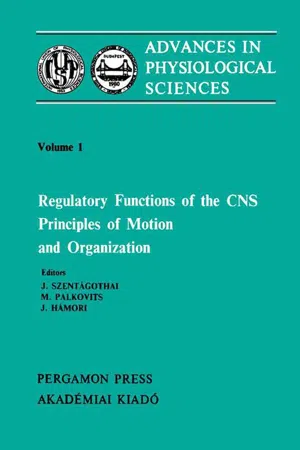
Regulatory Functions of the CNS Principles of Motion and Organization
Proceedings of the 28th International Congress of Physiological Sciences, Budapest, 1980
- 350 pages
- English
- ePUB (mobile friendly)
- Available on iOS & Android
eBook - ePub
Regulatory Functions of the CNS Principles of Motion and Organization
Proceedings of the 28th International Congress of Physiological Sciences, Budapest, 1980
About this book
Advances in Physiological Sciences, Volume 1: Regulatory Functions of the CNS: Principles of Motion and Organization covers the proceedings of the 28th International Congress of Physiological Sciences, held in Budapest in 1980. This text is comprised of six parts. Before presenting the six major topics, this book first explains the principles of neural organization and the perception and action. The first part studies the mechanisms of transmission in the monosynaptic reflex pathway in the spinal cord, while the second part looks into the neural mechanisms of voluntary movements and precentral motor area. Other parts of this book present papers on motor organization, eye movements, sleep, and unitary activity of the brain. This selection will be invaluable to physiologists, students of physiology, and others interested in studying the principles of motion and organization.
Information
Topic
MedicineSubtopic
PharmacologyPRINCIPLES OF NEURAL ORGANIZATION
J. Szentágothai, 1st Department of Anatomy, Semmelweis University Medical School, Budapest, Tüzoltó u. 58, H-1450, Hungary
Publisher Summary
This chapter discusses the principles of neural organization. Neuroanatomy is characterized by an explosive development of techniques. The application of modern retrograde labeling techniques, especially the uptake by nerve endings of horseradish peroxidase (HRP) have shown increasingly that one has greatly underestimated, even in the spinal cord, the length, variety, and distribution of intersegmental connections to different target structures. This is more evident for the neurons of the upper part of the central core of the neuraxis, the lower brainstem, which include anything from hypothalamus, and parts of the upper brainstem nuclei down to the medulla oblongata, where the ascending branches of the same neurons may extend as far up as the cerebral cortex and as far down as the spinal cord. This principle may apply particularly to certain specific neuron types—the catecholaminergic or more generally the monoaminergic neuron systems. The building block principle is apparent already at the macroscopic level, its most generally known examples being the segmental organization of the neuraxis. The most elegant and only relatively discovered cases are the assembly of the cerebellum, including both afferent and efferent connections in sagittally oriented relatively narrow disks, and the thalamo-cortical projection principle.
My choice of title has set me something of a trap by seeming to imply that the problem/s/ of neural organization can be reduced to a few questions about the blueprints of neuronal connectivity, with very few functional considerations added. Since the principal question could be dealt with as well - or even better - within the conceptual framework of the molecular biologist, the cellular biophysicist, the biochemist, and of the ethologist - or more generally speaking of the behavioral scientist, I fear I may appear to be giving some ontological priority to one of the very different frameworks or levels of analysis at which the nervous system can be studied. Even worse, I might appear to be trying to reduce one of these frameworks into another, a danger which is now increasingly recognised /see for example MacKay– 1978, Rose– 1980/.
So what is the justification of my present approach? Simply this: It is my belief that in spite of my high regard for molecular biology, cellular biophysics, biochemistry, etc., these important disciplines, with all their sophisticated knowledge and technology apply to virtually all other organ systems and are not even confined to the animal kingdom. The very essence of the neural, separating it from all other living systems, is its unbelievably complex internal connectivity. In spite of chemical and other messages transmitted between various parts of the organ systems, and the complexity of the corresponding processing of information, nothing even remotely similar is found in any other system of the living organism. In addition, I happen to be a neuroanatomist which would make it advisable - at least before such an audience - to stick to my own trade.
Neuroanatomy of today is characterised by an explosive development of techniques. To be sure, this is no longer pure anatomy, because it requires the combined approach of the most advanced microphysiology, biochemistry and immunocytology. We are now theoretically able - and in fact may demand this as a strict criterion - that any connexion or synapse studied, be identified both at the light- and the electron microscopic level as to its parent and receiving neurons, which must themselves be anatomically, physiologically, biochemically and immunocyto-chemically identified. I hope that I am not expected here to enter into the technicalities, which will be amply discussed at this congress. It will also be understood that we are at this stage very far from a synthesis, so that my modest attempts will be recognised as what they are meant to be: no more than the rudiments of - or perhaps some groundwork for - a synthesis that is yet to come.
The danger I see in the present situation - of this “embarras de richesse” - is that connectivity may be seen as some kind of magic tool destined to replace or at least swallow physiology and eventually to explain behaviour. Apart from the philosophical dangers I have hinted at, neuroanatomy - or more specifically neuron connectivity - has at the outset to come to grips with certain basic questions, often expressed as alternatives: neuron chains and reflex arcs versus neuron networks with central programs; or discrete pathways and centres versus distributed systems; or genetically preprogrammed connectivity versus plasticity, or even perhaps some randomness in connexions. Most neuroscientists will probably agree with my view that these concepts are not necessarily mutually exclusive, but rather different aspects of neural organization, all of which do represent some part of the truth.
Take for example the option of discrete pathways and centres versus distributed systems.
The application of modern retrograde labelling techniques, especially the uptake by nerve endings of HRP have shown us increasingly that we have greatly underestimated, even in the spinal cord, the length, variety, and distribution of intersegmental connexions to different target structures. This is more evident for the neurons of the upper part of the central core of the neuraxis, the lower brainstem - in which let me include, in a somewhat unorthodox manner, anything from hypothalamus and parts of the upper brainstem nuclei down to the medulla oblongata - where the ascending branches of the same neurons may extend as far up as the cerebral cortex and as far down as the spinal cord. This principle, demonstrated most elegantly by the Scheibels as early as 1958, may apply particularly to certain specific neuron types: the catecholaminergic or more generally the monoaminergic neuron systems. However, as shown also by recent studies in our laboratory on hypothalamic neurons, this applies also to regions lacking perikarya of these specific neuron systems, or containing only few local dopaminergic neurons. It would thus be unreasonable to deny the general validity of this principle for other neuron systems with more conventional kinds of synaptic mediators.
Already this sole example may convince us that the traditional view of ascending or descending chains of sequentially arranged neuron links cover at best one small part of the reality in overall neuronal connectivity. Since the longitudinally arranged and practically continuous neuron network of the entire neuraxis is connected everywhere, by both afferent and efferent connexions, with all the peripheral receptors and effectors as well as by ascending and descending ones with the higher integrative centers, we may hardly conceive of any two specific sites in any part of the nervous system that would not be interconnected by fewer than five neurons. A generalization like this, of course, is only an indication of an order of magnitude rather than an attempt at a realistic estimate. But even so, we meet here the clear anatomic reality of a “distributed system” without having to abandon or even getting into conflict with the traditional concept of the “neuron chain”. Both may easily be - and certainly are - valid at the same time.
I shall try to discuss the other apparently contradictory options relating to neuronal connectivity - particularly that of predetermined versus less determined addressing of connexions - while trying to answer a speculative question: What are some of the principles that might be useful in the assembly of such highly complex systems as those of the neural centres?
The building of a nervous system consisting of thirty billion neurons /3×1010/ for the human brain× often with 1013 or 1014 synapses, is indeed a major feat of systems engineering, and difficult to envisage also in view of the relatively minute number of genes available /perhaps 108/. Do not think that I refer specifically to the human brain in order to overwhelm you by sheer numbers. Even the cat cerebellum contains 2.2 billion granule cells. This problem was most elegantly solved by nature by the simple trick of assembling the vertebrate nervous system out of “building blocks” of regular structure that could be used repetitively and would thus secure a relatively large number of quasi automatic connexions, thus radically reducing the number of specific genetic instructions required for a predetermined connectivity. This “building block” system applies equally from the macroscopic range down through the neuronal level to that of electron microscopic microanatomy. In fact, the electron microscopic structure of the neural centre looks rather reminiscent of an Escher drawing×× with the difference that the fine structure of the neural centres is in three dimensions. I have often wondered whether this similarity could not be exploited to improve our understanding; but my romantic notions were cooled down soon enough by experts in discrete geometry who thought such an attempt - in three dimensions - out of touch with reality.
The “building block” principle is apparent already at the macroscopic level, its most generally known examples being the segmental organization of the neuraxis. But the most elegant and only relatively recently discovered cases are the assembly of the cerebellum, including both afferent and efferent connections in sagittally oriented relatively narrow discs, and the thalamo-cortical projection principle discovered by Kievit and Kuypers /1977/, according to which quasi-sagittal /slightly diverging/ slices of thalamic tissue project to coronal discs of the cerebral cortex. However, the real advantages of this architectural principle become apparent at the level of neuron assemblies - containing numbers of neurons of the order of tens to thousands - the so-called structural modules. The principle resembles that of the application of integrated circuits in electronics technology, when building blocks of various degrees of miniaturization secure proper connexions and interchangeability automatically by a certain repetitiveness in the regularities of outlets. Figure 1 shows the application of this principle to the central core of the spinal cord. In fact, the same principle holds for the lower brainstem - where it was first discovered by the Scheibels in 1958, although its full implications could not be realized at that time - and also, with certain modifications, even in the hypothalamus. As you may see, especially the central core - the intermediate gray matter - is built up of repetitive coin-shaped transverse discs, within which both the dendrites of cells and the entering axon terminals are rather strictly confined. The ventral and dorsal horns can be considered as appendages attached to this column of discs, which tend to penetrate into them so that each motor neuron belongs to a number of neighbouring discs with the appropriate interneuron connexions, although they have a number of specifically addressed connexions not belonging to the disc architecture. Most collaterals entering the central core from the anterior and lateral white funiculi are confined to one of those transverse discs, and tend to transverse them along fairly straight radial courses. They do not appear to be specifically directed to any part of the core, but give off synaptic terminal branches all along their course. Of course, effective synaptic contacts with certain types of neurons may be forbidden by some mismatching in biochemical labels, but otherwise they would form synapses with every element they might encounter. Simply by /genetically/ specifyin...
Table of contents
- Cover image
- Title page
- Table of Contents
- ADVANCES IN PHYSIOLOGICAL SCIENCES
- Copyright
- FOREWORD
- PREFACE
- Chapter 1: PRINCIPLES OF NEURAL ORGANIZATION
- Chapter 2: PERCEPTION AND ACTION
- Mechanisms of transmission in the monosynaptic reflex pathway in the spinal cord
- Neural mechanisms of voluntary movements and precentral motor area
- Locomotion
- Principles of motor organization
- Eye movements and pursuit control system
- Sleep and unitary activity of the brain
- INDEX
Trusted by 375,005 students
Access to over 1.5 million titles for a fair monthly price.
Study more efficiently using our study tools.
Frequently asked questions
Yes, you can cancel anytime from the Subscription tab in your account settings on the Perlego website. Your subscription will stay active until the end of your current billing period. Learn how to cancel your subscription
No, books cannot be downloaded as external files, such as PDFs, for use outside of Perlego. However, you can download books within the Perlego app for offline reading on mobile or tablet. Learn how to download books offline
Perlego offers two plans: Essential and Complete
- Essential is ideal for learners and professionals who enjoy exploring a wide range of subjects. Access the Essential Library with 800,000+ trusted titles and best-sellers across business, personal growth, and the humanities. Includes unlimited reading time and Standard Read Aloud voice.
- Complete: Perfect for advanced learners and researchers needing full, unrestricted access. Unlock 1.5M+ books across hundreds of subjects, including academic and specialized titles. The Complete Plan also includes advanced features like Premium Read Aloud and Research Assistant.
We are an online textbook subscription service, where you can get access to an entire online library for less than the price of a single book per month. With over 1.5 million books across 990+ topics, we’ve got you covered! Learn about our mission
Look out for the read-aloud symbol on your next book to see if you can listen to it. The read-aloud tool reads text aloud for you, highlighting the text as it is being read. You can pause it, speed it up and slow it down. Learn more about Read Aloud
Yes! You can use the Perlego app on both iOS and Android devices to read anytime, anywhere — even offline. Perfect for commutes or when you’re on the go.
Please note we cannot support devices running on iOS 13 and Android 7 or earlier. Learn more about using the app
Please note we cannot support devices running on iOS 13 and Android 7 or earlier. Learn more about using the app
Yes, you can access Regulatory Functions of the CNS Principles of Motion and Organization by J. Szentágothai,M. Palkovits,J. Hámori in PDF and/or ePUB format, as well as other popular books in Medicine & Pharmacology. We have over 1.5 million books available in our catalogue for you to explore.