eBook - ePub
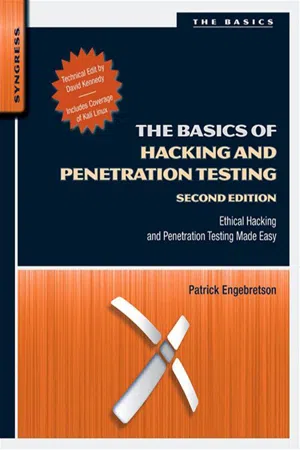
The Basics of Hacking and Penetration Testing
Ethical Hacking and Penetration Testing Made Easy
- 225 pages
- English
- ePUB (mobile friendly)
- Available on iOS & Android
eBook - ePub
The Basics of Hacking and Penetration Testing
Ethical Hacking and Penetration Testing Made Easy
About this book
The Basics of Hacking and Penetration Testing, Second Edition, serves as an introduction to the steps required to complete a penetration test or perform an ethical hack from beginning to end. The book teaches students how to properly utilize and interpret the results of the modern-day hacking tools required to complete a penetration test. It provides a simple and clean explanation of how to effectively utilize these tools, along with a four-step methodology for conducting a penetration test or hack, thus equipping students with the know-how required to jump start their careers and gain a better understanding of offensive security.Each chapter contains hands-on examples and exercises that are designed to teach learners how to interpret results and utilize those results in later phases. Tool coverage includes: Backtrack Linux, Google reconnaissance, MetaGooFil, dig, Nmap, Nessus, Metasploit, Fast Track Autopwn, Netcat, and Hacker Defender rootkit. This is complemented by PowerPoint slides for use in class.This book is an ideal resource for security consultants, beginning InfoSec professionals, and students.
- Each chapter contains hands-on examples and exercises that are designed to teach you how to interpret the results and utilize those results in later phases
- Written by an author who works in the field as a Penetration Tester and who teaches Offensive Security, Penetration Testing, and Ethical Hacking, and Exploitation classes at Dakota State University
- Utilizes the Kali Linux distribution and focuses on the seminal tools required to complete a penetration test
Information
Chapter 1
What is Penetration Testing?
Information in This Chapter:

Introduction
Penetration testing can be defined as a legal and authorized attempt to locate and successfully exploit computer systems for the purpose of making those systems more secure. The process includes probing for vulnerabilities as well as providing proof of concept attacks to demonstrate the vulnerabilities are real. Proper penetration testing always ends with specific recommendations for addressing and fixing the issues that were discovered during the test. On the whole, this process is used to help secure computers and networks against future attacks. The general idea is to find security issues by using the same tools and techniques as an attacker. These findings can then be mitigated before a real hacker exploits them.
Penetration testing is also known as
It is important to spend a few moments discussing the difference between penetration testing and vulnerability assessment. Many people (and vendors) in the security community incorrectly use these terms interchangeably. A vulnerability assessment is the process of reviewing services and systems for potential security issues, whereas a penetration test actually performs exploitation and Proof of Concept (PoC) attacks to prove that a security issue exists. Penetration tests go a step beyond vulnerability assessments by simulating hacker activity and delivering live payloads. In this book, we will cover the process of vulnerability assessment as one of the steps utilized to complete a penetration test.
Setting the Stage
Understanding all the various players and positions in the world of hacking and penetration testing is central to comprehending the big picture. Let us start by painting the picture with broad brush strokes. Please understand that the following is a gross oversimplification; however, it should help you see the differences between the various groups of people involved.
It may help to consider the Star Wars universe where there are two sides of the “force”: Jedis and Siths. Good vs Evil. Both sides have access to an incredible power. One side uses its power to protect and serve, whereas the other side uses it for personal gain and exploitation.
Learning to hack is much like learning to use the force (or so I imagine!). The more you learn, the more power you have. Eventually, you will have to decide whether you will use your power for good or bad. There is a classic poster from the Star Wars Episode I movie that depicts Anakin as a young boy. If you look closely at Anakin’s shadow in the poster, you will see it is the outline of Darth Vader. Try searching the Internet for “Anakin Darth Vader shadow” to see it. Understanding why this poster has appeal is critical. As a boy, Anakin had no aspirations of becoming Darth Vader, but it happened nonetheless.
It is probably safe to assume that very few people get into hacking to become a super villain. The problem is that journey to the dark side is a slippery slope. However, if you want to be great, have the respect of your peers, and be gainfully employed in the security workforce, you need to commit yourself to using your powers to protect and serve. Having a felony on your record is a one-way ticket to another profession. It is true that there is currently a shortage of qualified security experts, but even so, not many employers today are willing to take a chance, especially if those crimes involve computers. The rules and restrictions become even more stringent if you want a computer job which requires a security clearance.
In the pen testing world, it is not uncommon to hear the terms “white hat” and “black hat” to describe the Jedis and Siths. Throughout this book, the terms “white hat”, “ethical hacker”, or “penetration tester” will be used interchangeably to describe the Jedis or good guys. The Siths will be referred to as “black hats”, “crackers”, or “malicious attackers”.
It is important to note that ethical hackers complete many of the same activities with many of the same tools as malicious attackers. In nearly every situation, an ethical hacker should strive to act and think like a real black hat hacker. The closer the penetration test simulates a real-world attack, the more value it provides to the customer paying for the penetration testing (PT).
Please note how the previous paragraph says “in nearly every situation”. Even though white hats complete many of the same tasks with many of the same tools, there is a world of difference between the two sides. At its core, these differences can be boiled down to three key points: authorization, motivation, and intent. It should be stressed that these points are not all inclusive, but they can be useful in determining if an activity is ethical or not.
The first and simplest way to differentiate between white hats and black hats is authorization. Authorization is the process of obtaining approval before conducting any tests or attacks. Once authorization is obtained, both the penetration tester and the company being audited need to agree upon the scope of the test. The scope includes specific information about the resources and systems to be included in the test. The scope explicitly defines the authorized targets for the penetration tester. It is important that both sides fully understand the authorization and scope of the PT. White hats must always respect the authorization and remain within the scope of the test. Black hats will have no such constraints on the target list.
The second way to differentiate between an ethical hacker and a malicious hacker is through examination of the attacker’s motivation. If the attacker is motivated or driven by personal gain, including profit through extortion or other devious methods of collecting money from the victim, revenge, fame, or the like, he or she should be considered a black hat. However, if the attacker is preauthorized and his or her motivation is to help the organization and improve their security, he or she can be considered a white hat. In addition, a black hat hacker may have a significant amount of time focused on attacking the organization. In most cases, a PT may last 1 week to several weeks. Based on the time allotted during the PT, a white hat may not have discovered more advanced time-intensive exposures.
Finally, if the intent is to provide the organization a realistic attack simulation so that the company can improve its security through early discovery and mitigation of vulnerabilities, the attacker should be considered a white hat. It is also important to comprehend the critical nature of keeping PT findings confidential. Ethical hackers will never share sensitive information discovered during the process of a penetration testing with anyone other than the client. However, if the intent is to leverage information for personal profit or gain, the attacker should be considered a black hat.
It is also important to understand that not all penetration tests are carried out in the same manner or have the same purpose. White box penetration testing, also known as “overt” testing, is very thorough and comprehensive. The goal of the test is to examine every nook and cranny of the target’s system or network. This type of test is valuable in assessing the overall security of an organization. Because stealth is not a concern, many of the tools we will examine throughout this book can be run in verbose mode. By disregarding stealth in favor of thoroughness the penetration tester is often able to discover more vulnerabilities. The downside to this type of test is that it does not provide a very accurate simulation of how most modern day, skilled attackers exploit networks. It also does not provide a chance for the organization to test its incident response or early-alert systems. Remember, the tester is not trying to be stealthy. The tester is attempting to be thorough.
Black box penetration testing, also known as “covert” testing, employs a significantly different strategy. A black box test is a much more realistic simulation of the way a skilled attacker would attempt to gain access to the target systems and network. This type of test trades thoroughness and the ability to detect multiple vulnerabilities for stealth and pin-point precision. Black box testing typically only requires the tester to locate and exploit a single vulnerability. The benefit to this type of test is that it more closely models how a real-world attack takes place. Not many attackers today will scan all 65,535 ports on a target. Doing so is loud and will almost certainly be detected by firewalls and intrusion detection systems. Skilled malicious hackers are much more discrete. They may only scan a single port or interrogate a single service to find a way of compromising and owning the target. Black box testing also has the advantage of allowing a company to test its incident response procedures and to determine if their defenses are capable of detecting and stopping a targeted attack.
Introduction to Kali and Backtrack Linux: Tools. Lots of Tools
A few years back, the open discussion or teaching of hacking techniques was considered a bit taboo. Fortunately, times have changed and people are beginning to understand the value of offensive security. Offensive security is now being embraced by organizations regardless of size or industries. Governments are also getting serious about offensive security. Many governments have gone on record stating they are actively building and developing offensive security capabilities.
Ultimately, penetration testing sho...
Table of contents
- Cover image
- Title page
- Table of Contents
- Copyright
- Dedication
- Acknowledgments
- About the Author
- Introduction
- Chapter 1. What is Penetration Testing?
- Chapter 2. Reconnaissance
- Chapter 3. Scanning
- Chapter 4. Exploitation
- Chapter 5. Social Engineering
- Chapter 6. Web-Based Exploitation
- Chapter 7. Post Exploitation and Maintaining Access with Backdoors, Rootkits, and Meterpreter
- Chapter 8. Wrapping Up the Penetration Test
- Index
Trusted by 375,005 students
Access to over 1.5 million titles for a fair monthly price.
Study more efficiently using our study tools.
Frequently asked questions
Yes, you can cancel anytime from the Subscription tab in your account settings on the Perlego website. Your subscription will stay active until the end of your current billing period. Learn how to cancel your subscription
No, books cannot be downloaded as external files, such as PDFs, for use outside of Perlego. However, you can download books within the Perlego app for offline reading on mobile or tablet. Learn how to download books offline
Perlego offers two plans: Essential and Complete
- Essential is ideal for learners and professionals who enjoy exploring a wide range of subjects. Access the Essential Library with 800,000+ trusted titles and best-sellers across business, personal growth, and the humanities. Includes unlimited reading time and Standard Read Aloud voice.
- Complete: Perfect for advanced learners and researchers needing full, unrestricted access. Unlock 1.5M+ books across hundreds of subjects, including academic and specialized titles. The Complete Plan also includes advanced features like Premium Read Aloud and Research Assistant.
We are an online textbook subscription service, where you can get access to an entire online library for less than the price of a single book per month. With over 1.5 million books across 990+ topics, we’ve got you covered! Learn about our mission
Look out for the read-aloud symbol on your next book to see if you can listen to it. The read-aloud tool reads text aloud for you, highlighting the text as it is being read. You can pause it, speed it up and slow it down. Learn more about Read Aloud
Yes! You can use the Perlego app on both iOS and Android devices to read anytime, anywhere — even offline. Perfect for commutes or when you’re on the go.
Please note we cannot support devices running on iOS 13 and Android 7 or earlier. Learn more about using the app
Please note we cannot support devices running on iOS 13 and Android 7 or earlier. Learn more about using the app
Yes, you can access The Basics of Hacking and Penetration Testing by Patrick Engebretson in PDF and/or ePUB format, as well as other popular books in Computer Science & Computer Science General. We have over 1.5 million books available in our catalogue for you to explore.