- 456 pages
- English
- ePUB (mobile friendly)
- Available on iOS & Android
eBook - ePub
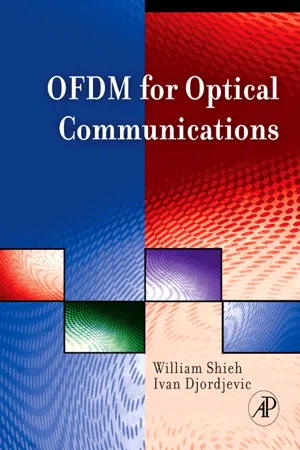
OFDM for Optical Communications
About this book
- The first book on optical OFDM by the leading pioneers in the field
- The only book to cover error correction codes for optical OFDM
- Gives applications of OFDM to free-space communications, optical access networks, and metro and log haul transports show optical OFDM can be implemented
- Contains introductions to signal processing for optical engineers and optical communication fundamentals for wireless engineers
This book gives a coherent and comprehensive introduction to the fundamentals of OFDM signal processing, with a distinctive focus on its broad range of applications. It evaluates the architecture, design and performance of a number of OFDM variations, discusses coded OFDM, and gives a detailed study of error correction codes for access networks, 100 Gb/s Ethernet and future optical networks.
The emerging applications of optical OFDM, including single-mode fiber transmission, multimode fiber transmission, free space optical systems, and optical access networks are examined, with particular attention paid to passive optical networks, radio-over-fiber, WiMAX and UWB communications.
Written by two of the leading contributors to the field, this book will be a unique reference for optical communications engineers and scientists. Students, technical managers and telecom executives seeking to understand this new technology for future-generation optical networks will find the book invaluable.
William Shieh is an associate professor and reader in the electrical and electronic engineering department, The University of Melbourne, Australia. He received his M.S. degree in electrical engineering and Ph.D. degree in physics both from University of Southern California.
Ivan Djordjevic is an Assistant Professor of Electrical and Computer Engineering at the University of Arizona, Tucson, where he directs the Optical Communications Systems Laboratory (OCSL). His current research interests include optical networks, error control coding, constrained coding, coded modulation, turbo equalization, OFDM applications, and quantum error correction.
"This wonderful book is the first one to address the rapidly emerging optical OFDM field. Written by two leading researchers in the field, the book is structured to comprehensively cover any optical OFDM aspect one could possibly think of, from the most fundamental to the most specialized. The book adopts a coherent line of presentation, while striking a thoughtful balance between the various topics, gradually developing the optical-physics and communication-theoretic concepts required for deep comprehension of the topic, eventually treating the multiple optical OFDM methods, variations and applications. In my view this book will remain relevant for many years to come, and will be increasingly accessed by graduate students, accomplished researchers as well as telecommunication engineers and managers keen to attain a perspective on the emerging role of OFDM in the evolution of photonic networks." -- Prof. Moshe Nazarathy, EE Dept., Technion, Israel Institute of Technology
- The first book on optical OFDM by the leading pioneers in the field
- The only book to cover error correction codes for optical OFDM
- Applications of OFDM to free-space communications, optical access networks, and metro and log haul transports show optical OFDM can be implemented
- An introduction to signal processing for optical communications
- An introduction to optical communication fundamentals for the wireless engineer
Information
Chapter 1 Introduction
In the virtually infinite broad electromagnetic spectrum, there are only two windows that have been largely used for modern-day broadband communications. The first window spans from the long-wave radio to millimeter wave, or from 100 kHz to 300 GHz in frequency, whereas the second window lies in the infrared lightwave region, or from 30 THz to 300 THz in frequency. The first window provides the applications that we use in our daily lives, including broadcast radio and TV, wireless local area networks (LANs), and mobile phones. These applications offer the first meter or first mile access of the information networks to the end user with broadband connectivity or the mobility in the case of the wireless systems. Nevertheless, most of the data rates are capped below gigabit per second (Gb/s) primarily due to the lack of the available spectrum in the RF microwave range. In contrast, due to the enormous bandwidth over several terahertz (THz) in the second window, the lightwave systems can provide a staggering capacity of 100 Tb/s and beyond. In fact, the optical communication systems, or fiber-optic systems in particular, have become indispensable as the backbone of the modern-day information infrastructure. There has been a worldwide campaign in the past decade to push the fiber ever closer to the home. Despite the fact that the Internet “bubble” fizzled out in the early 2000s, Internet traffic has been increasing at an astounding rate of 75% per year.1,2 The new emerging video-centric applications such as IPTV will continue to put pressure on the underlying information infrastructure.
Digital modulation techniques can be generally classified into two categories. The first is single-carrier modulation, in which the data are carried on a single main carrier. This is the “conventional” modulation format that has been the workhorse in optical communications for more than three decades. Single-carrier modulation has in fact experienced rapid advancement in recent years, and many variants to the conventional non-return-to-zero (NRZ) format have been actively explored, including return-to-zero (RZ),3,4 duobinary,5,6 differential phase-shift keying (DPSK),7,8,9 and coherent quaternary phase-shift keying (QPSK).10-12 The second category of modulation technique is multicarrier transmission, in which the data are carried through many closely spaced subcarriers. Orthogonal frequency-division multiplexing (OFDM) is a special class of MCM system that has only recently gained attention in the optical communication community, especially after being proposed as the attractive long-haul transmission format in coherent detection13 and direct detection.14,15 Experiments on coherent optical OFDM (CO-OFDM) transmission at 100 Gb/s by various groups16–18 have put the optical OFDM in the race for the next generation of 100 Gb/s Ethernet transport.
OFDM has emerged as the leading modulation technique in the RF domain, and it has evolved into a fast-progressing and vibrant field. It has been triumphant in almost every major communication standard, including wireless LAN (IEEE 802.11 a/g, also known as Wi-Fi), digital video and audio standards (DAV/DAB), and digital subscriber loop (DSL). It is not surprising that the two competing fourth-generation (4G) mobile network standards, Worldwide Interoperability for Microwave Access (WiMAX, or IEEE 802.16) from the computing community and Long-Term Evolution (LTE) from the telecommunication community, both have adopted OFDM as the core of their physical interface. Although the arrival of optical OFDM has been quite recent, it does inherit the major controversy that has lingered more than a decade in the wireless community—the debate about the supremacy of single-carrier or multicarrier transmission.19,20 It has been claimed that OFDM is advantageous with regard to computation efficiency due to the use of fast Fourier transform (FFT), but the single carrier that incorporates cyclic prefix based on blocked transmission can achieve the same purpose.19,20 Perhaps the advantage of the OFDM has to do with the two unique features that are intrinsic to multicarrier modulation. The first is scalable spectrum partitioning from individual subcarriers to a sub-band and the entire OFDM spectrum, which provides tremendous flexibility in either device-, or subsystem-, or system-level design compared to single-carrier transmission. The second is the adaptation of pilot subcarriers simultaneously with the data carriers enabling rapid and convenient ways for channel and phase estimation. In this book, we do not intend to resolve the debate on the superiority between single-carrier and multicarrier transmission. Instead, we focus on multicarrier modulation related to its principle, design, transmission, and application. Readers who are interested in advanced modulation formats for single-carrier transmission are referred to other excellent reading material that summarizes progress in single-carrier transmission.21,22
Optical OFDM bears both similarities to and differences from the RF counterpart. On the one hand, optical OFDM suffers from two well-known problems, namely high peak-to-average power ratio (PAPR) and sensitivity to phase/frequency noise. On the other hand, the optical channel has its own unique set of problems. One of the prominent differences is the existence of fiber channel nonlinearity and its intricate interaction with fiber dispersion, which is nonexistent in the RF systems. Furthermore, in the RF systems, the main nonlinearity occurs in the RF power amplifier, where a bandpass filter cannot be used to cut off the out-of-band leakage due to unacceptable filter loss. However, in optical OFDM systems, the erbium-doped fiber amplifier (EDFA; by far the most prevalent optical amplifier) is perfectly linear regardless of the level of saturation, and it is usually accompanied by a wavelength multiplexor that can remove the out-of-band spectral leakage.
In summary, after reading this book, we expect that readers—whether from an RF or an optical background—will grasp the unique promises and challenges of the optical OFDM systems.
1.1 Historical Perspective of Optical Communications
The use of light as a means of communication is natural and can be traced back to early ages of many civilizations. For instance, along the Great Wall of China is a relatively sophisticated ancient communication system composed of countless beacon towers that in many ways resembles modern-day optical communication systems. Using the color of smoke or the number of lanterns to inform the size of an invading enemy is a crude method of “multilevel” signaling. Analogous to today’s repeated communication systems, the beacon towers are positioned at regular intervals along the Great Wall, and guards in each tower, upon seeing a signal from the previous one, would send the same pattern of signal to the next tower. A message could be relayed from one end of the Great Wall to the other, more than 7300 km, in slightly more than 1 hour.
Optical communication systems took a back seat for quite awhile after the advent of telegraphy, telephone, and radio networks in the first half of the 20th century. However, in the late 20th century, such electrical-based systems had reached a point of saturation in terms of capacity and reach. A typical coaxial transport system operated at a rate of 200 Mb/s needs to regenerate every 1 km, which is costly to operate. The natural trend was to study the lightwave communication systems, in which the data rate can be increased dramatically. This was boosted after the invention and the realization of a laser that gives a coherent source for the transmitter.23 The remaining obstacle is to find an appropriate lightwave transmission medium. In 1966, Kao and Hockman proposed the idea of using the optical fiber as the lightwave transmission medium despite the fact that optical fiber at the time suffered unacceptable loss.24 They arg...
Table of contents
- Cover
- Title Page
- Copyright
- Dedication
- Table of Contents
- Preface
- Author Biography
- Chapter 1: Introduction
- Chapter 2: OFDM Principles
- Chapter 3: Optical Communication Fundamentals
- Chapter 4: Signal Processing for Optical OFDM
- Chapter 5: Polarization Effects in Optical Fiber
- Chapter 6: Coding for Optical OFDM Systems
- Chapter 7: Various Types of Optical OFDM
- Chapter 8: Spectrally Efficient High-Speed Coherent OFDM System
- Chapter 9: OFDM for Multimode Fiber Systems
- Chapter 10: OFDM in Free-Space Optical Communication Systems
- Chapter 11: OFDM Applications in Access Optical Networks
- Chapter 12: Future Research Directions
- Index
Trusted by 375,005 students
Access to over 1.5 million titles for a fair monthly price.
Study more efficiently using our study tools.
Frequently asked questions
Yes, you can cancel anytime from the Subscription tab in your account settings on the Perlego website. Your subscription will stay active until the end of your current billing period. Learn how to cancel your subscription
No, books cannot be downloaded as external files, such as PDFs, for use outside of Perlego. However, you can download books within the Perlego app for offline reading on mobile or tablet. Learn how to download books offline
Perlego offers two plans: Essential and Complete
- Essential is ideal for learners and professionals who enjoy exploring a wide range of subjects. Access the Essential Library with 800,000+ trusted titles and best-sellers across business, personal growth, and the humanities. Includes unlimited reading time and Standard Read Aloud voice.
- Complete: Perfect for advanced learners and researchers needing full, unrestricted access. Unlock 1.5M+ books across hundreds of subjects, including academic and specialized titles. The Complete Plan also includes advanced features like Premium Read Aloud and Research Assistant.
We are an online textbook subscription service, where you can get access to an entire online library for less than the price of a single book per month. With over 1.5 million books across 990+ topics, we’ve got you covered! Learn about our mission
Look out for the read-aloud symbol on your next book to see if you can listen to it. The read-aloud tool reads text aloud for you, highlighting the text as it is being read. You can pause it, speed it up and slow it down. Learn more about Read Aloud
Yes! You can use the Perlego app on both iOS and Android devices to read anytime, anywhere — even offline. Perfect for commutes or when you’re on the go.
Please note we cannot support devices running on iOS 13 and Android 7 or earlier. Learn more about using the app
Please note we cannot support devices running on iOS 13 and Android 7 or earlier. Learn more about using the app
Yes, you can access OFDM for Optical Communications by William Shieh,Ivan B. Djordjevic,Ivan Djordjevic in PDF and/or ePUB format, as well as other popular books in Technology & Engineering & Civil Engineering. We have over 1.5 million books available in our catalogue for you to explore.