- 296 pages
- English
- ePUB (mobile friendly)
- Available on iOS & Android
eBook - ePub
About this book
Understanding Augmented Reality addresses the elements that are required to create augmented reality experiences. The technology that supports augmented reality will come and go, evolve and change. The underlying principles for creating exciting, useful augmented reality experiences are timeless.
Augmented reality designed from a purely technological perspective will lead to an AR experience that is novel and fun for one-time consumption - but is no more than a toy. Imagine a filmmaking book that discussed cameras and special effects software, but ignored cinematography and storytelling! In order to create compelling augmented reality experiences that stand the test of time and cause the participant in the AR experience to focus on the content of the experience - rather than the technology - one must consider how to maximally exploit the affordances of the medium.
Understanding Augmented Reality addresses core conceptual issues regarding the medium of augmented reality as well as the technology required to support compelling augmented reality. By addressing AR as a medium at the conceptual level in addition to the technological level, the reader will learn to conceive of AR applications that are not limited by today's technology. At the same time, ample examples are provided that show what is possible with current technology.
- Explore the different techniques, technologies and approaches used in developing AR applications
- Learn from the author's deep experience in virtual reality and augmented reality applications to succeed right off the bat, and avoid many of the traps that catch new developers and users of augmented reality experiences
- Some AR examples can be experienced from within the book using downloadable software
Information
Chapter 1
What Is Augmented Reality?
Introduction
This chapter introduces the idea of augmented reality (AR) and defines what is meant by the term augmented reality in the context of this book. It also distinguishes augmented reality from other related media and technologies, as well as introduces some terms that will aid in understanding the chapters that follow.
Throughout the entirety of this book, I consider augmented reality to be a medium, as opposed to a technology. By medium, I mean that it mediates ideas between humans and computers, humans and humans, and computers and humans. Of course, implementing augmented reality as a medium requires technology and a clear understanding of that technology. Numerous technologies can be used to implement augmented reality, and this book addresses a variety of different methods and types of technology that can be used. These technologies and the ideas behind them are covered in later chapters in the book. There are advantages and disadvantages with different technologies for different types of applications. The chapters that follow address the characteristics of the technologies and show the advantages and disadvantages of using them in different types of applications. By taking the stance that augmented reality is a medium, it will become much clearer how the technologies involved can be used to create compelling applications for a variety of purposes instead of as a mere technological novelty. In much the same manner as a book about making movies needs to treat not only the technologies involved, such as cameras, lights, and projectors, but also how to use the medium to tell a story, to evoke emotion, or to document an event, it is important to consider more than just technology to create compelling augmented reality applications.
Humans interact with different media in different ways. Typically, people read a book. They watch a movie. They listen to music. This book considers that the way people engage with augmented reality is to experience it. Augmented reality can appeal to many of our senses (although currently it is primarily a visual medium). Augmented reality is interactive, so it doesn’t make sense to watch it or listen to it. We must engage with it in order to gain the experience that it provides. Augmented reality can support many different application areas. It can be applied in education, entertainment, medicine, and many more areas discussed in this book. Each of these different application areas and specific applications constitute an experience.
So what is this augmented reality experience? In brief, the core essence of an augmented reality experience is that you, the participant, engage in an activity in the same physical world that you engage with whether augmented reality is involved or not, but augmented reality adds digital information to the world that you can interact with in the same manner that you interact with the physical world. I’ll define augmented reality more precisely later in this chapter, but for now, consider it that you are engaged in the regular normal world, but there are additions to that world that consist of digital information that is placed in the world to augment the world with things you would not normally see, hear, feel, touch, etc. What’s an example of an augmented reality experience? Imagine for a moment that you go to visit a vacant lot where you intend to build your dream home. Now let’s consider an augmented reality experience in which you go to that (vacant) lot, but through the use of technology you are able to see your dream home in place on that lot. You can walk around the house and see it from all different viewpoints just like you could if the house was actually completed on the lot. You can interact with the house, open the door, and so on just like you could in the real world. However, AR can also offer the potential to do things that are not possible in a normal interaction in the real world. Perhaps you want to see the house in a different color, move the house on the lot, or see the house take off like a rocket ship. These are all possible with augmented reality.
Let’s start by looking to the past to see where some of the ideas behind augmented reality came from. Then, we will be able to define augmented reality more precisely and explore how it works and what it is good for.
Where Did Augmented Reality Come from?
Since the beginning of time, humankind has sought to alter and improve their environment. Early attempts to modify and enhance their world involved manipulating physical objects in the physical world. For example, early humans cut clearings in jungles, gathered rocks to sit on, and sharpened branches into spears. Later, they learned to represent information symbolically and learned to create imagery, such as paintings on cave walls for functional purposes—to indicate a map to a favorite location, to tell a story, or purely as an aesthetic adornment (Figure 1.1).

Figure 1.1 In ancient times, people adorned their dwellings with drawings regarding their life experiences. Note that these drawings remain today, long after they were created. Photo courtesy of Kevin Connors.
As humankind progressed, they began to discover and make tools to aid them in altering their environment. However, most changes they made were rather permanent and required a lot of effort to make and alter. At this point, the world was purely in the physical realm (Figure 1.2).

Figure 1.2 Ancient humans used primitive tools to manipulate their environment. Here, the results of altering and augmenting the natural environment are shown. This is the sphinx and the pyramid of Khafre at Giza. The sphinx was carved from a single piece of limestone. Photo courtesy of the Central Intelligence Agency.
As humankind and technology progressed, ideas became much more important, and those ideas were represented symbolically, whether realistically (such as a literal drawing) or symbolically (such as a map). At this point, the world consisted of physical entities, but also ideas and representation of those ideas in physical media. Ideas were expressed as paintings, sculpture, music, dance, and more. Mapping technology improved, and the field of semiotics matured (Figure 1.3).

Figure 1.3 Even children desire to alter their physical world—even if it is just for fun. Photo courtesy of Alan B. Craig.
It wasn’t until the 20th century that it became feasible to create, store, and retrieve information rapidly. The “industrial age” saw rapid improvements in the ability to construct, deconstruct, and modify physical structures with relative ease. However, the rate at which they could be constructed and dismantled still remained rather long, measured in years, in months, or, at the best, in days. Adornments to the physical world remained in the physical realm, that is, any modification to the environment was manifested with other physical entities that had weight and occupied space. Thus, if it was desired to make a piece of information available in a specific physical space, the only real way to do it was to create a physical artifact that either was or contained a representation of that piece of information. For example, if it was desired to indicate the maximum rate of speed at a certain place on a specific road, a physical sign would be erected that was constructed to convey the desired information (Figure 1.4).

Figure 1.4 A speed limit sign conveys specific information for a specific place. Photo courtesy of Alan B. Craig.
If it was desired to change the information regarding that place, it was necessary to construct a new sign, or at least to repaint the sign. Advances in technology made it possible to construct more generic signs with information that could be changed at will. Thus, if there was a need to change the speed limit, whether permanently or temporarily, the sign could be updated with the flick of a few switches (Figure 1.5).
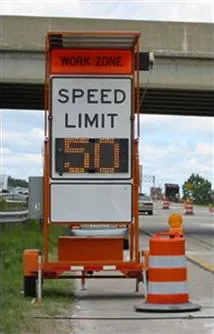
Figure 1.5 A speed limit sign conveys specific information for a specific place. The speed limit shown on this sign can be changed at will by an appropriate official. The sign does not need to be repainted to indicate the new speed limit. Photo courtesy of U.S. Department of Transportation.
Additional technology allows the addition of still more information based on what is happening at that place and time. This additional technology allows the physical sign to indicate the maximum speed allowed at that place and time, but also indicates a driver’s current rate of speed (Figure 1.6).
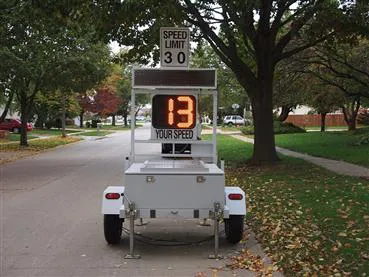
Figure 1.6 A sign can also convey information about what is happening at that place in real time. In this case, a sign indicates the speed of a car at that point in time and space. Photo courtesy of Alan B. Craig.
Finally, a modern sign can not only convey the speed limit and your current rate of speed, but it can also determine whether or not you are abid...
Table of contents
- Cover image
- Title page
- Table of Contents
- Copyright
- Dedication
- Foreword to Alan B. Craig’s Understanding Augmented Reality
- Preface
- About the Author
- Acknowledgments
- Chapter 1. What Is Augmented Reality?
- Chapter 2. Augmented Reality Concepts
- Chapter 3. Augmented Reality Hardware
- Chapter 4. Augmented Reality Software
- Chapter 5. Content Is Key!— Augmented Reality Content
- Chapter 6. Interaction in Augmented Reality
- Chapter 7. Mobile Augmented Reality
- Chapter 8. Augmented Reality Applications
- Chapter 9. The Future of Augmented Reality
- Index
Trusted by 375,005 students
Access to over 1.5 million titles for a fair monthly price.
Study more efficiently using our study tools.
Frequently asked questions
Yes, you can cancel anytime from the Subscription tab in your account settings on the Perlego website. Your subscription will stay active until the end of your current billing period. Learn how to cancel your subscription
No, books cannot be downloaded as external files, such as PDFs, for use outside of Perlego. However, you can download books within the Perlego app for offline reading on mobile or tablet. Learn how to download books offline
Perlego offers two plans: Essential and Complete
- Essential is ideal for learners and professionals who enjoy exploring a wide range of subjects. Access the Essential Library with 800,000+ trusted titles and best-sellers across business, personal growth, and the humanities. Includes unlimited reading time and Standard Read Aloud voice.
- Complete: Perfect for advanced learners and researchers needing full, unrestricted access. Unlock 1.5M+ books across hundreds of subjects, including academic and specialized titles. The Complete Plan also includes advanced features like Premium Read Aloud and Research Assistant.
We are an online textbook subscription service, where you can get access to an entire online library for less than the price of a single book per month. With over 1.5 million books across 990+ topics, we’ve got you covered! Learn about our mission
Look out for the read-aloud symbol on your next book to see if you can listen to it. The read-aloud tool reads text aloud for you, highlighting the text as it is being read. You can pause it, speed it up and slow it down. Learn more about Read Aloud
Yes! You can use the Perlego app on both iOS and Android devices to read anytime, anywhere — even offline. Perfect for commutes or when you’re on the go.
Please note we cannot support devices running on iOS 13 and Android 7 or earlier. Learn more about using the app
Please note we cannot support devices running on iOS 13 and Android 7 or earlier. Learn more about using the app
Yes, you can access Understanding Augmented Reality by Alan B. Craig in PDF and/or ePUB format, as well as other popular books in Computer Science & Computer Graphics. We have over 1.5 million books available in our catalogue for you to explore.