- 360 pages
- English
- ePUB (mobile friendly)
- Available on iOS & Android
eBook - ePub
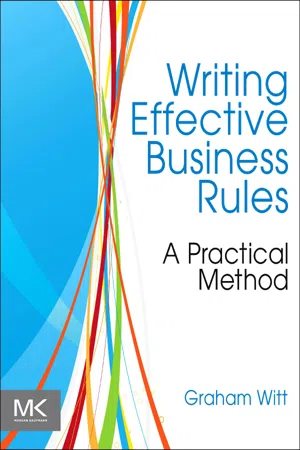
Writing Effective Business Rules
About this book
Writing Effective Business Rules moves beyond the fundamental dilemma of system design: defining business rules either in natural language, intelligible but often ambiguous, or program code (or rule engine instructions), unambiguous but unintelligible to stakeholders. Designed to meet the needs of business analysts, this book provides an exhaustive analysis of rule types and a set of syntactic templates from which unambiguous natural language rule statements of each type can be generated. A user guide to the SBVR specification, it explains how to develop an appropriate business vocabulary and generate quality rule statements using the appropriate templates and terms from the vocabulary. The resulting rule statements can be reviewed by business stakeholders for relevance and correctness, providing for a high level of confidence in their successful implementation.
- A complete set of standard templates for rule statements and their component syntactic elements
- A rigorous approach to rule statement construction to avoid ambiguity and ensure consistency
- A clear explanation of the way in which a fact model provides and constrains the rule statement vocabulary
- A practical reader-friendly user guide to the those parts of the SBVR specification that are relevant to rule authoring
Information
Chapter 1
The world of rules
This chapter
• defines some important technical terms used throughout this book;
• establishes why rules are important;
• describes the problems that face most organizations in managing rules;
• describes the benefits of the approach described in this book to solving those problems;
• discusses the various ways in which rules govern an organization and its employees, customers, suppliers, and partners;
• discusses how rule management has evolved over time.
1.1 What is a business rule?
Over time various authors have produced different definitions of the term business rule. Unfortunately some of these definitions have conflicted with others.
According to the Business Rules Group,1 the first authoritative definition of the term ‘business rule’ appeared in the seminal 1995 report of the GUIDE Business Rules Project, entitled “Defining Business Rules—What Are They Really?” This definition reads: “A business rule is a statement that defines or constrains some aspect of the business. It is intended to assert business structure or to control or influence the behavior of the business.” The same definition appeared in the Business Rules Group's Final Report of July 2000.2
In 2001, von Halle3 defined a business rule as “a condition that govern[s] … business event[s] so that [they] occur in such a way that is acceptable to the business.” So far, so good.
By contrast, Ross4 had in 1998 defined a business rule as “a rule that is under business jurisdiction.” In 2008, the authors of the SBVR5 chose to elaborate on this definition rather than the more general one and defined a business rule as “a rule that is under business jurisdiction … the semantic community can opt to change or discard the rule. Laws of physics may be relevant to a company (or other semantic community); legislation and regulations may be imposed on it; external standards and best practices may be adopted. These things are not business rules from the company's perspective.” This narrower definition, in explicitly excluding “laws of physics, … legislation, … regulations, … external standards and best practices,” places a significant proportion of the constraints on an organization, or the conditions that govern it, outside the set of business rules.
The business rules community has quite rightly, in the Business Rules Approach (discussed in Section 3.3.3 in Chapter 3) and the Business Rules Manifesto6 (discussed in Section 3.3.4, also in Chapter 3), established guidelines for analysis, expression, and management of business rules, which should be applied to all rules that govern an organization, so let us look at the types of rules that fall outside the SBVR definition.
1.1.1 Laws of physics
All organizations are subject to the laws of physics. Therefore, since these cannot be violated, it might seem that an organization does not need to document such rules or include code in its application systems to ensure that such rules are not violated. However, many laws of physics need to be taken into account when establishing the rules governing the capture of information about the real world.
Consider a school timetabling system in which school days are divided into periods of, say, 45 min each and in which groups of students are assigned to a particular classroom for each of those periods, to be taught a particular subject by a particular teacher. At least two laws of physics need to be taken into account in such a system.
First, a person, or for that matter any concrete object, cannot be in more than one location at the one time.7 Our school timetabling system should therefore (for example) prevent any teacher being timetabled to be in more than one classroom during the same timetable period.
Second, time is unidirectional (for all practical non-relativistic purposes). Nothing can therefore finish before it starts. Our school timetabling system should therefore also prevent (for example) a timetable period being defined with an end time earlier than its start time, or a part-time staff member's availability on a particular day starting after it finishes.
The school can, of course, “opt to change or discard” the rules that ensure that information representing such impossible situations cannot be entered into the timetabling system; these rules would then qualify as ‘business rules’ according to the SBVR definition. If it were to change or discard any such rules, however, the risk of producing an impractical timetable is increased, so it would make no sense to allow the school to do so.
1.1.2 Legislation, regulations, external standards, and best practices
Why should these be excluded from being analyzed, expressed, and managed in accordance with best practice, namely, the Business Rules Approach and the Business Rules Manifesto?
Failure to comply with legislation or regulation, for example, exposes the organization to the risk of litigation, leading to financial penalty and possibly loss of business through adverse publicity. Compliance with external standards typically yields efficiencies in dealing with other organizations, while compliance with best practice typically minimizes risk and/or ensures efficiency without “reinventing the wheel.”
Any organization should therefore constrain its activities and (at the very least) those of its employees so as to comply with all relevant legislation and regulations, and stands to benefit from similarly constraining those activities so as to comply with relevant external standards and best practices.
Again, an organization can opt to change or discard the rules that ensure compliance with legislation and regulations so that these rules qualify as ‘business rules’ according to the SBVR definition. If, however, an organization were to change or discard any such rules, the risks of financial penalty and possible loss of business arising from litigation are increased, so again it makes no sense to allow an organization to do so, unless it believes it can ‘get away with it.’
As an aside, I cannot help wondering whether the SBVR8 restriction of the term ‘business rule’ might have been a contributing factor to the global financial crisis. If the financial services industry focused only on those rules that they could “opt to change or discard,” this might have led to paying insufficient attention to the governance requirements of Sarbanes–Oxley9 or Basel II.10 A similar focus by the oil industry may arguably have led to 2010's disastrous oil spill in the Gulf of Mexico.
1.1.3 Rule or business rule?
Admittedly, the SBVR includes the more general term rule (signifying a superset of the set signified by the term business rule) with the definition “one of a set of explicit or understood regulations or principles governing conduct or procedure within a particular area of activity… a law or principle that operates within a particular sphere of knowledge, describing, or prescribing what is possible or allowable.” This appears to cover not only business rules but also the other types of constraints excluded from the definition of business rule. It is significant that the Business Rules Manifesto11 refers to “rules” 44 times but “business rules” only nine times.
Any business, indeed any organization, is governed by a wide variety of rules. While many of these will have been established by the organization itself and will therefore be able to be modified by the organization, others will reflect legislation or regulation, external standards or best practice, or even, as we have seen, laws of physics. Therefore, despite its title, this book focuses on all rules that might govern an organization, whether or not they would be considered to be business rules according to the SBVR definition.
1.1.4 System rule or business rule?
The GUIDE Business Rules Project12 sensibly decided to focus only on “constraints on the creation, updating and removal of persistent data in an information system” rather than the rules that govern business practice or human behavior within an organization.
That decision, while understandable, actually applied ...
Table of contents
- Cover Image
- Contents
- Title
- Copyright
- Dedication
- Acknowledgments
- Introduction
- Chapter 1. The world of rules
- Chapter 2. How rules work
- Chapter 3. A brief history of rules
- Chapter 4. Types of rules
- Chapter 5. The building blocks of natural language rule statements
- Chapter 6. Fact models
- Chapter 7. How to write quality natural language rule statements
- Chapter 8. An end-to-end rule management methodology
- Chapter 9. Rule statement templates and subtemplates
- Bibliography
- Glossary
- Index
Trusted by 375,005 students
Access to over 1.5 million titles for a fair monthly price.
Study more efficiently using our study tools.
Frequently asked questions
Yes, you can cancel anytime from the Subscription tab in your account settings on the Perlego website. Your subscription will stay active until the end of your current billing period. Learn how to cancel your subscription
No, books cannot be downloaded as external files, such as PDFs, for use outside of Perlego. However, you can download books within the Perlego app for offline reading on mobile or tablet. Learn how to download books offline
Perlego offers two plans: Essential and Complete
- Essential is ideal for learners and professionals who enjoy exploring a wide range of subjects. Access the Essential Library with 800,000+ trusted titles and best-sellers across business, personal growth, and the humanities. Includes unlimited reading time and Standard Read Aloud voice.
- Complete: Perfect for advanced learners and researchers needing full, unrestricted access. Unlock 1.5M+ books across hundreds of subjects, including academic and specialized titles. The Complete Plan also includes advanced features like Premium Read Aloud and Research Assistant.
We are an online textbook subscription service, where you can get access to an entire online library for less than the price of a single book per month. With over 1.5 million books across 990+ topics, we’ve got you covered! Learn about our mission
Look out for the read-aloud symbol on your next book to see if you can listen to it. The read-aloud tool reads text aloud for you, highlighting the text as it is being read. You can pause it, speed it up and slow it down. Learn more about Read Aloud
Yes! You can use the Perlego app on both iOS and Android devices to read anytime, anywhere — even offline. Perfect for commutes or when you’re on the go.
Please note we cannot support devices running on iOS 13 and Android 7 or earlier. Learn more about using the app
Please note we cannot support devices running on iOS 13 and Android 7 or earlier. Learn more about using the app
Yes, you can access Writing Effective Business Rules by Graham Witt in PDF and/or ePUB format, as well as other popular books in Computer Science & Computer Science General. We have over 1.5 million books available in our catalogue for you to explore.