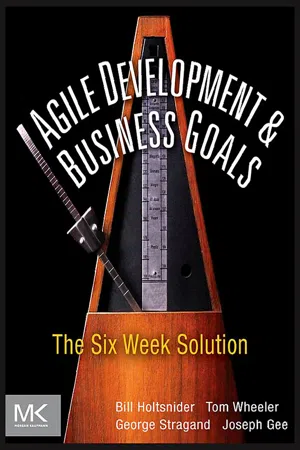
eBook - ePub
Agile Development and Business Goals
The Six Week Solution
- 256 pages
- English
- ePUB (mobile friendly)
- Available on iOS & Android
eBook - ePub
Agile Development and Business Goals
The Six Week Solution
About this book
Agile Development and Business Goals: The Six-Week Solution is a guide for the software development process, which can be challenging, difficult, and time-consuming. This process, called the "Agile process, is unique, and it features several aspects that distinguish it from the classical methods of software development. The book offers readers information about the design, implementation, and management of the different methods of creating world-class software. The book discusses the various reasons that the development of software is a difficult process, and it addresses how software development sometimes fails and why it seldom aligns with business needs. It further examines the risk associated with software creation and the different ways to mitigate them. This book is relevant to software development managers responsible for creating quality software products, and managing software development teams.
- Explains how to employ automation in your development process to improve your company's profitability
- Introduces a compensation structure that incents your technical talent to deliver measurable results on a predictable basis
- Provides real-world solutions – questions to ask when hiring or which build server software to consider, for example – instead of theoretical discussions
Information
Chapter 1 Introduction
Ask Yourself These 10 Key Questions
Chapter contents
- Introduction 2
- Ten Questions to Ask about Your Software Development Process 2
- Why Listen to us? 7
Introduction
Creating software is a difficult, expensive, and time-consuming process fraught with perils for your budgets and your deadlines. It is also challenging, potentially very rewarding financially, and filled with pockets of excitement and unpredictability that will keep you on your corporate toes. It is not for the faint of heart.
The Six Week Solution is a unique and powerful process of creating software. To determine if this process is right for you, ask yourself the following questions:
Ten questions to ask about your software development process
Does your process:
- 1. Align software development with business needs?
- 2. Compensate your development team based on delivering on their commitments?
- 3. Lend itself to a description so simple that everyone in the company can understand it?
- 4. Have both core Business and core Technical components?
- 5. Produce revenue-generating results that address real-world needs?
- 6. Tie your investment in your software development to the delivery of the software you need?
- 7. Account directly for Quality?
- 8. Hit your short-term goals while…
- 9. Addressing your long-term goals at the same time?
- 10. Reward success and make tangible the effects of failure?
The Six Week Solution does all of the above—and more.
1 Align software development with business needs
Is your development entirely focused on the needs for your business or do these needs fall second to cool technical solutions, “architectural” roadblocks, and technology wars? Steering a development team can often be challenging; simple requests seem to always get refused with obscure technical roadblocks. Despite it being the reason for a project’s existence, actually delivering what the business needs seems to somehow slip behind other esoteric concerns.
The Six Week Solution formally ties the needs of your business with the goals of your software development team. The section called “Deliver Something of Value” on page 34 discusses this connection in detail.
With software delivery happening every six weeks, the business gets new software, including bug fixes, enhancements, and entirely new features and functionality, on a predictable schedule. The concept that something will be delivered and the schedule is known from the start allows planning for deployment, through upgrading and finally through product launch. No department is held hostage to the software development organization and can proceed independently with their own responsibilities.
For further details on this topic, see the following sections: “Why the Six Week Solution Is Different” on page 28, “Software Development Sometimes (Accidentally) Succeeds” on page 32, and “True Negotiation” on page 83.
2 Compensate aggressively
How tangible to the development team is the business impact of the development effort? Is the delivery of the business needs that define success for every member of your development team or is that an incidental aspect of their efforts? Are you sure? Developer motivations can frequently surprise business-minded people. One of the unique features of the Six Week Solution is its implementation of a risk/reward compensation system for the development team. While it is a radical approach—some companies reward technical people for performance, but not very many—the compensation piece of the Six Week Solution is not a random technique. It is a core component of the process.
Note that currently all of the critical people in your company are probably paid like this: they are incented monetarily. This is true of your upper management and your salespeople, just to list a few. Why are you not doing this with your software developers?
Further, software developers who lived through the dot bomb crash have probably collected a lot of useless paper in the form of stock options that never paid off like they were promised. While those who had success with options would relish another opportunity, those who have all this worthless paper are not as interested in working for yet another piece of paper promising a payoff in the far-away future. Compensating aggressively, quickly, and with every cycle proves your money is where your mouth is and dispels any notion that your developers are working toward some nebulous goal.
Another reason to compensate aggressively is that good developers have realized that they are in an environment where they are “free agents.” They are free to get traded, go to another team, or hold out and not work at all, much like a professional athlete. The top talent has achieved this freedom without unionizing and understands that they make their own deals and can create their own future. The base pay and bonus structure allow them to have a say in how they are compensated, how much risk they are willing to assume, and how much confidence they have in their own abilities. This approach to compensation is a tool you can use to attract and retain the top talent.
For further details on this topic, see the section called “Compensation” on page 79.
3 Addresses both core business and core technical components
Is your development process entirely focused on the technical needs of the development effort? Is it instead focused on serving the needs of the business and compromising the technical concerns to get there? Both aspects must be intertwined to make the most successful, effective project that you can. This duality is a critical component of the Six Week Solution and one of its key differentiators from other Agile processes. Scrum, for example, addresses some of the business components the Six Week Solution does, but does not fully address the critical aspect of bringing technical disciplines to the process.
For a detailed discussion of differences between the Six Week Solution and other types of software development, see Chapter 9, “Other Software Development Approaches” on page 161.
- • The business components of this process are critical to the sustainability of your product. They are examined throughout the book, but are discussed in detail in Chapter 4, “Overview of the Six Week Solution” on page 37 and Chapter 8, “Integrating Automation” on page 135.
- • The technical components of this process are critical to the sustainability of your product. They are examined thr...
Table of contents
- Cover
- Title Page
- About the Authors
- Copyright
- Dedication
- Preface
- Chapter 1: Introduction
- Chapter 2: The Problem
- Chapter 3: Expectations
- Chapter 4: Overview of the Six Week Solution
- Chapter 5: The Solution's Critical Pieces
- Chapter 6: Managing the Cost of Change
- Chapter 7: Assuring Software Quality
- Chapter 8: Integrating Automation into Your Development Process
- Chapter 9: Other Software Development Approaches
- Chapter 10: Risks with Using This Approach
- Chapter 11: Transitioning to the Six Week Solution
- Chapter 12: Conclusions
- Glossary
- Sources
- Index
Trusted by 375,005 students
Access to over 1.5 million titles for a fair monthly price.
Study more efficiently using our study tools.
Frequently asked questions
Yes, you can cancel anytime from the Subscription tab in your account settings on the Perlego website. Your subscription will stay active until the end of your current billing period. Learn how to cancel your subscription
No, books cannot be downloaded as external files, such as PDFs, for use outside of Perlego. However, you can download books within the Perlego app for offline reading on mobile or tablet. Learn how to download books offline
Perlego offers two plans: Essential and Complete
- Essential is ideal for learners and professionals who enjoy exploring a wide range of subjects. Access the Essential Library with 800,000+ trusted titles and best-sellers across business, personal growth, and the humanities. Includes unlimited reading time and Standard Read Aloud voice.
- Complete: Perfect for advanced learners and researchers needing full, unrestricted access. Unlock 1.5M+ books across hundreds of subjects, including academic and specialized titles. The Complete Plan also includes advanced features like Premium Read Aloud and Research Assistant.
We are an online textbook subscription service, where you can get access to an entire online library for less than the price of a single book per month. With over 1.5 million books across 990+ topics, we’ve got you covered! Learn about our mission
Look out for the read-aloud symbol on your next book to see if you can listen to it. The read-aloud tool reads text aloud for you, highlighting the text as it is being read. You can pause it, speed it up and slow it down. Learn more about Read Aloud
Yes! You can use the Perlego app on both iOS and Android devices to read anytime, anywhere — even offline. Perfect for commutes or when you’re on the go.
Please note we cannot support devices running on iOS 13 and Android 7 or earlier. Learn more about using the app
Please note we cannot support devices running on iOS 13 and Android 7 or earlier. Learn more about using the app
Yes, you can access Agile Development and Business Goals by Bill Holtsnider,Tom Wheeler,George Stragand,Joe Gee in PDF and/or ePUB format, as well as other popular books in Business & Business Intelligence. We have over 1.5 million books available in our catalogue for you to explore.