eBook - ePub
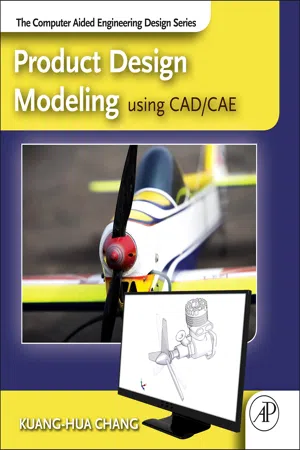
Product Design Modeling using CAD/CAE
The Computer Aided Engineering Design Series
- 438 pages
- English
- ePUB (mobile friendly)
- Available on iOS & Android
eBook - ePub
About this book
Product Design Modeling using CAD/CAE is the third part of a four-part series. It is the first book to integrate discussion of computer design tools throughout the design process. Through this book, you will:
- Understand basic design principles and all digital design paradigms
- Understand computer-aided design, engineering, and manufacturing (CAD/CAE/CAM) tools available for various design-related tasks
- Understand how to put an integrated system together to conduct all-digital design (ADD)
- Provides a comprehensive and thorough coverage of essential elements for product modeling using the virtual engineering paradigm
- Covers CAD/CAE in product design, including solid modeling, mechanical assembly, parameterization, product data management, and data exchange in CAD
- Case studies and tutorial examples at the end of each chapter provide hands-on practice in implementing off-the-shelf computer design tools
- Provides two projects showing the use of Pro/ENGINEER and SolidWorks to implement concepts discussed in the book
Information
Subtopic
CAD-CAMChapter 1
Introduction to e-Design
Abstract
The e-Design paradigm employs IT-enabled technology, including virtual prototyping, early in product development to support cross-functional analysis of performance, reliability, and costs, as well as quantitative trade-offs in decision making. Physical prototypes of the product design are then produced using rapid prototyping and computer numerical control. e-Design has the potential to shorten overall product development, improve product quality, and reduce product costs (1) by bringing together product performance, quality, and cost early in the design phase; (2) by supporting design decision making based on quantitative product performance data; and (3) by incorporating physical prototyping to support design verification and functional prototyping. This chapter introduces the e-Design paradigm and the components it comprises, including knowledge-based engineering and virtual and physical prototyping. Designs of a simple airplane engine and a high-mobility multipurpose wheeled vehicle are offered as illustrations.
Keywords
e-Design paradigm; virtual prototyping; CAD parametric product model; motion simulation; product performance; fatigue; fracture; reliability; virtual manufacturing; tool integration; decision making; problem formulation; design sensitivity; parametric study; trade-off; what-if; rapid prototyping; CNC machining; airplane engine; high-mobility multipurpose wheeled vehicle; HMMWV; hierarchicalChapter Outline
1.1 Introduction
1.2 The e-Design paradigm
1.3 Virtual prototyping
1.3.1 Parameterized CAD product model
1.3.1.1 Parameterized product model
1.3.1.2 Analysis models
1.3.1.3 Motion simulation models
1.3.2 Product performance analysis
1.3.2.1 Motion analysis
1.3.2.2 Structural analysis
1.3.2.3 Fatigue and fracture analysis
1.3.2.4 Product reliability evaluations
1.3.3 Product virtual manufacturing
1.3.4 Tool integration
1.3.5 Design decision making
1.3.5.1 Design problem formulation
1.3.5.2 Design sensitivity analysis
1.3.5.3 Parametric study
1.3.5.4 Design trade-off analysis
1.3.5.5 What-if study
1.4 Physical prototyping
1.4.1 Rapid prototyping
1.4.2 CNC machining
1.5 Example: simple airplane engine
1.5.1 System-level design
1.5.2 Component-level design
1.5.3 Design trade-off
1.5.4 Rapid prototyping
1.6 Example: High-mobility multipurpose wheeled vehicle
1.6.1 Hierarchical product model
1.6.2 Preliminary design
1.6.3 Detail design
1.6.4 Design trade-off
1.7 Summary
Questions and exercises
References
Sources
Conventional product development employs a design-build-test philosophy. The sequentially executed development process often results in prolonged lead times and elevated product costs. The proposed e-Design paradigm employs IT-enabled technology for product design, including virtual prototyping (VP) to support a cross-functional team in analyzing product performance, reliability, and manufacturing costs early in product development, and in making quantitative trade-offs for design decision making. Physical prototypes of the product design are then produced using the rapid prototyping (RP) technique and computer numerical control (CNC) to support design verification and functional prototyping, respectively.
e-Design holds potential for shortening the overall product development cycle, improving product quality, and reducing product costs. It offers three concepts and methods for product development:
• Bringing product performance, quality, and manufacturing costs together early in design for consideration.
• Supporting design decision making based on quantitative product performance data.
• Incorporating physical prototyping techniques to support design verification and functional prototyping.
1.1. Introduction
A conventional product development process that is usually conducted sequentially suffers the problem of the design paradox (Ullman 1992). This refers to the dichotomy or mismatch between the design engineer's knowledge about the product and the number of decisions to be made (flexibility) throughout the product development cycle (see Figure 1.1). Major design decisions are usually made in the early design stage when the product is not very well understood. Consequently, engineering cha...
Table of contents
- Cover image
- Title page
- Table of Contents
- Copyright
- Dedication
- Preface
- About the Author
- About the Cover
- Acknowledgement
- Chapter 1. Introduction to e-Design
- Chapter 2. Geometric Modeling
- Chapter 3. Solid Modeling
- Chapter 4. Assembly Modeling
- Chapter 5. Design Parameterization
- Chapter 6. Product Data Management
- Project S1. Project S1 Solid Modeling with SolidWorks
- Project P1. Project P1 Solid Modeling with Pro/ENGINEER
- Index
Trusted by 375,005 students
Access to over 1.5 million titles for a fair monthly price.
Study more efficiently using our study tools.
Frequently asked questions
Yes, you can cancel anytime from the Subscription tab in your account settings on the Perlego website. Your subscription will stay active until the end of your current billing period. Learn how to cancel your subscription
No, books cannot be downloaded as external files, such as PDFs, for use outside of Perlego. However, you can download books within the Perlego app for offline reading on mobile or tablet. Learn how to download books offline
Perlego offers two plans: Essential and Complete
- Essential is ideal for learners and professionals who enjoy exploring a wide range of subjects. Access the Essential Library with 800,000+ trusted titles and best-sellers across business, personal growth, and the humanities. Includes unlimited reading time and Standard Read Aloud voice.
- Complete: Perfect for advanced learners and researchers needing full, unrestricted access. Unlock 1.5M+ books across hundreds of subjects, including academic and specialized titles. The Complete Plan also includes advanced features like Premium Read Aloud and Research Assistant.
We are an online textbook subscription service, where you can get access to an entire online library for less than the price of a single book per month. With over 1.5 million books across 990+ topics, we’ve got you covered! Learn about our mission
Look out for the read-aloud symbol on your next book to see if you can listen to it. The read-aloud tool reads text aloud for you, highlighting the text as it is being read. You can pause it, speed it up and slow it down. Learn more about Read Aloud
Yes! You can use the Perlego app on both iOS and Android devices to read anytime, anywhere — even offline. Perfect for commutes or when you’re on the go.
Please note we cannot support devices running on iOS 13 and Android 7 or earlier. Learn more about using the app
Please note we cannot support devices running on iOS 13 and Android 7 or earlier. Learn more about using the app
Yes, you can access Product Design Modeling using CAD/CAE by Kuang-Hua Chang in PDF and/or ePUB format, as well as other popular books in Technology & Engineering & CAD-CAM. We have over 1.5 million books available in our catalogue for you to explore.