eBook - ePub
The Basics of Cyber Warfare
Understanding the Fundamentals of Cyber Warfare in Theory and Practice
- 164 pages
- English
- ePUB (mobile friendly)
- Available on iOS & Android
eBook - ePub
The Basics of Cyber Warfare
Understanding the Fundamentals of Cyber Warfare in Theory and Practice
About this book
The Basics of Cyber Warfare provides readers with fundamental knowledge of cyber war in both theoretical and practical aspects. This book explores the principles of cyber warfare, including military and cyber doctrine, social engineering, and offensive and defensive tools, tactics and procedures, including computer network exploitation (CNE), attack (CNA) and defense (CND).
Readers learn the basics of how to defend against espionage, hacking, insider threats, state-sponsored attacks, and non-state actors (such as organized criminals and terrorists). Finally, the book looks ahead to emerging aspects of cyber security technology and trends, including cloud computing, mobile devices, biometrics and nanotechnology.
The Basics of Cyber Warfare gives readers a concise overview of these threats and outlines the ethics, laws and consequences of cyber warfare. It is a valuable resource for policy makers, CEOs and CIOs, penetration testers, security administrators, and students and instructors in information security.
- Provides a sound understanding of the tools and tactics used in cyber warfare
- Describes both offensive and defensive tactics from an insider's point of view
- Presents doctrine and hands-on techniques to understand as cyber warfare evolves with technology
Information
Chapter 1
Cyber Threatscape
Information in this chapter:
• How Did We Get Here?
• Attack Methodology Plus Tools/Techniques Used
• Attackers (The Types of Threats)
• How Most Organizations Defend Today (Defensive Mountain Range)?
• Targeted Capabilities (What We should be Defending)
How Did We Get Here?
In the early 1980s, when ARPANET was becoming the World Wide Web which grew into today’s Internet, the focus was on interoperability and reliability as a means of communication and potential command and control in the event of an emergency. Everyone with access to the system knew each other and security was not a consideration. Then, in the late 1980s, trouble started; Robert Morris released the first worm (a self-replicating piece of malware) and Clifford Stoll discovered Soviet Block spies stealing US secrets via a mainframe at the University of California, Berkeley. These were quickly followed by a number of incidents that highlighted the security risks associated with our new communication capability (see Appendix 1 for list of major events through the years).
The key events as they relate to and impact the military occurred in the mid-to late-1990s when Time magazine had a cover on “Cyber War.” The 1998 Solar Sunrise incident hit the news as the Pentagon got hacked while America was at war with Iraq, but the instigators were two kids from California. Moonlight Maze, where the Department of Defense (DoD) found intrusions from systems in the Soviet Union (though the source of the attacks was never proven) and Russia denied any involvement (hackers will often route their attacks through countries that will not cooperate with an investigation). By the early 2000s, a series of attacks, generally accepted as being from China, were identified and code named Titan Rain. The name was changed to Byzantine Hades after the Titan Rain code name was disclosed in the media and changed again when the Byzantine Hades code name was posted to WikiLeaks. The term “Advance Persistent Threat (APT)” has become the common reference term for this state-sponsored systematic electronic reconnaissance/digital espionage. By late 2000s there was a physical aspect added to the entropic attacks which the DoD code named Operation Buckshot Yankee. Thumb drives used by US Military were found to have malcode embedded which caused DoD to ban thumb drive usage on all military networks and systems.
Note
Code Word/Name—A word or a phrase designed to represent a program or activity while remaining inconspicuous to people not cleared for the information. A code word should be assigned randomly and have no association with the program or activity it represents. Active code words are classified. If the code word/name is compromised it is cancelled and a new code word/name is issued.
In addition to attacks on the US Military, some international incidents occurred in the 2000s. In 2007, hackers believed to be linked to the Russian government brought down the Web sites of Estonia’s parliament, banks, ministries, newspapers, and broadcasters. Estonia called on the NATO treaty for protection and troops to help recover. A year later cyber attackers hijacked government and commercial Web sites in Georgia during a military conflict with Russia, creating a new form of digital signal jamming over the Web. Finally in 2010, the Stuxnet worm attacked the systems that control Iran’s nuclear material development causing damage to these systems.
There are some other key events that parallel the military’s pains. In 2009, reports revealed that hackers downloaded data from the DoDs multibillion-dollar F-35 Joint Strike Fighter program, showing that the cyber attackers were going after defense contractors as well as the military itself. Then in 2010, Operation Aurora broke into the news when Google publicly revealed itself as being one of many commercial companies hacked by the APT showing that the cyber attackers were also going after commercial intellectual property. There were two troubling attacks in 2011. The first was a series of hacks exposed in the global energy report “Night Dragon” which showed how China was trying to gain a competitive edge in the energy market through espionage. The second was the RSA attack where stolen information would allow a hacker to replicate the number that showed up on the password token many organizations used to secure their networks, showing that the enemy was willing to attack the infrastructure used to protect the US.
For 30 years, there has been a continuous battle between defenders and attackers from networks around the globe. In many cases it does not matter to the attacker if the target is military, government, or commercial, they are just after as many systems as they can acquire. As new solutions are invented, new attacks are developed, and the cycle continues.
The threatscape map in Figure 1.1 was designed to assist everyone in understanding this complex environment. Some will see the map of Mordor from J.R. Tolkien’s fictional Middle-Earth while others see the Ponderosa, but the map is really designed to show the methodology (upper left) and resources (lower left) the attackers (second column) will use to attempt to beat the defenses built into the mountain range (center) to get to the valuable data they want on the far side (far right side).
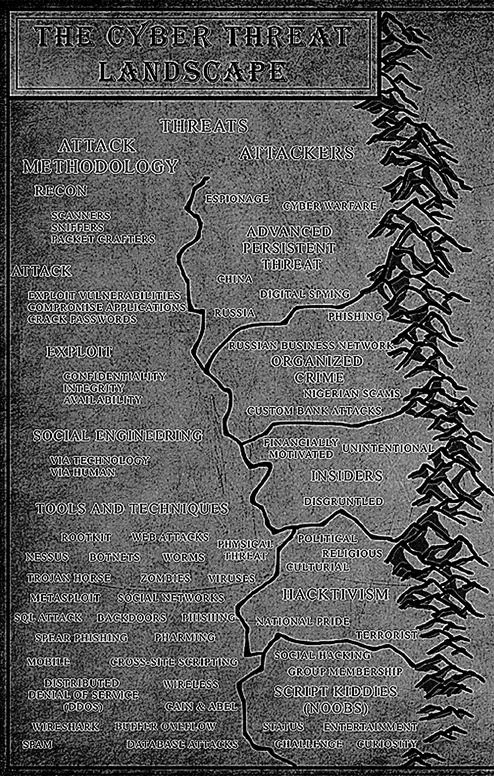
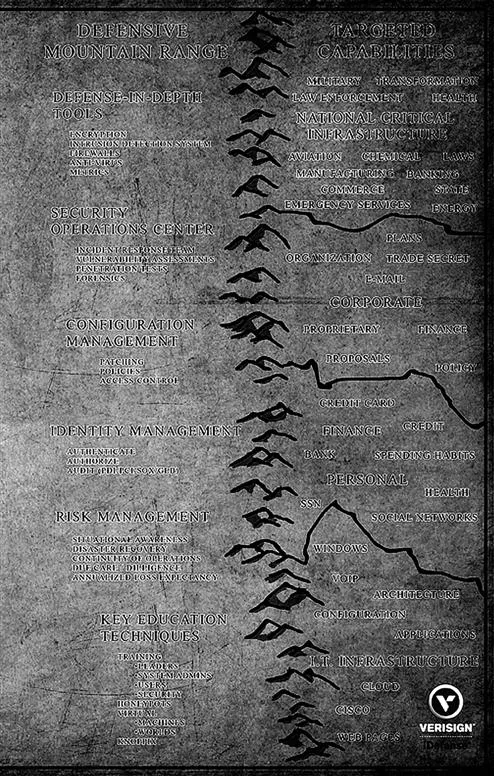
Figure 1.1 This is a Threatscape Map Designed to Show the Different Components in the Cyber Environment and How They Interact
Attack Methodology Plus Tools/Techniques Used
As we examine how networks are broken into, it is evident that the basic steps in the process are analogous to traditional military attack/defend doctrine. When we look at how defending armies build defense in depth, we see the same term used by network administrators—Demilitarized Zone (DMZ), just like the physical zone between South and North Korea. On the attacking side attackers go through the reconnaissance, marshal forces at the point of weakness, attack and exploit penetration to gain control over the enemy.
The major difference between Kinetic (real world) and Non-Kinetic (virtual world) warfare methodology is the weapons vs. software programs they use. So we will walk through the steps and define a few of the tools used. The tools will be covered in more detail in later chapters so this will just be to gain an initial understanding.
Warning
The only difference between a hacker tool and a cybersecurity professional tool is “written permission.” Please don’t load a password cracker on a work computer to test the security without permission—many people have been fired for using these tools with good intentions.
Attack methodology is the process or general steps used to attack a target and potential tools/techniques that can be used to conduct the attack. The major steps are recon, attack, and exploit. These steps can be a variety of activities, from launching machine to machine attacks to using social engineering. (Think of social engineering as scamming or conning someone out of information that allows the hacker to compromise a network.) Each of these steps or phases have a number of substeps to accomplish them and in many cases different hackers will both modify and automate them to suit their style.
To begin the recon phase a target is required. The target can be the specific systems that will be attacked or the personnel that use them. To attack the machines the unique Internet Protocol (IP) address for the machine or Uniform Resource Locator (URL) for the Web page must be known. To attack via the users, a phone number is generally all that is needed. IP addresses and phone numbers can be found with a quick Google search or with services like American Registry for Internet Numbers (ARIN) searches. Much of what is needed for a social engineering attack can be found on a business card.
Once the target is identified the recon begins to find the weak point or vulnerability. The attack can be against the operating system or one of the applications on it (i.e. Adobe Flash, Microsoft Office, Games, Web browsers, or an instant messenger). A scanner is run against the system to determine and list many of the vulnerabilities. Some of the more popular scanners are Nmap, Nessus, eEye Retina, and Saintscanner. Attack framework tools are available that both scan and then have the exploits to launch the attack matching vulnerabilities found built into the application. Some popular framework tools are Metasploit, Canvas, and Core Impact. Finally there is a tool that transforms a machine into a Linux system by booting off of a Linux live CD. The most popular live CD attack tool is BackTrack.
Another tool that is useful during recon is a sniffer. This is a tool that has the attacker’s system mimic every computer on the network so it gets a copy of all the traffic. It will allow the attacker to read all unencrypted emails and documents as well as see the Web pages being accessed by everyone on the network. Popular sniffers are Wireshark, Ettercap, and Tcpdump. On the wireless side tools include Aircrack-ng and Kismet.
While there are a lot of recon tools that are very powerful and easy to use, the one set of tools that show how the threat environment has evolved is packet crafters. Someone with no programming skills can now craft unique attacks. Popular tools include NetCat and Hping. There are a host of other tools for recon but these represent the baseline tools used to discover the vulnerabilities that allow movement to the attack phase.
When attacking a system there are many types of malcode that can be used. At the code level there are worms or viruses that can use attack vectors like cross-site scripting (XSS) or buffer overflows to install rootkits or a Trojan horse which acts as a backdoor into a system, and is use to spread the attack. A worm spreads without any help. It infects a system and use it to find more systems to spread to, while a virus needs some user interaction like opening any type of file (email, document, presentation) or starting a program (game, video, new app). Worms and viruses use techniques like cross-site scripting or buffer overflows which attack mistakes in the code in order to compromise it. Cross-site scripting is a Web-based attack that allows unauthorized code to be executed on the viewer’s computer that could result in information being stolen or the system’s identification certificates being stolen. An overly simplified example of a buffer overflow is when a program asks for a phone number rather than give it the 10 digits needed the software sends 1000 digits then a command to install the malcode. Because the program does not have good error handling, it executes the malcode.
A rootkit is a program that takes over control of the operating system and tells lies about what is happening on the system. Once a rootkit is installed, it can hide the hacker’s folders (i.e. hacker tools, illegal movies, stolen credit card numbers), misdirect applications (i.e. show the antivirus updating daily but don’t allow it to update), or misrepresent the system status (i.e. leave port 666 open so the hacker can remotely access the system but show it as closed).
The first generation of rootkits was much like my daughter when she was four (called the fibbing 4s because that is when most kids learn to lie). Like a 4 year old, the rootkits of the first generation did not lie very well. The generation we are on now is more like when she was 21 (she was MUCH better at telling a coherent story that is not easy to detect as a lie). The current generation of rootkits does a much better job of hiding themselves from detection. The next generation will be like someone with a masters in social engineering, almost undetectable. A Trojan horse backdoor is a program that masquerades as a legitimate file (often a system file: i.e. files ending in .sys on a Windows box or the system library on a Mac). These files are actually fakes and have replaced the actual system file. The new file both runs the system and opens a backdoor to the system allowing the hacker remote control of the system.
One use for worms and viruses is to build botnet armies. A bot (also called a zombie) is a computer that is a slave to a controller. Once someone builds an army of millions of bots they can cause a distributed denial of service (DDoS) by having all of the bots try to connect to the same site or system simultaneously. This can be done to blackmail a Website (pay or be blocked so no customers can get access), disrupt command and control systems, click fraud (if Acme.org gets paid one cent for every customer that clicks on link taking them to Selling.com a botnet could be used to do that millions of times a day) or compile complex problems (much like a distributed supercomputer).
There are a number of ways to launch attacks targeted at a specific system rather than the broad net a worm or virus would catch. The attack framework tools mentioned earlier are the most common. The key is to correlate the exploit to the vulnerability. Much like there has never been a bank built that cannot be robbed, there is not a computer or network that cannot be broken into given enough resources and persistence. If no vulnerability can be found then the attacker can go after the authentication via password or credential attacks.
Cracking passwords can be done with brute force by having a program try every possible password iteration. This can be time consuming and is easy to detect but, depending on the strength of the password, is very effective. If the hacker can get access to the password file then tools like Cain & Able or Jack the Ripper can be utilized to crack them. Another technique that is available is called rainbow tables. These are databases where popular password encryption protocols have been run on every possible key combination on a standard keyboard. This precompiled list allows a simple lookup when the hacker gets access to the list of encrypted passwords. Many of these tables have done every combination for 8–20 characters and the length grows as hackers continue to use botnet to build the tables.
Note
Exploit has three meanings within the cyber community. When talking about code it refers to malcode that allows a system to be compromised. When talking about the methodology it refers to what the payload of the attack is intended to accomplish. When talking about military doctrine it is used by the intelligence community to refer to recon/espionage.
The exploit phase is where the attacker takes advantage of gaining control. There are generally three factors that the hacker can compromise: Confidentiality, Integrity, or Availability (CIA). When attacking confidentiality they are simply stealing secrets. Integrity attacks are when they change the data on the system. In a commercial setting this could be changing prices or customer data. On a military network it might be to change the equations used to calculate command and control guidance. Availability attacks are normally time based and can be accomplished by taking the system down or overwhelming the bandwidth. The type of exploit is based on the motivations of the attacker. They can use the system to attack more systems on the network, misrepresent the user (send fake emails), or load a rootkit with a backdoor to maintain long-term access. They will often try to avoid detection and might even use anti-forensic techniques like log wiping and time stomping. Some will patch the system so others will not be able to break in and take it away from them. Finally they may load digital tripwire alarms to tell them if they have been detected.
Another vector of attack is social engineering. This can be done in person but is normally done over the phone. It can include research via an organization’s Web site, social media, and meeting people at places like a conference to exchange business cards. The most common attack today is via email. This kind of social engineering attack is called phishing (sending general email to multiple people), spear phishing (targeted at a specific person), or whaling (targeting a specific senior member of the organization). There are also technical tools like the “Social Engineer Toolkit” that are designed to assist attacking the workforce.
Attackers (The Types of Threats)
This section will focus on the different categories of attackers. As we look at the threatscape map (Figure...
Table of contents
- Cover image
- Title page
- Table of Contents
- Copyright
- Dedication
- Author Biography
- Introduction
- Chapter 1. Cyber Threatscape
- Chapter 2. Cyberspace Battlefield Operations
- Chapter 3. Cyber Doctrine
- Chapter 4. Tools and Techniques
- Chapter 5. Offensive Tactics and Procedures
- Chapter 6. Psychological Weapons
- Chapter 7. Defensive Tactics and Procedures
- Chapter 8. Challenges We Face
- Chapter 9. Where is Cyber Warfare Headed?
- Index
Trusted by 375,005 students
Access to over 1.5 million titles for a fair monthly price.
Study more efficiently using our study tools.
Frequently asked questions
Yes, you can cancel anytime from the Subscription tab in your account settings on the Perlego website. Your subscription will stay active until the end of your current billing period. Learn how to cancel your subscription
No, books cannot be downloaded as external files, such as PDFs, for use outside of Perlego. However, you can download books within the Perlego app for offline reading on mobile or tablet. Learn how to download books offline
Perlego offers two plans: Essential and Complete
- Essential is ideal for learners and professionals who enjoy exploring a wide range of subjects. Access the Essential Library with 800,000+ trusted titles and best-sellers across business, personal growth, and the humanities. Includes unlimited reading time and Standard Read Aloud voice.
- Complete: Perfect for advanced learners and researchers needing full, unrestricted access. Unlock 1.5M+ books across hundreds of subjects, including academic and specialized titles. The Complete Plan also includes advanced features like Premium Read Aloud and Research Assistant.
We are an online textbook subscription service, where you can get access to an entire online library for less than the price of a single book per month. With over 1.5 million books across 990+ topics, we’ve got you covered! Learn about our mission
Look out for the read-aloud symbol on your next book to see if you can listen to it. The read-aloud tool reads text aloud for you, highlighting the text as it is being read. You can pause it, speed it up and slow it down. Learn more about Read Aloud
Yes! You can use the Perlego app on both iOS and Android devices to read anytime, anywhere — even offline. Perfect for commutes or when you’re on the go.
Please note we cannot support devices running on iOS 13 and Android 7 or earlier. Learn more about using the app
Please note we cannot support devices running on iOS 13 and Android 7 or earlier. Learn more about using the app
Yes, you can access The Basics of Cyber Warfare by Jason Andress,Steve Winterfeld in PDF and/or ePUB format, as well as other popular books in Computer Science & Computer Science General. We have over 1.5 million books available in our catalogue for you to explore.