eBook - ePub
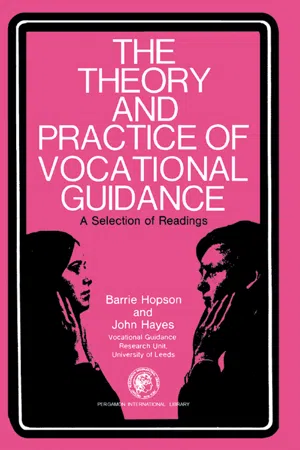
The Theory and Practice of Vocational Guidance
A Selection of Readings
- 538 pages
- English
- ePUB (mobile friendly)
- Available on iOS & Android
eBook - ePub
About this book
The Theory and Practice of Vocational Guidance: A Selection of Readings is a compilation of papers that discusses theoretical foundations and practical applications of vocational guidance. The book presents 36 articles that cover various concerns in career counseling, both in theory and in practice. The first part of the text deals with theoretical concerns in vocational guidance, such as model for the translation of self-concepts into vocational terms; social factors in vocational development; young workers in their first jobs; and the criteria of vocational success. In the next part, the book presents the practical issues, which include needed counselor competencies in vocational aspects of counseling and guidance; an occupational classification for use in vocational guidance; psycho-social aspects of work; and key concepts in the use of psychological tests in vocational guidance. The book will be of great use to any professionals, but will be most useful to those involved in career counseling, such as human resource practitioners, school counselors, and college career advisers.
Information
Topic
EducationSubtopic
Education GeneralPART I
THEORY
INTRODUCTION TO THEORY
“Every man’s work, whether itbe literature or music or pictures or architecture or anything else, is always a portrait of himself.”
SAMUEL BUTLER
Introduction
THE subject of Part I of the book is occupational choice. The major points of emphasis are two: “why” people choose one job in preference to another, and “how” this is accomplished.
People can always provide ready-to-wear answers to describe how they came to choose a particular job, but subjective evaluation is notorious for its attractive “red herrings”. It is, therefore, most disappointing when we look for objective investigations into the phenomenon of occupational choice to discover that until quite recently the cupboards were depressingly bare. Psychology, in the form of Mrs. Hubbard, did not really have a change of heart until the early nineteen-fifties. As it transpired, the provider was not a psychologist, but the economist Eli Ginzberg and his associates (1951), who were to bring to the attention of psychologists and sociologists the paucity of empirical information and theoretical interest existing at the time.
Prior to Ginzberg’s book, Occupational Choice: An Approach to a General Theory, three generalized approaches to occupational choice can be elicited. Part I of this book is concerned with theories of occupational choice and decision-making; none of the following three approaches can justify the title of “theory”.
ACCIDENT HYPOTHESIS
This may be described as the “St. Paul on the road to Damascus” approach. With a blinding flash of insight, a person suddenly “hits” on the idea of being, for example, a plumber, by watching one at work on the sink in his house. The anthropologist Malinowski explained his transference of interest from chemistry to anthropology following the experience of reading Frazer’s Golden Bough during a convalescence from tuberculosis. Whistler relates how, if he had not failed a military examination, he would have lived out his life as an army officer. These examples illustrating some of the ways in which people describe the discovery of their raison d’être, are, in reality, emphasizing the role of chance occurrences in life decision-making processes. This explanation of occupational choice sees chance as the important operating factor.
No one doubts the substantial element of chance operating in these examples, but all that they illustrate is that chance was an important factor reinforcing trends already existing at that point in time. The accident factor is seen as the iceberg trip above the submerged mass of earlier experiences and individual dispositions. Many people observe plumbers at work in their kitchens but they are not all motivated to rush out to seek employment as a plumber. Many American young men fail their West Point examinations, but they do not all become artists like Whistler. Thousands of people must have read Frazer’s Golden Bough, and some of these could also have been recovering from tuberculosis, yet they were not all converted to anthropology as a career.
In explaining their occupational choices as accidents—”I was walking down the High Street, saw this advert in the window, went in and got the job”—most people mean that they were affected by an unplanned exposure to a powerful stimulus. But there are countless such occurrences in everyone’s life, and the important question is why are some of these stimuli responded to while others are ignored. The “accident” hypothesis does not tell us.
An attempt to deal with the problem of the selection/non-selection of stimuli in the occupational choise process has been made by the developmental theorists like Super (Chapter 1), Tiedeman (Chapter 4), Blau (Chapter 5), and the decision-making theorists (Chapter 6 and 7).
IMPULSE HYPOTHESIS
This approach has been stressed in particular by the psychoanalysts who emphasize the importance of unconscious motivations in everyday life. Ernest Jones quotes the case of the child who showed an unnaturally strong interest in micturition who became a well-known engineer of bridges and canals. We have all heard stories of the sadist who becomes a surgeon or a butcher, and the homosexual who becomes a barber. Again, however, a few examples do not substantiate an all-embracing theory. As the accident hypothesis attributes all occupational choice to the responses of an individual to external forces, so the impulse hypothesis stresses the all-importance of internal factors, that is, the emotional forces. Many surgeons can be shown not to have had abnormal sadistic urges during childhood, and all engineers involved in the construction of bridges and canals do not exhibit childish fascination with micturition. Also, occupational choices other than surgery are made by persons with strong sadistic impulses, and even if this category of occupations were broadened to include butchers, dentists, prison officers, etc., it would still be too narrow to include all occupations permitting expression of so pervasive an impulse.
An attempt to substitute a more sophisticated approach to the question of “impulses” and their effects on occupational choice has been made by “need theorists” like Anne Roe (Chapter 11) and psychoanalytic theorists like Bordin, Segal and Nachman (1963).
TALENT-MATCHING APPROACH
This approach grew up from the needs of the vocational guidance practitioners—professionals working privately, within a youth employment service, guidance agency, or some branch of the educational system. Their work, fundamentally, is to find a suitable occupation for an individual sitting in front of them. The essentials of this approach are cont...
Table of contents
- Cover image
- Title page
- Table of Contents
- SOME OTHER TITLES OF INTEREST
- Copyright
- Foreword
- Preface
- PART I: THEORY
- PART II: PRACTICE
- Author Index
- Subject Index
Trusted by 375,005 students
Access to over 1.5 million titles for a fair monthly price.
Study more efficiently using our study tools.
Frequently asked questions
Yes, you can cancel anytime from the Subscription tab in your account settings on the Perlego website. Your subscription will stay active until the end of your current billing period. Learn how to cancel your subscription
No, books cannot be downloaded as external files, such as PDFs, for use outside of Perlego. However, you can download books within the Perlego app for offline reading on mobile or tablet. Learn how to download books offline
Perlego offers two plans: Essential and Complete
- Essential is ideal for learners and professionals who enjoy exploring a wide range of subjects. Access the Essential Library with 800,000+ trusted titles and best-sellers across business, personal growth, and the humanities. Includes unlimited reading time and Standard Read Aloud voice.
- Complete: Perfect for advanced learners and researchers needing full, unrestricted access. Unlock 1.5M+ books across hundreds of subjects, including academic and specialized titles. The Complete Plan also includes advanced features like Premium Read Aloud and Research Assistant.
We are an online textbook subscription service, where you can get access to an entire online library for less than the price of a single book per month. With over 1.5 million books across 990+ topics, we’ve got you covered! Learn about our mission
Look out for the read-aloud symbol on your next book to see if you can listen to it. The read-aloud tool reads text aloud for you, highlighting the text as it is being read. You can pause it, speed it up and slow it down. Learn more about Read Aloud
Yes! You can use the Perlego app on both iOS and Android devices to read anytime, anywhere — even offline. Perfect for commutes or when you’re on the go.
Please note we cannot support devices running on iOS 13 and Android 7 or earlier. Learn more about using the app
Please note we cannot support devices running on iOS 13 and Android 7 or earlier. Learn more about using the app
Yes, you can access The Theory and Practice of Vocational Guidance by Barrie Hopson,John Hayes in PDF and/or ePUB format, as well as other popular books in Education & Education General. We have over 1.5 million books available in our catalogue for you to explore.