eBook - ePub
Low Tech Hacking
Street Smarts for Security Professionals
- 264 pages
- English
- ePUB (mobile friendly)
- Available on iOS & Android
eBook - ePub
Low Tech Hacking
Street Smarts for Security Professionals
About this book
Low Tech Hacking teaches your students how to avoid and defend against some of the simplest and most common hacks. Criminals using hacking techniques can cost corporations, governments, and individuals millions of dollars each year. While the media focuses on the grand-scale attacks that have been planned for months and executed by teams and countries, there are thousands more that aren't broadcast. This book focuses on the everyday hacks that, while simple in nature, actually add up to the most significant losses. It provides detailed descriptions of potential threats and vulnerabilities, many of which the majority of the information systems world may be unaware. It contains insider knowledge of what could be your most likely low-tech threat, with timely advice from some of the top security minds in the world.
Author Jack Wiles spent many years as an inside penetration testing team leader, proving that these threats and vulnerabilities exist and their countermeasures work. His contributing authors are among the best in the world in their respective areas of expertise. The book is organized into 8 chapters covering social engineering; locks and ways to low tech hack them; low tech wireless hacking; low tech targeting and surveillance; low tech hacking for the penetration tester; the law on low tech hacking; and information security awareness training as a countermeasure to employee risk.
This book will be a valuable resource for penetration testers, internal auditors, information systems auditors, CIOs, CISOs, risk managers, fraud investigators, system administrators, private investigators, ethical hackers, black hat hackers, corporate attorneys, and members of local, state, and federal law enforcement.
- Contains insider knowledge of what could be your most likely Low Tech threat
- Includes timely advice from some of the top security minds in the world
- Covers many detailed countermeasures that you can employ to improve your security posture
Information
Chapter 1. Social engineering
The ultimate low tech hacking threat
Information in this chapter
• How Easy Is It?
• The Mind of a Social Engineer
• The Mind of a Victim
• Tools of the Social Engineering Trade
• One of My Favorite Tools of the Trade
• Social Engineering Would Never Work against Our Company
• What Was I Able to Social Engineer out of Mary?
• The Final Sting—Two Weeks Later—Friday Afternoon
• Why Did This Scam Work?
• Let's Look at a Few More Social Engineering Tools
• Let's Look at That Telephone Butt-in Set on My Tool Belt
• Meet Mr. Phil Drake
• Meet Mr. Paul Henry
• Do You Have a Guest User of Your Credit Card?
• A Few Possible Countermeasures
Social engineering is not a new phenomenon. Yet, it is still one of the most effective outsider-insider threats to any security plan. Despite valiant attempts by corporations to manage risk by not becoming victims of social engineering attacks, it is often far too easy for hackers to use the art of the con to gain access to intellectual property and to the buildings housing that property. This chapter explores the phenomenon of social engineering and explains why it is the ultimate low tech hacking threat. The chapter begins by explaining what social engineering is and how easy it is to pull off. Next, it digs into the minds of a social engineering attacker and a victim of an attack, and covers some of the more popular tools of the trade. The chapter also includes interviews with specialists in technical security issues, and closes with a few countermeasures associated with social engineering.
Key Words: Black hat hacker, Butt-set kit, Caller ID spoofing, KeyGhost, Keystroke logger, Social engineering, Sound amplifier
Some of the things I will discuss in this chapter have been on my mind since the mid-1980s. I believe it's time that I put them in writing and share a few of my thoughts on what I believe could be the most effective and dangerous threat to any security plan: social engineering! It has, in my opinion, become the low tech hacker's most valuable and effective tool. This age-old threat has taken on a new meaning as what I collectively call “bad guys” have continued to use the art of the con to gain access to intellectual property and if necessary the buildings that house that property.
This chapter, or the rest of the book for that matter, isn't meant to be read as a complete story from beginning to end. Social engineering and ways to prevent it are subjects with many meanings. This will be more of a potpourri of tips, tricks, vulnerabilities, and lessons learned from my thirty plus years of dealing with these issues. As an inside penetration team leader, I was constantly looking for more innovative ways to conduct a successful inside penetration test. It was during those years of physical and technical penetration testing that I gained most of my social engineering experience. These skills helped me to eventually hang up my dumpster diving penetration team jersey and retire from the tiger team (a term sometimes used for penetration testing) world UNDETECTED! Although I came close several times, I was never stopped or reported to security as a possible burglar or corporate espionage agent, even though that's what I effectively was.
As you read this chapter, if you think that it has a strong risk management flavor, that was intentional. Just about every area of concern with security today involves managing the risks associated with staying safe and secure. This chapter, and most of the other chapters in this book are chock full of what I like to call techno tidbits of useful risk management countermeasures. Hopefully, many of them will be topics that you might not have considered in the past as you put together your security plan. External, internal, and information systems auditors will find information on a few new potential vulnerabilities that they can recommend countermeasures for.
I've included discussions about social engineering in each of my former books. I've also used the term social engineering as a partial title for many of my presentations over the past 15 years. My most popular presentation to date is titled “Social engineering: Here's how I broke into their buildings.” Following these presentations, I frequently have people come up and talk to me about some of the things that I discussed. Many of these people are longtime friends and attend pretty much every session that I give at the yearly events where I present. What has been encouraging to me this past year is the number of people who come to me after the presentation saying that they incorporated some of what they learned and that they are now conducting some of their own corporate penetration tests to help protect their companies from the threat of social engineering. Each of them seemed to have experienced the same things that I have over the years of using social engineering as a training tool and somewhat of a hobby. They find that it is often way too easy to get people to give them access to places where they are not supposed to be able to easily access and to things that they should not see.
How easy is it?
Way back in 1988, I was a part of an internal security team for a large corporation. On several occasions, I had the opportunity to hear some of the conversations that went on when a “black hat” (in this case malicious) group targeted victims by calling them on the phone. They were using social engineering skills to gain access to proprietary information including passwords. I'll never forget what I heard one of the experienced black hats say to another black hat in training: “Social engineering is the easiest way to break into a system.” He then followed up that comment by saying, “The stupidity of the average system administrator amazes me.”
That was almost 25 years ago, and that was the first time I had heard the words social engineering. Why do I think of it as a tool that could be used by any bad guy from a black hat hacker to a terrorist? Social engineering is what I believe could be the most effective and dangerous outsider–insider threat to any security plan.
In the first three chapters of this book, I will be talking about social engineering, physical security, and a little bit more about locks. If we look at physical security as the target of an attack and locks as the gatekeeper for the entrance into the target, social engineering is often the way that we are able to gain access to the keys that open those locks and possibly the rest of the building. It is often the people who have those keys who become the victims of social engineering. We'll take a much closer look at that as we progress through the book.
The mind of a social engineer
Although I've been using and teaching social engineering for almost two decades now, the true extent of the impact of social engineering really became clear to me about 9 years ago. When I was out in L.A. for a meeting on financial crimes security (what else?), I purchased a very interesting book titled The Art of Deception: Controlling the Human Element of Security by Kevin D. Mitnick and William L. Simon.
Just above the title on the cover of the book in red letters are the words Controlling the Human Element of Security. I found the book to be very well written and full of a lot of good examples of how social engineering works and how companies can try to defend against its use. I also learned quite a bit about a few approaches to targeting a potential victim than I had ever thought of before. A social engineer will continuously learn more clever ways to take advantage of how our minds work in order to perform the illusion or deception. The more that I used social engineering as one of my tools during my penetration testing days, the bolder I became in its use during those tests. After years of success in pretending to be something or someone that I wasn't, I just KNEW that whatever I said to the people that I encountered during the tests would be believed, and it was!
The mind of a victim
Any one of us, at any time, could easily become the victim of some form of social engineering. I personally believe that it is not possible to completely eliminate the risk. There are some things that can and should be done to reduce the risk as much as possible and I'll address some of them in the rest of this chapter. Without some form of training (and practice) in learning how to prevent being a victim of social engineering, you could easily become a victim and not even know it.
Our minds work in very trusting and predictable ways, and that means that exaggerated deviations from the norm might not ever be considered. This is what social engineers count on. Without awareness of the problem and without an understanding of how our minds can be fooled, there is little defense against social engineering. For this awareness training to be of any benefit for an organization, it must include every employee of every organization.
We see things all day long and we don't pay close attention to certain details because they are too familiar to us. That's exactly how the illusions that magicians call magic work and also why so many magic tricks are related to simple everyday things like a deck of cards. I use magic in much of my training and it really adds a lot to the attention span of the people in front of me. They are all so used to seeing those 52 cards that they don't even begin to think about how the different card gimmicks being used in most card tricks work. Most of these illusions are self-working yet almost mind boggling to the unsuspecting mind.
Tools of the social engineering trade
If you would join me in taking a look at Figure 1.1, you will see a picture of the social engineering bag that I used for roughly 10 years. It was a pretty expensive bag to purchase. I spent around $200 for it, but it was money well spent. I often thought of it as something similar to those clown cars that you see in the circus. It is very deceptive how much will fit in that bag. Not only could I put all of my social engineering tools in the bag, but also there was a lot of room left over for the things I was able to take out of the buildings once my penetration test was successful. On the outside it simply looks like a briefcase that pretty much anyone within that organization would be carrying to and from work. On the inside were some slightly different items from what you would normally see someone bringing to work.
 |
| Figure 1.1 My inside penetration team bag |
I took the time to put the contents of the bag on the table for you to see in Figure 1.2. This is the first time that I've ever done that. Not that what I have in the bag is anything special; it's just that I've never shared the contents with anyone in quite this way, especially in a book.
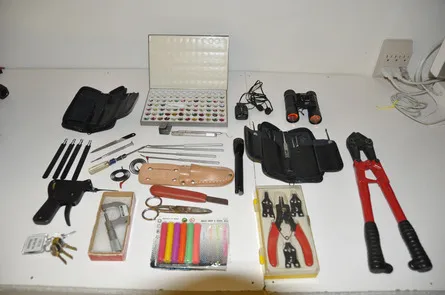 |
| Figure 1.2 It's not as innocent as it looks |
I wish that I had taken a picture of the bag as I was leaving some of these buildings with everything in it. It even amazed me how much that bag could expand and still look comparatively normal. Some of these things are tools that I have had for more than 40 years. Each has its own purpose and I'll explain some of that as we progress through the book. I know what you're thinking. There's no way that he has a pair of bolt cutters in that bag. Well, they were in there, and I had t...
Table of contents
- Cover image
- Table of Contents
- Front matter
- Copyright
- Acknowledgments
- Foreword
- About the Authors
- Introduction
- Chapter 1. Social engineering
- Chapter 2. Low tech vulnerabilities
- Chapter 3. More about locks and ways to low tech hack them
- Chapter 4. Low tech wireless hacking
- Chapter 5. Low tech targeting and surveillance
- Chapter 6. Low tech hacking for the penetration tester
- Chapter 7. Low tech hacking and the law
- Chapter 8. Information security awareness training
- Index
Trusted by 375,005 students
Access to over 1.5 million titles for a fair monthly price.
Study more efficiently using our study tools.
Frequently asked questions
Yes, you can cancel anytime from the Subscription tab in your account settings on the Perlego website. Your subscription will stay active until the end of your current billing period. Learn how to cancel your subscription
No, books cannot be downloaded as external files, such as PDFs, for use outside of Perlego. However, you can download books within the Perlego app for offline reading on mobile or tablet. Learn how to download books offline
Perlego offers two plans: Essential and Complete
- Essential is ideal for learners and professionals who enjoy exploring a wide range of subjects. Access the Essential Library with 800,000+ trusted titles and best-sellers across business, personal growth, and the humanities. Includes unlimited reading time and Standard Read Aloud voice.
- Complete: Perfect for advanced learners and researchers needing full, unrestricted access. Unlock 1.5M+ books across hundreds of subjects, including academic and specialized titles. The Complete Plan also includes advanced features like Premium Read Aloud and Research Assistant.
We are an online textbook subscription service, where you can get access to an entire online library for less than the price of a single book per month. With over 1.5 million books across 990+ topics, we’ve got you covered! Learn about our mission
Look out for the read-aloud symbol on your next book to see if you can listen to it. The read-aloud tool reads text aloud for you, highlighting the text as it is being read. You can pause it, speed it up and slow it down. Learn more about Read Aloud
Yes! You can use the Perlego app on both iOS and Android devices to read anytime, anywhere — even offline. Perfect for commutes or when you’re on the go.
Please note we cannot support devices running on iOS 13 and Android 7 or earlier. Learn more about using the app
Please note we cannot support devices running on iOS 13 and Android 7 or earlier. Learn more about using the app
Yes, you can access Low Tech Hacking by Terry Gudaitis,Jennifer Jabbusch,Russ Rogers,Jack Wiles,Sean Lowther in PDF and/or ePUB format, as well as other popular books in Business & Information Management. We have over 1.5 million books available in our catalogue for you to explore.