eBook - ePub
Making Enterprise Information Management (EIM) Work for Business
A Guide to Understanding Information as an Asset
- 552 pages
- English
- ePUB (mobile friendly)
- Available on iOS & Android
eBook - ePub
Making Enterprise Information Management (EIM) Work for Business
A Guide to Understanding Information as an Asset
About this book
Making Enterprise Information Management (EIM) Work for Business: A Guide to Understanding Information as an Asset provides a comprehensive discussion of EIM. It endeavors to explain information asset management and place it into a pragmatic, focused, and relevant light.
The book is organized into two parts. Part 1 provides the material required to sell, understand, and validate the EIM program. It explains concepts such as treating Information, Data, and Content as true assets; information management maturity; and how EIM affects organizations. It also reviews the basic process that builds and maintains an EIM program, including two case studies that provide a birds-eye view of the products of the EIM program. Part 2 deals with the methods and artifacts necessary to maintain EIM and have the business manage information. Along with overviews of Information Asset concepts and the EIM process, it discusses how to initiate an EIM program and the necessary building blocks to manage the changes to managed data and content.
- Organizes information modularly, so you can delve directly into the topics that you need to understand
- Based in reality with practical case studies and a focus on getting the job done, even when confronted with tight budgets, resistant stakeholders, and security and compliance issues
- Includes applicatory templates, examples, and advice for executing every step of an EIM program
Information
CHAPTER
1
The Asset Called Information
CONTENTS
Formal Asset Treatment
EIM and IAM Explained
An Example
Content as Lubricant
Content as Fuel
Change
Definitions to Go Forward
Value Proposition Please
EIM Vision
Summary
References
If you are not a CEO, pretend you are for a moment. If you are a CEO, then thanks for reading. As a CEO or Chairperson, imagine receipt of the following letter from an auditor sometime in the near future. While the following may seem trite, it sets the context.
Dear Sir/Madam:
You are well aware that as your auditor, it is incumbent on our firm to bring matters to your attention that, while seemingly under control, may threaten financial progress, or at worst, contain sufficient risk to cause irreversible harm to your organization.
In that context, we need to discuss your enterprise’s treatment of an asset we believe is at risk:
• This asset is costing your organization millions per year, and while we have documented expenses, credits, and amortization in relation to creating this asset, we cannot find it on the balance sheet.
• Regulators and compliance may soon require us to report liabilities inherent in that asset.
• Nobody can tell us where the asset sits, how much we have, or where it came from.
• In spite of this lack of control, this asset is repurposed thousands of times a day.
• Many managers claim to own this asset, but an equal number try to absolve themselves of any accountability at all.
• Those that do claim ownership deny all accountability.
• For every request from compliance to destroy this asset once it offers more risk than usefulness, there are four requests to keep this asset available and “take a chance” with the risks.
Please schedule a meeting with us at your earliest convenience to review your action plan to mitigate these risk areas.
Since you know the title of this book, you know the asset is information. The sample note presented earlier is appearing in some form at many companies. But the note is not from auditors of information assets. There are no such positions (yet). The message in the note is swelling up from middle managers, external regulators, and customers.
This fictional memorandum contains good news and bad news. The good news is that there truly is genuine interest in Data Strategy/Information Management (IM) at the enterprise level. But that good news is being delivered in the form of reports and documentation of the cost of poor data and content quality. Part of the interest comes from the “new ROI.” As a client recently put it, ROI is the abbreviation for “Risk of Incarceration.” In short, the legal and regulatory ramifications to the presentation and accuracy of data are beginning to materialize. As this book was written, a global recession was under way, fueled in part by poor information and failure to recognize risk.
The bad news is that those who are close to hands-on management of information still really stink (and I use that word with deliberation) at explaining what this means to business people. Even if the explanation of data value and the need for good data is presented well (via Davenport & Harris, 2007; Redman, 2008; and others), someone still needs to make it real for the business. If the CEO gets a note from the financial auditor, he/she goes to the CFO. If there is an operations issue, he/she goes to the COO. Where does the CEO go for Information Asset Management (IAM)? Can he/she go to the CIO or not?
This chapter sets the stage for the remainder of this book. We are going to talk about managing an asset called information. Some of this material will be basic and familiar, but with a twist. Some of it will be new. All of it is wrapped around a holistic approach to managing “that which cannot be counted,” i.e., data, information, e-mails, web content, catalogs, memos, and the list goes on.
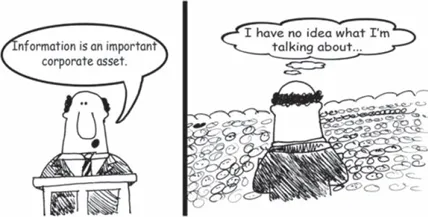
Is there an executive who will say “information is not an asset—it is a burden?” Is there an executive who does not want to “exploit” information? Probably not; if there is, give them a copy of this book. But take any businessperson who states information is an asset and make them explain it in realistic, comprehensible terms. Are there formal standards and policies deployed for creating, using, and disposing of all data and content? Not written down and ignored—but deployed. Does his/her company or division have a formal program to reduce or manage inherent risk in data? Does the CFO or CEO sign the Sarbanes–Oxley form every quarter with unabashed confidence? Ask him/her to explain the difference in accounting or balance sheets if information is treated like an asset, or it is not. This isn’t easily done. But if the asset metaphor is more than metaphor, these questions require better answers.
Information as an asset is the main theme of this book. Until data, information, and content are managed as other assets are managed, neither information nor data nor content has a chance to fulfill its potential or its role within organizations. There can be billions more spent on “exploiting” data. Buying Business Intelligence (BI) tools and replicating data and content many times in many places just increases the costs with little perceptible gain. It is wasted money unless you know what to exploit, where it comes from, and what it is worth to your enterprise. If you are going to do business or operate any organization in the twenty-first century, the asset metaphor needs to become the asset policy.
FORMAL ASSET TREATMENT
There is a lot of proof that data is valuable. But formalizing the management of data to make it more efficient and add value has been elusive. There are frameworks and guidelines and still, solid IM remains elusive. “An increasing amount of money is being spent on new technologies that will deliver even more information. Yet, neither the information nor the technology dollars are being consistently translated into business value.”1 We manage entire Information Technology (IT) portfolios as programs, we look for earned value and strive to find (ROI) on IT. But we totally miss the boat on the “stuff” that IT and all of the technology manages.
There are scores of “tools” to move and look at data, yet few businesspeople know how to truly handle data. There is access, literally, to more content than a human being can possibly comprehend, yet we still miss findings or fail to communicate critical conclusions. I believe the basic root of this problem is twofold:
1. We focus too much on the ROI and contribution of IT in general. However, IT is a label for a myriad of functions. We do not focus on what IT has to manage; i.e., data, content, information. All of the rules and tools are for the processes, not the product.
2. Organizations are too hung up on parables and metaphors as a technique to explain the real value proposition of IM. One of the core reasons for this book is to bypass metaphor and present a real foundation for value.
“Information Is an Asset” is an extremely common statement, and probably the most common information principle published within organizations. The subsequent explanation is that assets are managed, so information has to be managed. While this makes eminent sense, it does not sell or get IM efforts funded. Leadership is not impressed. The metaphor certainly starts the explanation process, but does not complete it. There have been several excellent books printed in the last few years that delve into the definition and explanation of the asset metaphor and offer a somewhat focused business justification. But the justification is anecdotal, and quantifiable results are scarce. We have plenty of examples of cool things that happened AFTER an organization took the risk to exploit data in some way. We have few examples where organizations embarked on a formal business-altering program that treats data and other content as a formally managed asset. There are also many books on the “value of IT,” or the return on technology investments. The emphasis is on program or portfolio management. This is a great start, but the raw material that is being handled, used, abused, and replicated has no formal oversight. The bottom line is we do not have a guide (hopefully until now) that instructs the business on creating and operating a formal program to create the opportunities to improve the value of your organization through information and content management.
Often CEOs will demand a precise business case. This can be done, and I will address the topic in a few chapters. But they also may want the business case to predict valuable usage—in effect, promise analytical “aha” moments. This is not unreasonable, but there is no way this can be done unless the care, feeding, and use of all enterprise content are understood as business issues.
EIM AND IAM EXPLAINED
Enterprise Information Management (EIM) is a program to treat data and all other types of enterprise information as assets. This book calls out the asset management concepts separately, and I will use the label IAM to separate these concepts from the EIM program. IAM represents the fundamental asset management concepts and processes to manage an asset—in this case, the asset of information vs. cash or a physical facility.
The program we have labeled EIM shows a company how to best weave those asset management concepts and best practices most effectively and efficiently into their core corporate business model. IAM represents the concepts and EIM is the program that implements those concepts.
We need to know what an EIM program, or the concept of IAM, does for us on a daily basis, what its value is, and what impact it would have on the balance sheet. We can always look at a financial statement and say “My, didn’t we do well!” If we get an “aha,” that’s great. But we cannot guarantee the “aha.” We also certainly cannot tie that financial result or “aha” moment to the data or content that we used to generate the result or have the flash of inspiration. How can we increase the chances of the “aha” moment? Right now it seems we can only justify and program the scenario to make the “aha” possible.
Does that make data and information mundane? No. I contend that when we weave EIM into the day-to-day fabric of a company, we see that the IAM concept can have value and assist us in managing the value of our content. A company does not want to flat out grab and store every single tidbit of data and hope for the “aha.” It is too expensive. We want the right amount of content and detail to use data to our advantage. So we need to not only acknowledge the asset metaphor, but also apply it.
AN EXAMPLE
Managing information at the enterprise level must be pragmatic. There is too much “shelf-ware technology” where long-term development of applications like data warehouse fails to align with the needs of shorter-term business cycles. Managing information assets must also be efficient. We will point out how and why an EIM program should not result in higher costs. But managing information is, in itself, strategic. Finished goods inventory, supply chains, and customer retention are all strategic processes. Information is in the same league, but it does not receive the same treatment. If EIM is to add value, and if the asset is real, then data and content must move into the strategic league.
To further understand the implications of information “inventory” asset management, we should “track” a “piece” of information inventory. We can contrast this with a “piece” of hard inventory, like an aluminum billet. (I chose an aluminum billet because many years ago, aluminum billets created great career angst for me.) A billet is a large chunk of something—in this case, aluminum—and we made doors, window frames, and the aluminum frames that go on the outside of buildings to hold glass and building-climbers.
The hard asset/soft asset comparison is given in Table 1.1.
We can beat this example up ad nauseam. For example, if the aluminum billet is of lower quality alloy, perhaps it is qualified. If the data is from a source that is less than reputable, perhaps it is also tagged as to its level of reliability. If the billet can be heated and improved, then the data can also be enhanced or changed to improve its usefulness.
Of course, any use of the billet is recorded. Eventually, it is melted down and made into appliances, door frames, or baseball bats. The data is also used. It is read, updated, and enriched. The one, and really irrelevant difference, is the data isn’t “used up.” Some experts will declare that this aspect of data means that information cannot be tracked along a value chain like other consumable items. However, this difference is insignificant. The billet is turned into valuable goods. The data is used to create value as well (business decisions, documents, and reports). The key...
Table of contents
- Cover
- Halftitle
- Title
- Copyright
- Dedication
- Contents
- Preface
- Acknowledgment
- About the Author
- Introduction
- Chapter 1 The Asset Called Information
- Chapter 2 Exploring the Challenges
- Chapter 3 Information Management Maturity
- Chapter 4 The Business Model
- Chapter 5 EIM Alignment
- Chapter 6 A Case for the Case
- Chapter 7 The EIM Business Case
- Chapter 8 The Economic Conundrum of Information
- Chapter 9 An Overview of the Process
- Chapter 10 Sustaining EIM and Culture Change
- Chapter 11 Sustain EIM and Business Alignment
- Chapter 12 Sustaining EIM and the Organization
- Chapter 13 Placing EIM into Real Context
- Chapter 14 Final Words for Part 1
- Chapter 15 Introduction to Part 2: EIM Overview for Managers
- Chapter 16 EIM Program Design Overview
- Chapter 17 Initiating the EIM Program Design
- Chapter 18 How to Read the Phase Chapters
- Chapter 19 Assessments
- Chapter 20 Alignment
- Chapter 21 Vision for EIM
- Chapter 22 Business Model
- Chapter 23 Architecture Part 1
- Chapter 24 Architecture Part 2
- Chapter 25 Architecture Part 3
- Chapter 26 Road Map
- Chapter 27 Sustaining EIM
- Chapter 28 Measuring EIM and the Value of Information
- Chapter 29 Down the Road
- Chapter 30 Final Word
- Appendix A Initiation Phase Summary and Work Products
- Appendix B Assessment Phase Summary and Work Products
- Appendix C Alignment Phase Summary and Work Products
- Appendix D Vision Phase Summary and Work Products
- Appendix E Business Model Phase Summary and Work Products
- Appendix F Architectures Phase Summary and Work Products
- Appendix G Road Map Phase Summary and Work Products
- Appendix H Sustaining Phase Summary and Work Products
- EIM Topics Bibliography
- Index
Trusted by 375,005 students
Access to over 1.5 million titles for a fair monthly price.
Study more efficiently using our study tools.
Frequently asked questions
Yes, you can cancel anytime from the Subscription tab in your account settings on the Perlego website. Your subscription will stay active until the end of your current billing period. Learn how to cancel your subscription
No, books cannot be downloaded as external files, such as PDFs, for use outside of Perlego. However, you can download books within the Perlego app for offline reading on mobile or tablet. Learn how to download books offline
Perlego offers two plans: Essential and Complete
- Essential is ideal for learners and professionals who enjoy exploring a wide range of subjects. Access the Essential Library with 800,000+ trusted titles and best-sellers across business, personal growth, and the humanities. Includes unlimited reading time and Standard Read Aloud voice.
- Complete: Perfect for advanced learners and researchers needing full, unrestricted access. Unlock 1.5M+ books across hundreds of subjects, including academic and specialized titles. The Complete Plan also includes advanced features like Premium Read Aloud and Research Assistant.
We are an online textbook subscription service, where you can get access to an entire online library for less than the price of a single book per month. With over 1.5 million books across 990+ topics, we’ve got you covered! Learn about our mission
Look out for the read-aloud symbol on your next book to see if you can listen to it. The read-aloud tool reads text aloud for you, highlighting the text as it is being read. You can pause it, speed it up and slow it down. Learn more about Read Aloud
Yes! You can use the Perlego app on both iOS and Android devices to read anytime, anywhere — even offline. Perfect for commutes or when you’re on the go.
Please note we cannot support devices running on iOS 13 and Android 7 or earlier. Learn more about using the app
Please note we cannot support devices running on iOS 13 and Android 7 or earlier. Learn more about using the app
Yes, you can access Making Enterprise Information Management (EIM) Work for Business by John Ladley in PDF and/or ePUB format, as well as other popular books in Computer Science & Business Intelligence. We have over 1.5 million books available in our catalogue for you to explore.