- 46 pages
- English
- ePUB (mobile friendly)
- Available on iOS & Android
eBook - ePub
About this book
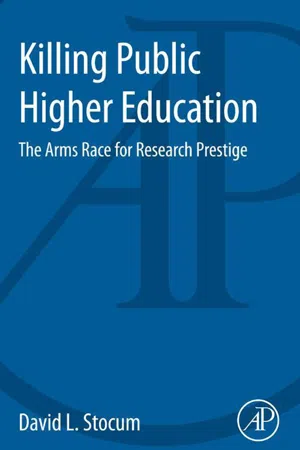
This is an opinion piece from a highly qualified professor of science who has served in administration highlights the need for reform in our public higher education research institutions. In this well-researched reference, Dr. Stocum illustrates how the competition among the public flagship universities for more money, research prestige, and power, and the imposition of mission differentiation on public universities, is detrimental to the educational needs of 21st century. The goal of the work is to expose the issues that exist, give a voice to under-recognized institutions and to provide suggestions for more effective education system moving forward.
- A well researched reference on widespread policy
- Offers insightful reflection based on first-hand experience
- Examines and proposes solutions to ignite the conversation and promote possible solutions to the problems in our present higher education structure
Information
Topic
EducationSubtopic
Education GeneralKilling Public Higher Education
The Arms Race for Research Prestige
Introduction
In 1968, armed with a PhD from a distinguished private research university, the University of Pennsylvania, I began a faculty career in a public flagship research university, the University of Illinois at Urbana-Champaign (UIUC). Two decades later, I became dean of science at a large urban public university, Indiana University-Purdue University at Indianapolis (IUPUI), a position I held for 15 years. The contrast between these two types of public universities brought into sharp focus for me the fact that American public higher education is a caste system disguised under the euphemism of “mission differentiation.” The system is dominated in each state by one or two massive flagship universities characterized by a culture of snobbish exclusivity and entitlement that compete in a frantic arms race for money and research prestige rankings. The flagships treat their subordinate campuses and other state-supported universities with patronizing condescension, if not outright contempt.
In this essay, I argue that whereas research itself is an important function of universities, the competition among the public flagships for more money, research prestige, and power, and the imposition of mission differentiation on their subordinate and other public universities, is dysfunctional and does not well serve the needs of our society in the twenty-first century. The addiction to research prestige is a chronic impairment that contributes to the ever-increasing costs of higher education and the devaluing of undergraduate education. This problem has been extensively documented, particularly over the past 20 years, it can no longer be denied even by the most ardent apologists and cannot be solved by schemes to preserve the status quo or by tweaking around the edges. The most viable solution is a fundamental restructuring of public higher education in which the flagships play a less dominating role and imposed mission differentiation is ended. This will require the flagships (as well as other state universities who wish to emulate them) to make undergraduate education a much higher priority, make research significance per se, not research prestige rankings the objective, and be willing to collaborate in state and regional educational and research networks to produce the kinds of graduates and new knowledge that states, and the nation and society in general, need to flourish.
This text evolved from two previous publications by the author (Stocum, 2000, 2001). While writing it, I read the book titled Higher Education? How Colleges Are Wasting Our Money and Failing Our Kids—and What We Can Do About it by Andrew Hacker and Claudia Dreifus (2010). This volume is the broadest treatment of the good, the bad, and the ugly in higher education today, and I recommend it to anyone interested in the subject.
The Addiction to Research Prestige Contributes to the Increasing Costs of Higher Education
Tuition fees at all state-supported universities has increased at rates far greater than the rise in household income or the consumer price index over the past two decades. Many graduates are entering a weak job market carrying heavy debt and a feeling of having been shortchanged academically. The drivers of the tuition increases have been enumerated many times: declining state support, increasing salaries and benefits of administrators and faculty (although increases for the latter pale in comparison to those of the former), yearly increases in the cost of health insurance, subsidies for athletic programs, and legal fees (Hacker and Dreifus, 2010; Kamenetz, 2010a; Schrecker, 2010). Then there is the increasing specialization and proliferation of administrative positions with their attendant staff that did not exist three, or even two, decades ago, to promote the interests of various student groups, enforce an ever-increasing number of regulatory compliances (Lesher and Fluharty, 2012), and generate numbers for every conceivable category of university operations that might convince state legislators of university accountability, and influence national rankings (Tuchman, 2009). These cost drivers need to be addressed and reduced.
All types of public universities have shown similar percentage increases in tuition fees over the past decade. However, the absolute amount of tuition charged by public flagships is substantially more than universities lower in the caste system, and this differential is related to their extensive research and graduate education programs. In addition, many public flagships actively recruit significant numbers of out-of-state and international students who they charge two to three times more tuition than in-state students, thus creating a large gap in tuition revenue between themselves and other state institutions that cater mainly to in-state students.
The addiction to research prestige is a driver of tuition increases in flagship universities because it is costly and tightly coupled to the tenure and promotion system (see Hacker and Dreifus, 2010, and many others). To obtain tenure and advance in rank, professors must obtain research grants that result in an acceptable output of peer-reviewed articles. The direct costs of a typical grant provide salaries and benefits to professors, graduate students, and postdoctoral fellows, as well as for the purchase of equipment and supplies. There is, however, good grant money and bad grant money. Good grant money is that which adds indirect cost recovery (ICR) income of over 50% of personnel costs to each grant to defray the overhead costs of administration, space, energy, and water required to conduct the research. Bad grant money pays only the direct costs of research. Deans control most of the ICR funds and use them for any number of research-related purposes, such as laboratory start-up funding for newly-hired professors or to help pay for new or renovated space. In the science, technology, engineering and mathematics (STEM) disciplines, start-up costs can range from minimal (mathematics) to hundreds of thousands and even millions of dollars for research in biology, chemistry, physics, and computer science. Millions more are put into the construction of new facilities, banking on a steady stream of ICR income from faculty-generated grants over an extended period of time. In the past, many new facilities at private research universities have been built by negotiating ICR rates of over 100%.
Although grants are one of the three to four main revenue streams of research universities, they never cover the total costs of research. Tuition and fee income and state appropriations, which are intended primarily to support undergraduate education, are also used to support research. Part of the tuition and state appropriation income at research universities is used to employ highly-paid vice presidents and vice chancellors for research and their assistants to develop and implement research strategies and policies, as well as to support deans of graduate schools and their staff to do the same for graduate programs. In addition, grants and contracts units are essential to process grant proposals and awards and keep track of grant accounts. Collectively, these functions are a significant cost driver.
Another cost driver is the fact that research faculty teach less in order to free up the time required to continually write multiple grant proposals and supervise the research of postdoctoral fellows and graduate students. Rather than hire full-time faculty to fill in the instructional gaps, research universities hire nontenure-track part-time faculty to save money. According to a report by the American Association of Colleges and Universities (AACU), 68% of the faculty positions at all degree-granting institutions are nontenure-track appointments; the figure is 48% at public doctoral-granting/research universities (Bergom and Waltman, 2009). Many of these faculty members are excellent teachers, but they carry heavy work responsibilities, are paid much less on average than tenure-track faculty, have few or no health benefits, and get little respect within their universities. Among tenure-track faculty members, those who have successful research programs are paid much more and command more respect than those who focus on teaching or service. These differentials in prestige have led to significant disparities in salary and benefits for the same academic ranks within institutions, leading to the creation of two-tier faculties. Across institutions, these disparities follow exactly the mission differentiation hierarchy of flagship: secondary research university: comprehensive university: community college.
The situation is becoming even more exacerbated as the competition for research grants gets ever more intense in the face of static, or even potentially decreasing, federal research budgets. Although rigorous selection keeps turnover of tenure-track faculty relatively low at flagships, assistant professors who cannot get grants or fail to publish the requisite number of papers within 5 years are denied tenure and their positions are terminated. They are replaced by new research assistant professors, most likely at higher salaries an...
Table of contents
- Cover image
- Title page
- Table of Contents
- Copyright
- Acknowledgments
- About the Author
- Killing Public Higher Education: The Arms Race for Research Prestige
Trusted by 375,005 students
Access to over 1.5 million titles for a fair monthly price.
Study more efficiently using our study tools.
Frequently asked questions
Yes, you can cancel anytime from the Subscription tab in your account settings on the Perlego website. Your subscription will stay active until the end of your current billing period. Learn how to cancel your subscription
No, books cannot be downloaded as external files, such as PDFs, for use outside of Perlego. However, you can download books within the Perlego app for offline reading on mobile or tablet. Learn how to download books offline
Perlego offers two plans: Essential and Complete
- Essential is ideal for learners and professionals who enjoy exploring a wide range of subjects. Access the Essential Library with 800,000+ trusted titles and best-sellers across business, personal growth, and the humanities. Includes unlimited reading time and Standard Read Aloud voice.
- Complete: Perfect for advanced learners and researchers needing full, unrestricted access. Unlock 1.5M+ books across hundreds of subjects, including academic and specialized titles. The Complete Plan also includes advanced features like Premium Read Aloud and Research Assistant.
We are an online textbook subscription service, where you can get access to an entire online library for less than the price of a single book per month. With over 1.5 million books across 990+ topics, we’ve got you covered! Learn about our mission
Look out for the read-aloud symbol on your next book to see if you can listen to it. The read-aloud tool reads text aloud for you, highlighting the text as it is being read. You can pause it, speed it up and slow it down. Learn more about Read Aloud
Yes! You can use the Perlego app on both iOS and Android devices to read anytime, anywhere — even offline. Perfect for commutes or when you’re on the go.
Please note we cannot support devices running on iOS 13 and Android 7 or earlier. Learn more about using the app
Please note we cannot support devices running on iOS 13 and Android 7 or earlier. Learn more about using the app
Yes, you can access Killing Public Higher Education by David L. Stocum in PDF and/or ePUB format, as well as other popular books in Education & Education General. We have over 1.5 million books available in our catalogue for you to explore.