eBook - ePub
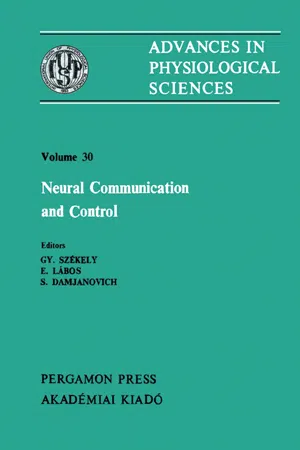
Neural Communication and Control
Satellite Symposium of the 28th International Congress of Physiological Science, Debrecen, Hungary, 1980
- 350 pages
- English
- ePUB (mobile friendly)
- Available on iOS & Android
eBook - ePub
Neural Communication and Control
Satellite Symposium of the 28th International Congress of Physiological Science, Debrecen, Hungary, 1980
About this book
Advances in Physiological Sciences, Volume 30: Neural Communication and Control is a collection of papers presented at the 1980 satellite symposium of the 28th International Congress of Physiological Science, held in Visegrá Hungary. This volume is composed of 26 chapters and begins with a description of nervous elements and systems on the phylogenetic scale. The succeeding chapters review studies on the excitable membrane, the properties of a single neuron, of small and large neuronal ensembles and of systems of increasing complexity, considering physiological and anatomical aspects, as well as experimenting and modeling. Other chapters explore the whole-brain function based on a conscious experience. The remaining chapters examine the understanding the neural basis of cognitive experience through experiment on evaluative cognitive agency in "split-brain" patients. This book is of value to physiologists, neurologists, and researchers.
Information
A COMPARATIVE NEUROLOGIST’S VIEW OF SIGNALS AND SIGNS IN THE NERVOUS SYSTEM
Theodore Holmes Bullock, Neurobiology Unit, Scripps Institution of Oceanography and Department of Neurosciences, School of Medicine, A-001 University of California, San Diego, La Jolla, CA 92093, USA
Publisher Summary
This chapter presents a comparative neurologist’s view of signals and signs in the nervous system. All neural systems consist of small components as the actual sensing and reacting elements. Chemical signs are generally the release of something if it’s an organic molecule or else movement in either direction if it’s an ion. Neurons have a lot of ways of responding. This reflects two different kinds of diversity;(1) diversity of types of neurons, and (2) multiplicity of substances released from single neurons. Neurons can release more than one transmitter, along with one or more modulators, several metabolites and sometimes proteins, neurosecretory, or other special products. There is a variety of synaptic potentials; not only excitatory and inhibitory consequences distinguish them but also several other properties. Some have a passive decay and are monophasic, others have a convex, partly active, decremental falling phase, and some are distinctly biphasic. Some are facilitating, others anti-facilitating and there can be fast and slow phases of these effects of history. There are three levels of interaction of neurons recognized, at least in mammals and believed to be general among vertebrates and higher invertebrates. In Floyd Bloom’s formulation, there are levels of (i) macrocircuits of sensory, motor, and association connections, (ii) microcircuits or local circuits operating within the macrocircuits, and (iii) modulatory macrosystems superimposed on both, such as the noradrenaline locus coeruleus system, the 5-hydroxytryptamine raphe system, and the dopamine medial forebrain bundle system.
I INTRODUCTION: AIMS, SLANT AND SCOPE
I take it one of the prime questions in the communication aspect of neurobiology is “what are the signals actually employed in neural systems?”
I take it we must look for them by measuring signs that something has been communicated. Therefore, an essential question that we must answer first, in order to come to the previous one is “what are the signs given by small components of the system?” The qualification “small components” is necessary merely to remind us that all neural systems, as far as we know, consist of small components as the actual sensing and reacting elements. I am not ruling out, you’ll note, that a massed potential for example from a piece of cortex could be a signal, but only reminding you that what detects and responds is not the cortex but cells of the cortex.
The aims of this modest piece are to ask these two questions, in sequence.
I take it that our brain is the product of a lot of evolution. Indeed it would seem obvious that no other system has come such a long way from the level exemplified in coelenterates, flatworms or even insects and gastropods to that of Einstein or Shakespeare, as has the nervous system. Therefore, it behooves us to maintain perspective and I propose to examine the two questions “What are the signs of response in small components of the nervous system?” and “What are the signals actually employed in neural systems?” from a comparative standpoint. It is not only that we can expect clues and leads by studying simpler systems, or that some favorable material like the squid giant axon may help, but in addition the perspective itself, the act of comparing, the effort to discern trends or at any rate differences is sure to reveal insights we would miss otherwise.
Further to expose my biases at the outset, the slant here will be pluralist, eclectic and empirical. That means I would rather notice and list than to overlook a phenomenon that could be a relevant sign or signal even if I can not explain it or fit it into a theoretical framework such as the sodium theory. I want to encourage theory and the development of a systematic frame of reference but even more I want to be sure we don’t overlook relevant phenomena when we erect such structures. I believe that as scientists we commonly exhibit our human limitations, one of which is a willingness to pay attention only to certain aspects of reality that impress us for some reason and to overlook or to take for granted, as not worth remark, a great deal that may be quite germane but is outside of our normal domain of discourse.
The scope of my effort today will be limited to those levels of neural events between major parts of a cell at a lower level and major parts of the brain at my upper limit. That means drawing lines to exclude molecules and organelles and membranes at one end and complex behavior, mentation or conscious experience at the other.
So much for aims, premise, slant and scope. Let me turn to the first question, about signs, that is, forms of response in cells and normal arrays of cells.
II SIGNS: FORMS OF RESPONSE
The main result of a survey of animals, high and low, is that almost every possible sign is either to be found or is probable. I don’t know of a nerve cell that luminesces or moves its pigment granules but the three main classes of response: chemical, electrical and physical are each represented by diverse specific examples.
Chemical signs are generally the release of something if it’s an organic molecule or else movement in either direction if it’s an ion. I wonder whether the former is limited to release just because it would be difficult to detect a transient uptake of a small quantity. What we can say, as a result of recent developments, is that the list of chemicals released in response to stimuli is long. There are not only the half dozen or so transmitters but a longer list of maybe fifteen or more different modulators and in addition a variety of metabolic by-products. Proteins are released by some nerve cells, so that the potential exists for a much longer list of specific substances. It’s not my purpose to discuss the substances, the circumstances that cause their release or the meaning of the release, because the point that deserves emphasis here is that neurons have a lot of ways of responding. It now appears clear that this reflects two different kinds of diversity. One is diversity of types of neurons – a diversity far larger than we used to think. The other is perhaps even farther from the usual textbook view, namely a multiplicity of substances released from single neurons. It is widely agreed now that neurons can release more than one transmitter, plus one or more modulators, plus several metabolites and sometimes proteins, neurosecretory or other special products.
Our knowledge of most of these classes of substances in invertebrates is meager but it does permit us to say that variety of substances is not a monopoly of vertebrates. There may well be a flowering in the vertebrates, increasing the number of substances but we don’t know that for sure.
Electrical signs have classically been given as synaptic potentials leading to spikes which are essentially all alike. The evidence today requires us to paint quite a different picture. First, there is a variety of synaptic potentials; not only excitatory and inhibitory consequences distinguish them but several other properties. Some last about a millisecond, others up to at least ten. Some have a passive decay and are monophasic, others have a convex, partly active, decremental falling phase and some are distinctly biphasic. Some are facilitating others antifacilitating and there can be fast and slow phases of these effects of history. Amplitudes of course can be from vanishingly small up to an overshooting 100 mv.
Then there is a whole spectrum of non-classical potentials such as the ILD’s – inhibitions of long duration. Hyperpolarizations and depolarizations can be associated, not only with increased conductance, but with decreased conductance and possibly increased pump action. There is a class of relatively unfamiliar potentials called plateau potentials in which a neuron acts as though it has two states and can be flipped between them; one input flips it to the depolarizing plateau and another flips it back. There are also other examples of regenerative hyper- or repolarizations, opposite in sign to the classical spike.
We musn’t forget the local potential, a graded, local, active but not regenerative event. This may be important in axonal terminals and other situations, indeed in many axons it is one of the normal forms of action and in some the only form. These are the spikeless neurons. They are not necessarily amacrine, not even necessarily short axon neurons in the usual sense of intrinsic, Golgi type II cells with axons a few hundred microns long. The best studied spikeless neuron is in the legs of crabs and has a large axon from a centimeter to several centimeters long, depending on the size of the animal.
A special form of graded and local potential that might be quite important but is little known even phenomenologically is the potential between points on the same cell, for example between dendrites and axon. How general this is or how large or how it changes with time and activity are hardly even studied since Gesell (1940) claimed its importance more than forty years ago. I for one regard it as a neglected and possibly major cellular state variable which might be both an effect and a cause.
Finally, there is a major category of potentials which is probably not one class in terms of mechanism, but heterogeneous. These are the oscillatory and more or less spontaneous potentials. They vary from extremely rhythmic to highly stochastic, from continuous, on-going autochthonous series to rapidly damped ringing, from nearly sinusoidal to quite spike-like. They may be signs of discrete inputs or of the prevailing steady state. They may act as though a single periodic process is at work or like relaxation oscillators.
In short, the variety of electrical signs is formidable. Like the chemical, they differentiate a variety of distinct cell types but at the same time, a given neuron can use several of these forms of electrical signs.
Notice that I have often used the word “cell” instead of neurons. This is to include the possibilities that glial cells may participate in some of the responses or signs of stimulation.
Evoked potentials and ongoing potentials recorded from organized arrays of cells and gross brain structures are also signs of response and of activity states. They are presumably the volume conducted sum of cellular events of all the just mentioned kinds dependent not only on the mix of kinds but also on the relative timing or synchrony and on the geometry of the cells and processes. There might also be contributions from other sources such as vascular streaming potentials, potentials due to accumulation of ions in intercellular spaces, glial cell membrane potentials, and potentials between cerebrospinal fluid and intercellular fluids. These sources are primarily steady or only slowly changing and hence may contribute little directly to the conventionally filtered evoked or ongoing potentials of the brain. But some of them might on occasion change rapidly enough and the slow and infraslow potentials might be indirectly signs of brain states because the events of higher frequency content might depend on the level of standing potential. I would like to underline that evoked potentials are facultative, or may I say optional products of a mass of cells, not an obligate or predictable ouput. We have various examples where no e.p. is seen although cells are very active – e.g. the inferior colliculus of dolphins stimulated with sonic frequencies; dolphins have nevertheless good e.p.’s in the cortex.
Mechanical signs of neural activity are the least familiar and it is something of a guess on my part that future research will uncover more examples both in respect to locus in the nervous system and to form of response. What we know is that in situations favorable for observation, movements and changes in dimensions can take place in the processes of neurons, as well as of glial cells. This is not the place to review the evidence, which is fragmentary, sparse and cannot in general be confidently extrapolated to gross movement of ordinary brain cells in situ. Suggestive evidence comes from tissue culture; some comes from organ culture or from small autonomic ganglia in the periphery. The ubiquity of cytoplasmic streaming, axoplasmic movement, mitochondrial active movement, changes in optical state of membranes and the like are all suggestive. Optical changes in axons do not always or necessarily mean dimensional changes but at least some are believed to. Dimensional changes in synapses are well established over periods of time adequate for sensory deprivation or enriched experience to act. It may seem maladaptive for a functioning, normal brain to permit cellular movements unless as part of a systematic learning process or lasting effect of environment. Nevertheless, I am betting that various forms of shifts, changes in shape, and in approximation of parts of separate cells are taking place in my brain right now, even if it doesn’t help!
So much for a natural history of signs of response, symptoms of activity, or consequences of stimulation by signals received.
III SIGNALS ADEQUATE TO INDUCE RESPONSE, HENCE TO CARRY INFORMATION
These are the prerequisites for addressing our second question, which was “What are the signals actually employed in neural systems?” Unless there are other signs of activity, not detectable by the methods used, it is from the foregoing list that we can expect to find the forms of activity that act as signals. Signals will be those signs that can normally influence another cell. We suppose that they are a subset of the list of signs, some of which are presumably epiphenomena like the noise of your automobile – a sign to us but not an effective signal to any part of the automobile.
The results of canvassing the candidate signals for evidence that they can normally be causes and not only effects are by no means all in; we don’t know the answer in the cases of many particular candidates. But there is enough evidence in to permit the conclusion that not a few but many of the substances including transmitters, modulators, ions and many metabolities, as well as many of the forms of current whose potentials we record, are physiological signals. It remains to evaluate where and to what effect some hormones, neurosecretions, CO2, pH, ions and several known as well as suspected transmitters and modulators are actually used normally. Extrapolation from one demonstrated case to others not directly tested is unsafe. The same is true for most field potentials, electroretinograms, evoked potentials and EEG waves.
Good evidence implicates field potentials as causative on the Mauthner cell axon hillock, where fine axonal terminals of the axon cap exert a hyperpolarizating effect without any EM synaptic contacts. Most fibers of the cap are several microns or even tens of microns from the Mauthner cell surface and yet are effective. I think it likely that the axon cap of Mauthner’s cell is a precedent for a l...
Table of contents
- Cover image
- Title page
- Table of Contents
- ADVANCES IN PHYSIOLOGICAL SCIENCES
- Copyright
- PREFACE
- OPENING REMARKS
- Chapter 1: A COMPARATIVE NEUROLOGIST’S VIEW OF SIGNALS AND SIGNS IN THE NERVOUS SYSTEM
- Chapter 2: MACROMOLECULAR DYNAMICS AND INFORMATION TRANSFER
- Chapter 3: MEMBRANE CURRENT FLUCTUATIONS AND NEURONAL INFORMATION PROCESSING
- Chapter 4: INFORMATION PROCESSING IN ABNORMALLY DISCHARGING NEURONS
- Chapter 5: SYNAPTIC INTERACTION ON PYRAMIDAL CELLS
- Chapter 6: CORRELATION FUNCTIONS AS TOOLS FOR ANALYSIS
- Chapter 7: FIRING SYNCHRONY IN A NEURAL GROUP: PUTATIVE SENSORY CODE
- Chapter 8: NEURAL REPRESENTATION OF SENSORY STIMULI AND SENSORY INTERPRETATION OF NEURAL ACTIVITY
- Chapter 9: OPTIMAL DESIGN OF NEURONAL NETWORKS
- Chapter 10: ANALYSIS OF NEURAL NETWORKS
- Chapter 11: SIGNIFICANCE OF THE DENDRITIC PATTERN IN THE FUNCTION OF THE NEURON
- Chapter 12: NEURAL CIRCUITS FOR GENERATING RHYTHMIC MOVEMENTS
- Chapter 13: A MODEL FOR INTERLIMB COORDINATION IN VERTEBRATE LOCOMOTION
- Chapter 14: TOPOGRAPHIC ORGANIZATION: A VIEW BASED ON STRIPED FROG TECTA
- Chapter 15: THE FORMATION OF CONTINUOUSLY ORDERED MAPS: EVIDENCE FROM COMPOUND EYES IN XENOPUS
- Chapter 16: NEURAL MODELS OF VISUOMOTOR INTEGRATION IM AMPHIBIANS
- Chapter 17: COMPLEX INTEGRATIVE PROPERTIES OF THE CEREBELLAR PURKINJE CELL SUGGEST TO POSTULATE AN ASYMMETRIC ORGANIZATION IN THE DENDRITIC INPUT
- Chapter 18: EXPERIMENTAL TESTS OF CONSTRUCTIVE MODELS OF THE CEREBELLUM
- Chapter 19: MULTIPLE OVERLAPPING CIRCUITS WITHIN OLFACTORY AND BASAL FOREBRAIN SYSTEMS
- Chapter 20: PRENATAL FORMATION OF SYNAPSES AND DENDRITIC SPINES IN GUINEA-PIG CORTEX AND THEIR POSTNATAL CHANGES
- Chapter 21: A SELECTION OF FACTS AND CONJECTURES ABOUT THE CEREBRAL CORTEX INSPIRED BY THE THEORY OF CELL ASSEMBLIES
- Chapter 22: OCULOMOTOR AND COGNITIVE ASPECTS OF VISUAL PERCEPTION
- Chapter 23: PSYCHOLOGICALLY DETERMINED RECEPTIVE FIELDS IN MONOCULAR AND BINOCULAR TEXTURE PERCEPTION
- Chapter 24: NEURAL BASIS OF COGNITIVE EXPERIENCE
- Chapter 25: GENERAL DISCUSSION: WHERE ARE THE GROWING POINTS?
- Chapter 26: GENERAL REFLECTIONS ON THE ACCOMPLISHMENTS OF THE CONFERENCE
- INDEX
Trusted by 375,005 students
Access to over 1.5 million titles for a fair monthly price.
Study more efficiently using our study tools.
Frequently asked questions
Yes, you can cancel anytime from the Subscription tab in your account settings on the Perlego website. Your subscription will stay active until the end of your current billing period. Learn how to cancel your subscription
No, books cannot be downloaded as external files, such as PDFs, for use outside of Perlego. However, you can download books within the Perlego app for offline reading on mobile or tablet. Learn how to download books offline
Perlego offers two plans: Essential and Complete
- Essential is ideal for learners and professionals who enjoy exploring a wide range of subjects. Access the Essential Library with 800,000+ trusted titles and best-sellers across business, personal growth, and the humanities. Includes unlimited reading time and Standard Read Aloud voice.
- Complete: Perfect for advanced learners and researchers needing full, unrestricted access. Unlock 1.5M+ books across hundreds of subjects, including academic and specialized titles. The Complete Plan also includes advanced features like Premium Read Aloud and Research Assistant.
We are an online textbook subscription service, where you can get access to an entire online library for less than the price of a single book per month. With over 1.5 million books across 990+ topics, we’ve got you covered! Learn about our mission
Look out for the read-aloud symbol on your next book to see if you can listen to it. The read-aloud tool reads text aloud for you, highlighting the text as it is being read. You can pause it, speed it up and slow it down. Learn more about Read Aloud
Yes! You can use the Perlego app on both iOS and Android devices to read anytime, anywhere — even offline. Perfect for commutes or when you’re on the go.
Please note we cannot support devices running on iOS 13 and Android 7 or earlier. Learn more about using the app
Please note we cannot support devices running on iOS 13 and Android 7 or earlier. Learn more about using the app
Yes, you can access Neural Communication and Control by Gy. Székely,E. Lábos,S. Damjanovich in PDF and/or ePUB format, as well as other popular books in Biological Sciences & Zoology. We have over 1.5 million books available in our catalogue for you to explore.