
- 296 pages
- English
- ePUB (mobile friendly)
- Available on iOS & Android
eBook - ePub
Client-Side Attacks and Defense
About this book
Client-Side Attacks and Defense offers background networks against its attackers. The book examines the forms of client-side attacks and discusses different kinds of attacks along with delivery methods including, but not limited to, browser exploitation, use of rich internet applications, and file format vulnerabilities. It also covers defenses, such as antivirus and anti-spyware, intrusion detection systems, and end-user education. The book explains how to secure Web browsers, such as Microsoft Internet Explorer, Mozilla Firefox, Google Chrome, Apple Safari, and Opera. It discusses advanced Web attacks and advanced defenses against them. Moreover, it explores attacks on messaging, Web applications, and mobiles. The book concludes with a discussion on security measures against client-side attacks, starting from the planning of security. This book will be of great value to penetration testers, security consultants, system and network administrators, and IT auditors.
- Design and implement your own attack, and test methodologies derived from the approach and framework presented by the authors
- Learn how to strengthen your network's host- and network-based defense against attackers' number one remote exploit—the client-side attack
- Defend your network against attacks that target your company's most vulnerable asset—the end user
Information
Chapter 1
Client-Side Attacks Defined
Information in this chapter:

One of the bigger threats that users will face today is client-side attacks that expose the vulnerability of the end user and his or her system. Over the last five years the amount of client-side attacks has increased dramatically leading to a statement by the SANS Institute that this type of attack represents historically one of the most critical Internet security vulnerabilities in existence.
In the past attackers wishing to cause harm, damage, or expose sensitive data would generally go after the servers themselves using a class of attacks known collectively as server-side attacks. These attacks were successful because in the past, the servers themselves were not as well defended as they are today. With new security advances, methodologies and processes, this is no longer the case. The server-side attack is now severely limited by security professionals putting an enhanced focus on edge security, securing the network and vendors of products writing and producing better products for safeguarding key systems. Because the attack vector has been protected, hackers and attackers had to find a new route in.
Since the server-side (and in adversely the network-side) became the focus and were better protected, the applications used on the servers and the systems in which use the applications became the new target. In sum, applications that exist on the server-side and the vulnerabilities associated with them are better understood and defended, so attackers have shifted their focus to the desktop environment and the weaknesses found there.
Whereas server-side attacks seek to compromise and breach the data and applications that are present on a server, client-side attacks specifically target the software on the desktop itself. Applications such as web browsers, media players, email clients, office suites, and other such applications are all prime targets for an attacker. This also does not encompass many of the in-house developed applications that are widely used in many organizations worldwide. Home-grown or applications built in-house add other items to the mix due to the fact that applications that fit into this category may not undergo any sort of formal security testing. It also doesn’t take into account that a server system is easier to patch, protect and monitor then the many clients that attach to it as well as the even more diverse operating systems that are used. Multiply that by the amount of different applications used and you can see that the problem grows exponentially making this a difficult problem to solve. The wide and diverse range of software present on the desktop in an organization presents a large target for attackers and a major concern for the security professional. In fact for the security professional overlooking the client-side attack is an easy way to miss one of the single most dangerous mechanisms for impacting security in an organization. Figure 1.1 shows an example of a typical client-side attack.
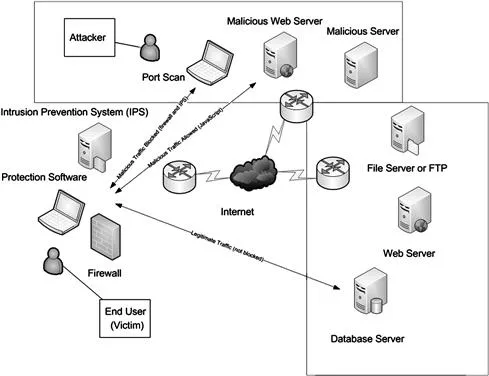
Figure 1.1 An Example of a Typical Client-Side Attack
Note
Servers in the context of this text will refer to the environment that is hosted on a specialized system designed to service users and respond to requests of various types. The server environment can and does include server based applications such as those that provide streaming audio and video, serve documents, and perform ecommerce functions to name just a few. While servers will be covered in this text at various points they are not the main focus of this text as our intention is to focus on attacks on the client-side. The server-side environment represents a tremendous level of complexity and other issues that exceed the scope of this book and therefore will only be covered as they relate to client-side attacks.
In this book we will examine what constitutes a client-side attack, the different types of attacks, how they work, and how to defend against them in the real world. While every type of attack that is available cannot be covered in this text, we will review the most common. In advanced chapters we will highlight more complex attacks. By learning about the most common and more complex attacks, you will gain a better understanding of how these attacks work and in turn be able to protect against them more effectively in the future. It is also important to note that new security flaws are found each day as more and more applications are upgraded, rolled out and created (see Figure 1.2).
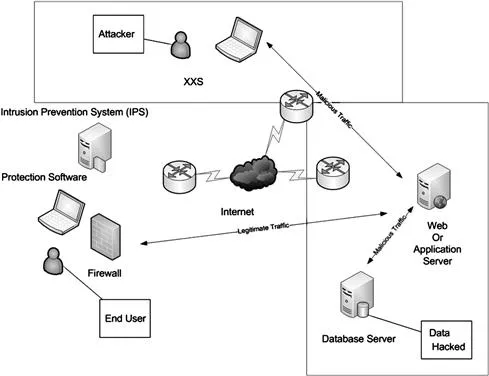
Figure 1.2 An Example of a Cross-Site Scripting (XSS)
Note
In this text we will use both terms “client” and “user” to refer to the recipient on the other side of the connection from the server. In the context of this book “client” shall refer to the system itself to include the carbon-based element operating it while “user” will refer to the individual alone that is operating the computer system. While both the “client” and “user” can be and are victims of attacks both can be targeted in different ways which will be illustrated throughout this text.
Client-Side Attacks: An Overview
While we will cover more about what constitutes a client-side attack in Chapter 2, Chapter 1 provides a basic overview. We will then move on to cover attacks in more detail in later chapters. Later chapters will explain more in depth why the client is susceptible to attacks and how the attacker is able to manipulate the system so easily, whether it be a code flaw or lack of security applied to the operating system as example. It is important for us to first take a high level look at these classes of attacks and what makes them possible. In order to better understand client-side attacks it is worthwhile where applicable to compare and contrast them with their well-known cousins known as server-side attacks (see Figure 1.3).
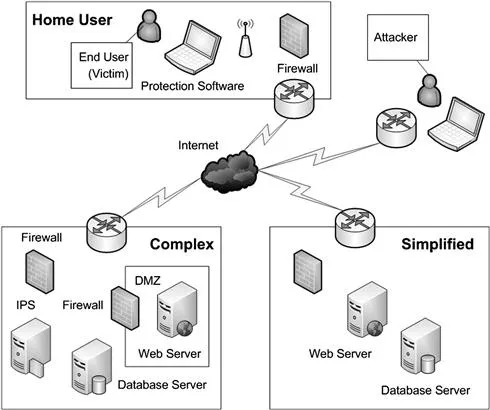
Figure 1.3 Basic Security Architecture
As mentioned previously attackers have traditionally concentrated their attacks on the server-side and the applications, data, and services hosted there. During normal operation a server-side application and the server itself will expose several types of services that will vary depending on the intended role of the server (i.e. document management or streaming video). Each service that a server exposes to the world is one more potential target that an attacker can exploit for whatever purpose they may have in mind. Even with a simple web-server that hosts static content the possibility of attack is present as there are services running that can be exploited. Add to a web-server the ability to host dynamic content such as Java Server Pages (JSP), Active Server Pages (ASP), or even Hypertext Preprocessor (PHP) and the situation gets even worse as even more services with their potential vulnerabilities are layered upon one another. These server-side scripting languages are often used provide dynamic content are generally embedded directly into the HTML code used to produce the pages you view, which also run scripts that could execute commands as an example (see Figure 1.4).
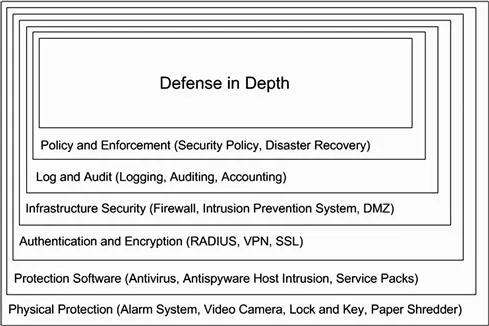
Figure 1.4 Defense in Depth
Note
Remember that even though this book focuses on the client-side attacks it is important to note that server-side attacks are still of strategic value and depending on their desired outcome an attacker may opt to use server-side attacks instead. For example, attacks such as format string, input validation and others may yield useful info from a victim that client-side attacks cannot achieve successfully. Other attacks such as the well-known SQL injection have client-side counterparts that are similar in nature, but achieve different results depending on whether the target is a client or server. Additionally modern technologies such as Google Gears and HTML 5 have not only made the web a more exciting place, but they have also made previous attacks more dangerous and likely.
Never forget that an attacker will typically have multiple tricks in their toolkit and will use whatever is perceived to get the best results at a given time. It is for this reason that you must always properly assess your vulnerabilities and put measures in place to mitigate the risk accordingly.
The list of potential vulnerabilities available on a server and its services is a long one, but some of the more common ones are:
• Malicious HTTP requests: This includes improperly formed or what are known as illegal arguments in an HTTP request. These are generally executed to trick an end user into thinking they are accessing legitimate code, which in reality malicious code (malcode) is being “smuggled” into the equation. HTTP Request Smuggling (or HRS) is used between a client and an application server and commonly executed when there is a proxy system in between.
• Buffer overflows: Vulnerabilities of this type are common in software and regularly exploited by savvy attackers. These are generally executed to produce a Denial-of-Service (DoS) attack to prevent legitimate connections from taking place by flooding buffers with bogus requests.
• Scripting errors and attacks: As will be introduced chapter 2, scripting errors take advantage of handling or coding errors to enact an attack against a client. This can be done via scripting languages such as JavaScript, VBScript, Flash scripting, and others. Cross-site scripting (XSS) is commonly used to bypass security controls by injecting the harmful content on the client-side or end user’s web browser.
• CGI errors and attacks: CGI or Common Gateway Interface programs run on ...
Table of contents
- Cover image
- Title page
- Table of Contents
- Copyright
- Dedication and Thanks
- Biography
- Chapter 1. Client-Side Attacks Defined
- Chapter 2. Dissection of a Client-Side Attack
- Chapter 3. Protecting Web Browsers
- Chapter 4. Security Issues with Web Browsers
- Chapter 5. Advanced Web Attacks
- Chapter 6. Advanced Web Browser Defenses
- Chapter 7. Messaging Attacks and Defense
- Chapter 8. Web Application Attacks
- Chapter 9. Mobile Attacks
- Chapter 10. Securing Against Client-Side Attack
- Index
Trusted by 375,005 students
Access to over 1.5 million titles for a fair monthly price.
Study more efficiently using our study tools.
Frequently asked questions
Yes, you can cancel anytime from the Subscription tab in your account settings on the Perlego website. Your subscription will stay active until the end of your current billing period. Learn how to cancel your subscription
No, books cannot be downloaded as external files, such as PDFs, for use outside of Perlego. However, you can download books within the Perlego app for offline reading on mobile or tablet. Learn how to download books offline
Perlego offers two plans: Essential and Complete
- Essential is ideal for learners and professionals who enjoy exploring a wide range of subjects. Access the Essential Library with 800,000+ trusted titles and best-sellers across business, personal growth, and the humanities. Includes unlimited reading time and Standard Read Aloud voice.
- Complete: Perfect for advanced learners and researchers needing full, unrestricted access. Unlock 1.5M+ books across hundreds of subjects, including academic and specialized titles. The Complete Plan also includes advanced features like Premium Read Aloud and Research Assistant.
We are an online textbook subscription service, where you can get access to an entire online library for less than the price of a single book per month. With over 1.5 million books across 990+ topics, we’ve got you covered! Learn about our mission
Look out for the read-aloud symbol on your next book to see if you can listen to it. The read-aloud tool reads text aloud for you, highlighting the text as it is being read. You can pause it, speed it up and slow it down. Learn more about Read Aloud
Yes! You can use the Perlego app on both iOS and Android devices to read anytime, anywhere — even offline. Perfect for commutes or when you’re on the go.
Please note we cannot support devices running on iOS 13 and Android 7 or earlier. Learn more about using the app
Please note we cannot support devices running on iOS 13 and Android 7 or earlier. Learn more about using the app
Yes, you can access Client-Side Attacks and Defense by Sean-Philip Oriyano,Robert Shimonski in PDF and/or ePUB format, as well as other popular books in Computer Science & Computer Science General. We have over 1.5 million books available in our catalogue for you to explore.