- 384 pages
- English
- ePUB (mobile friendly)
- Available on iOS & Android
eBook - ePub
Modern Component Families and Circuit Block Design
About this book
Kularatna's new book describes modern component families and how to design circuit blocks using them. While much of this information may be available elsewhere, in Modern Component Families and Circuit Block Design it is integrated with additional design hints that are unique. The discussion covers most components necessary in an embedded design or a DSP-based real time system design. The chapter on modern semi-conductor sensors allows system designers to use the latest sensor ICs for real-world physical parameter sensing.
- Covers the most recent low-power components
- Written by an authority on power electronics*Includes extensive illustrations and references
Information
Chapter 1
Voltage References and Voltage Regulators
Dileeka Dia
1.1 Introduction
Almost all electronic systems utilize a regulated power supply as an essential requirement. Most systems need a precision voltage reference as well. In the past, the task of voltage regulation was tediously accomplished with discrete devices. Today, with integrated circuit voltage references and regulators, this task has been significantly simplified. Not only can an extremely high precision be obtained, but also an extremely high degree of temperature stability.
The performance of today’s electronic devices such as microprocessors, test and measuring instruments, and sophisticated portable and handheld equipment is directly related to the quality of the supply voltage. This results in the need for tight regulation, low noise, and excellent transient response. The designer now has a wide choice of fixed, adjustable, and tracking voltage regulators, with many also incorporating built-in protection features.
One of the fastest growing markets in the world of power regulation is for switching regulators. These offer designers several important advantages over linear regulators, the most significant being size and efficiency. In addition, the ability to perform step-up, step-down, or voltage inverting functions is an attractive feature.
The old linear regulator is not totally out of business. The proliferation of battery-powered equipment in recent years has accelerated the development and usage of low-dropout (LDO) voltage regulators. Compared to a standard linear regulator, the LDO regulator using PNP transistors can maintain its output in regulation with a much lower voltage across it. While the NPN transistor requires about 2 V of headroom voltage to regulate, the LDO typically will work with less than 500 mV of input-to-output voltage differential. This reduced input voltage requirement is advantageous in battery-powered systems, since it translates directly into fewer battery cells (Simpson, 1996). In low-dropout applications, the efficiency advantage of switching regulators no longer is as great. A linear regulator design on the other hand offers several desirable features, such as low output noise and wide bandwidth, resulting in excellent transient response.
This chapter describes the basics of voltage references, linear and switching regulators, and continues to discuss the state-of-the-art components available, the advantages and disadvantages of different types of devices, their application environments as well as the basics of regulator design using these components.
1.2 Voltage References
1.2.1 Voltage Reference Fundamentals
A wide variety of voltage references are available today. However, all base their performance on the action of either a zener diode or a bandgap cell. Additional circuitry is included to obtain good temperature stability. Although discrete zener diodes are available in voltage ratings as low as 1.8 V to as high as 200 V, with power handling capabilities in excess of 100 W, their tolerance and temperature characteristics are unsuitable for many applications. Therefore, discrete zener diode-based references have additional circuitry to improve performance. The most popular reference is probably the temperature-compensated zener diode, particularly, for voltages above 5 V.
The operation of a bandgap reference is based on specific characteristics of diodes operating at the same current but different current densities. Bandgap references are available with output voltage ratings of about 1.2 to 10 V. The principal advantage of these devices is their ability to provide stable low voltages, such as 1.2, 2.5, or 5 V. However, bandgap references of 5 V and higher tend to have more noise than equivalent zener-based references. This is because, in bandgap references, higher voltages are obtained by amplification of the 1.2 V bandgap voltage by an internal amplifier. Their temperature stability also is below that of zener-based references.
1.2.2 Types of Voltage References
1.2.2.1 Zener-Based Voltage References
Zener diodes are semiconductor PN junction diodes with controlled reverse-bias properties, which make them extremely useful as voltage references. The V-I characteristics of an ideal zener diode is shown in Figure 1–1 (a) and a simple regulator circuit based on it in Figure 1-1 (b).
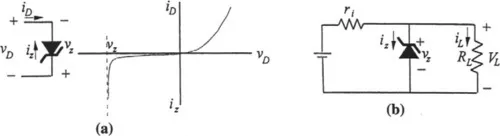
Figure 1-1 Zener diode and voltage regulator (a) Typical zener characteristics (b) a simple zener diode voltage regulator
The reverse characteristics show that, at the breakdown point, the knee voltage is independent of the diode current. This knee voltage or the zener voltage is controlled by the amount of doping applied in the manufacturing process. In the simple regulator circuit shown in Figure 1–1 (b), as long as the zener diode is in its regulating range, the load voltage VL remains constant and equal to the nominal zener voltage, even when the input voltage and the load resistance varies over a wide range. If the input voltage increases, the diode maintains a constant voltage across the load by absorbing the extra current and keeping the load current constant. If the load resistance decreases, the extra current required to keep the load voltage constant is facilitated by a decrease in the current drawn by the zener diode.
In the preceding simplified analysis, the temperatu...
Table of contents
- Cover image
- Title page
- Table of Contents
- Copyright page
- Dedication
- Preface
- Acknowledgments
- Chapter 1: Voltage References and Voltage Regulators
- Chapter 2: Operational Amplifiers
- Chapter 3: Data Converters
- Chapter 4: Microprocessors and Microcontrollers
- Chapter 5: Digital Signal Processors
- Chapter 6: Optoisolators
- Chapter 7: Sensors
- Chapter 8: Nonlinear Devices
- Chapter 9: Rechargeable Batteries and Their Management
- Chapter 10: Programmable Logic Devices
- Index
Trusted by 375,005 students
Access to over 1.5 million titles for a fair monthly price.
Study more efficiently using our study tools.
Frequently asked questions
Yes, you can cancel anytime from the Subscription tab in your account settings on the Perlego website. Your subscription will stay active until the end of your current billing period. Learn how to cancel your subscription
No, books cannot be downloaded as external files, such as PDFs, for use outside of Perlego. However, you can download books within the Perlego app for offline reading on mobile or tablet. Learn how to download books offline
Perlego offers two plans: Essential and Complete
- Essential is ideal for learners and professionals who enjoy exploring a wide range of subjects. Access the Essential Library with 800,000+ trusted titles and best-sellers across business, personal growth, and the humanities. Includes unlimited reading time and Standard Read Aloud voice.
- Complete: Perfect for advanced learners and researchers needing full, unrestricted access. Unlock 1.5M+ books across hundreds of subjects, including academic and specialized titles. The Complete Plan also includes advanced features like Premium Read Aloud and Research Assistant.
We are an online textbook subscription service, where you can get access to an entire online library for less than the price of a single book per month. With over 1.5 million books across 990+ topics, we’ve got you covered! Learn about our mission
Look out for the read-aloud symbol on your next book to see if you can listen to it. The read-aloud tool reads text aloud for you, highlighting the text as it is being read. You can pause it, speed it up and slow it down. Learn more about Read Aloud
Yes! You can use the Perlego app on both iOS and Android devices to read anytime, anywhere — even offline. Perfect for commutes or when you’re on the go.
Please note we cannot support devices running on iOS 13 and Android 7 or earlier. Learn more about using the app
Please note we cannot support devices running on iOS 13 and Android 7 or earlier. Learn more about using the app
Yes, you can access Modern Component Families and Circuit Block Design by Nihal Kularatna in PDF and/or ePUB format, as well as other popular books in Technology & Engineering & Industrial Design. We have over 1.5 million books available in our catalogue for you to explore.