eBook - ePub
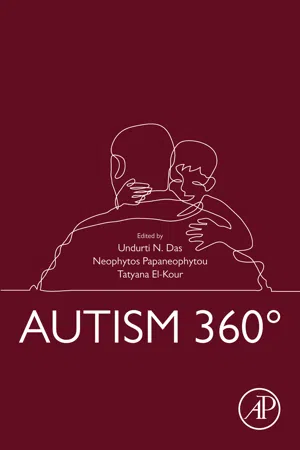
Autism 360°
- 554 pages
- English
- ePUB (mobile friendly)
- Available on iOS & Android
eBook - ePub
About this book
Autism 360 uses a hybrid and transdisciplinary methodology to identify mechanisms on how autism is prevented, diagnosed, treated and managed within personal and social constructs around the world. Adopting a lifespan approach, the book discusses lifestyle challenges and emphasizes issues relating to neurodiversity, individuality, best practices, and support of both people on the spectrum and their families. This book will help change population and individual attitudes and behaviors regarding autism. Its ultimate goal is to empower readers to become both agents of change and an integral part of the solution.
- Covers topics from the prevention and treatment of autism and how to live with it
- Adopts an integrated methods approach
- Features field experiences
- Provides valuable syntheses of scattered material
- Compares cross-cultural learnings
- Discusses the education and employment of those with autism
Information
Section III
Treatment and Interventions
Chapter 10
Introducing best practices in treatment modalities using a lifecycle approach
Gil Tippy Psychology, Dirty Hands Developmental Alliance, Sebastopol, CA, United States
Abstract
Introducing best practices in treatment modalities using a lifecycle approach.
This chapter looks at selecting a treatment modality based on what a parent would wish for their child as they grow older and continue into the world. Consideration is given to qualities one would look for in a treatment modality to have confidence that the one's child would be supported and prepared for life in the world after the parent is no longer supporting the child. Case examples are given, and markers to identify an effective lifespan intervention are provided.
Keywords
Autism; Developmental; Freedom; Transition
I am not an academic. In fact, I have spent a good part of my career trying to avoid the academic life. I have been an adjunct at times and loved teaching. In fact, I have been a teacher of one sort or another for the last 45 years, just not a tenured university person. I could never get that job, and I certainly could not keep it if I got it. The reason is I would never once get published in any of the juried periodicals I would have to get published in to get or keep my appointment.
I do not mean to imply that I do not like or believe in research. I do. I also love science and consider myself a real applied scientist. I do not, however, think much of the kind of “science” I would have to do in order to get into the journals I would have to get into in order to keep a university appointment. That science in my world, the world of developmental disorders, seems to me to be the most elementary and reductive kind of science, that doesn't actually prove anything about a person with developmental challenges and only shows incremental changes in a behavior. It is nonsensical and does not explain one thing about the rich, juicy, inner life, and motivations of the perfect and beautiful human being in front of you.
The type of research that I would like to do and have sometimes done is to look at long-term outcomes for people who I have worked with developmentally or who have been worked with in programs I have supervised or influenced. That type of research, because it does not use the scientific method that has been in place since at least Sir Issac Newton (Newton, 1999), does not get published in prominent journals, and because of that, never reaches the level of “evidence-based practice.”
All of the above prologue is to fully disclose that the rest of this article is based on my experience as a teacher, a psychologist, a program director, and a human being. I will cite the ideas I am pulling from, but I will not be citing my research, and many of the things I will say will not be “evidence-based” as it is currently understood in the world of autism intervention. I will be citing much that is scientific, just not the overly simplified scientific method that is depended upon in much published research.
I would also like to note a couple of naming conventions I am choosing to use here. I believe in person first language, and when I am unsure, I use it. So, I often say, “person with autism.” However, many of my friends say that they want to be called “autistic” or “autistic person.” So, when it is clear to me that a person wishes to be so designated, I so designate them. Next, I have chosen to use “they” or “their” for pronouns rather than “he” and “she”. If the person is unidentified as to gender, I will say, “they.” As an English major and a long time English teacher, this if no easy task for me, but it has become clear to me that the society in general calls for it, and the society of persons with autism calls for it even more loudly. Gender fluidity seems to be robustly represented in the autism community.
I am going to address this to persons who are worried about a loved one and trying to arrive at an intervention or are trying to get help, more accurately. I am fully aware that many, if not most, of the readers of this will be academics or interventionists. Maybe it would read easier for you if you could put aside your interventionist hat and put on your parent or relative hat. If taking the loved one's perspective allows you to be just a little more open to the dreams and desires and fears of parents, then maybe the time spent reading this will be worthwhile.
First steps
Parents, you should not take blindly what the “experts” are offering. No one should blindly follow what people say is right. Try to fight the panic that arises in you and that others are actively inducing in you, whether you are just discovering your child's differences, or you are coming up to some major milestone where you are terrified your child will lose services and support. Sit quietly in it for some time. There are things that will come up for you that you realize that you want for your child. As they begin to come into focus for you, these things that you want for your child, write them down. Make a list.
Things that I want for my child
- Happiness
- Respect
- Meaningful work
- Independence
- Love
- Freedom
-
- - To Think
- - To Do
- - To Not Do
- - To make mistakes
I have not met many people whose list looks like the following.
Things that I want for my child
- Compliance
- Silence
- No inappropriate
-
- No inappropriate smiling
- Laughing
- Running
- Fear
- Ability to do puzzles
If the latter list is the way in which you imagine a loved one of yours spending their lives, by all means, pursue it. I assure you that you will be able to find many programs that can supply many of those things and quickly. However, I am imagining that most people would wish the former list as what they want for their beloved child. So, after you make your list, you know what you want, and you know how you want your loved one to be treated. Your problem is how would you access that? Where is it offered? What would that list of wishes look like actualized, put into practice?
You might search for places that say they are doing the things you want. You might check their websites. Some of them say they fiercely advocate for persons with autism, and they may declare a list of rights they fight for. There are many “Autism Bill of Rights” floating around. I've read a lot of them, and I find that many of them are written by the neurotypical advocates for people with autism. I really like some of these “bills,” but slowly and surely the agendas of the people who are creating the interventions, who are presiding over the systems that deliver the interventions, and most especially the people who are funding the interventions begin to show themselves. For instance, this is one such bill of rights that I found on a website of a community autism treatment center.
The Autism Bill of Rights
- 1. Persons living with an autism spectrum disorder have the right to coordinated accurate and appropriate assessment and diagnosis services.
- 2. Persons living with an autism spectrum disorder have the right to adequate early intervention services.
- 3. Persons living with an autism spectrum disorder have the right to adequate and accurate medical supp...
Table of contents
- Cover image
- Title page
- Table of Contents
- Copyright
- Contributors
- Preface
- Non-Profit contact information
- Introduction
- Autism: The need for our suggested 360° approach
- Section I. Prevention
- Section II. Assessment and Diagnosis
- Section III. Treatment and Interventions
- Section IV. Training and Education
- Section V. Autism Spectrum Disorder: The Lived Experience with Environment and Support
- Index
Trusted by 375,005 students
Access to over 1.5 million titles for a fair monthly price.
Study more efficiently using our study tools.
Frequently asked questions
Yes, you can cancel anytime from the Subscription tab in your account settings on the Perlego website. Your subscription will stay active until the end of your current billing period. Learn how to cancel your subscription
No, books cannot be downloaded as external files, such as PDFs, for use outside of Perlego. However, you can download books within the Perlego app for offline reading on mobile or tablet. Learn how to download books offline
Perlego offers two plans: Essential and Complete
- Essential is ideal for learners and professionals who enjoy exploring a wide range of subjects. Access the Essential Library with 800,000+ trusted titles and best-sellers across business, personal growth, and the humanities. Includes unlimited reading time and Standard Read Aloud voice.
- Complete: Perfect for advanced learners and researchers needing full, unrestricted access. Unlock 1.5M+ books across hundreds of subjects, including academic and specialized titles. The Complete Plan also includes advanced features like Premium Read Aloud and Research Assistant.
We are an online textbook subscription service, where you can get access to an entire online library for less than the price of a single book per month. With over 1.5 million books across 990+ topics, we’ve got you covered! Learn about our mission
Look out for the read-aloud symbol on your next book to see if you can listen to it. The read-aloud tool reads text aloud for you, highlighting the text as it is being read. You can pause it, speed it up and slow it down. Learn more about Read Aloud
Yes! You can use the Perlego app on both iOS and Android devices to read anytime, anywhere — even offline. Perfect for commutes or when you’re on the go.
Please note we cannot support devices running on iOS 13 and Android 7 or earlier. Learn more about using the app
Please note we cannot support devices running on iOS 13 and Android 7 or earlier. Learn more about using the app
Yes, you can access Autism 360° by Undurti N. Das,Neophytos L. Papaneophytou,Tatyana El-Kour,Neophytos Papaneophytou in PDF and/or ePUB format, as well as other popular books in Psychology & Educational Psychology. We have over 1.5 million books available in our catalogue for you to explore.