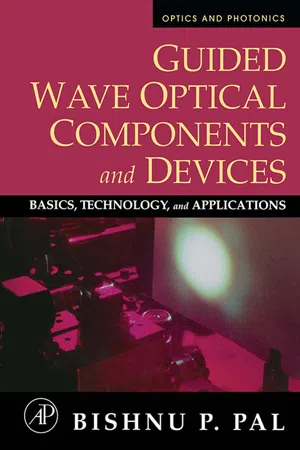
Guided Wave Optical Components and Devices provides a comprehensive, lucid, and clear introduction to the world of guided wave optical components and devices. Bishnu Pal has collaborated with some of the greatest minds in optics to create a truly inclusive treatise on this contemporary topic. Written by leaders in the field, this book delivers cutting-edge research and essential information for professionals, researchers, and students on emerging topics like microstructured fibers, broadband fibers, polymer fiber components and waveguides, acousto-optic interactions in fibers, higher order mode fibers, nonlinear and parametric process in fibers, revolutionary effects of erbium doped and Raman fiber amplifiers in DWDM and CATV networks, all-fiber network branching component technology platforms like fused fiber couplers, fiber gratings, and side-polished fiber half-couplers, arrayed waveguides, optical MEMS, fiber sensing technologies including safety, civil structural health monitoring, and gyroscope applications.
- Accessible introduction to wide range of topics relating to established and emerging optical components
- Single-source reference for graduate students in optical engineering and newcomer practitioners, focused on components
- Extensive bibliographical information included so readers can get a broad introduction to a variety of optical components and their applications in an optical network
Optical Fibers for Broadband Lightwave Communication: Evolutionary Trends in Designs
Bishnu P. Pal*, Physics Department, Indian Institute of Technology Delhi, New Delhi, India
1 INTRODUCTION
Development of optical fiber technology is considered to be a major driver behind the information technology revolution and the tremendous progress on global telecommunications that has been witnessed in recent years. Fiber optics, from the point of view of telecommunication, is now almost taken for granted in view of its wide-ranging application as the most suitable singular transmission medium for voice, video, and data signals. Indeed, optical fibers have now penetrated virtually all segments of telecommunication networks, whether transoceanic, transcontinental, intercity, metro, access, campus, or on-premise. The first fiber optic telecom link went public in 1977. Since that time, growth in the lightwave communication industry until about 2000 has been indeed mind boggling. According to a Lucent technology report [1], in the late 1990s optical fibers were deployed at approximately 4800 km/hr, implying a total fiber length of almost three times around the globe each day until it slowed down when the information technology bubble burst!
The Internet revolution and deregulation of the telecommunication sector from government controls, which took place almost globally in the recent past, have substantially contributed to this unprecedented growth within such a short time, which was rarely seen in any other technology. Initial research and development (R&D) in this field had centered on achieving optical transparency in terms of exploitation of the low-loss and low-dispersion transmission wavelength windows of high-silica optical fibers. Though the low-loss fiber with a loss under 20 dB/km that was reported for the first time was a single-mode fiber (SMF) at the He–Ne laserm wavelength [2], the earliest fiber optic lightwave systems exploited the first low-loss wavelength window centered on 820 nm with graded index multi-mode fibers forming the transmission media. However, primarily due to the unpredictable nature of the bandwidth of jointed multimode fiber links, since the early 1980s the system focus shifted to SMFs by exploiting the zero material dispersion characteristic of silica fibers, which occurs at a wavelength of 1280 nm [3] in close proximity to its second low-loss wavelength window centered at 1310 nm [4].
The next revolution in lightwave communication took place when broadband optical fiber amplifiers in the form of erbium-doped fiber amplifiers (EDFA) were developed in 1987 [5], whose operating wavelengths fortuitously coincided with the lowest-loss transmission wavelength window of silica fibers centered at 1550 nm [6] and heralded the emergence of the era of dense wavelength division multiplexing (DWDM) technology in the mid-1990s [7]. By definition, DWDM technology implies simultaneous optical transmission through one SMF of at least four wavelengths within the gain bandwidth of an EDFA (Fig. 1.1). Recent development of the so-called AllWave
and SMF-28e
fibers devoid of the characteristic OH− loss peak (centered at 1380 nm) extended the low-loss wavelength window in high-silica fibers from 1280 nm (235 THz) to 1650 nm (182 THz), thereby offering, in principle, an enormously broad 53 THz of optical transmission bandwidth to be potentially tapped through the DWDM technique! These fibers are usually referred to as enhanced SMF (G.652.C) and are characterized with an additional low-loss window in the E-band (1360-1460 nm), which is about 30% more than the two low-loss windows centered about 1310 and 1550 nm in legacy SMFs. The emergence of DWDM technology has also driven development of various specialty fibers and all-fiber components for seamless growth of the lightwave communication technology. These fibers were required to address new features like nonlinearity-induced potential impairments in optical transmission due to large optical throughput, broadband dispersion compensation, bend-loss sensitivity to variation in signal wavelengths, and so on.
FIGURE 1.1 Schematic representing DWDM optical transmission with a minimum of four wavelengths in the EDFA band as a sample.
In this chapter we attempt to present evolutionary trends in the design of single-mode optical transmission fibers, in particular for lightwave communication seen in the last 30 years or so. Multimode fibers in the form of plastic fibers, which hold promise for on-premise and other applications, are discussed in Chapter 2 authored by P. L. Chu.
2 OPTICAL TRANSPARENCY
2.1 Loss Spectrum
SMFs constitute an integral component of any DWDM link meant to transport high volumes of signals and data. Its characteristics greatly influence the choice of auxiliary components that go into a network and also the overall cost and eventual performance of the communication system. Loss and dispersion spectra are the two most important propagation characteristics of a single-mode optical fiber. Figure 1.2 gives an example of the loss spectrum of a state-of-the-art, commercially available, conventional G.652 type of SMF. Except for a portion of the loss spectrum around 1380 nm at which a peak appears due to absorption by minute traces (in parts per billion) of OH− present in the fiber, the rest of the spectrum in a G.652 fiber more or less varies, with wavelength as Aλ−4, meaning that signal loss in a state-of-the-art SMF is essentially caused by Rayleigh scattering. Rayleigh scattering loss coefficient A in a fiber may be approximately modeled through the relation [8]
FIGURE 1.2 A sample loss spectrum (full curve) of a state-of-the-art G.652 type single-mode fiber, e.g. SMF-28: (a) 1.81 dB/km at 850 nm, (b) 0.35 dB/km at 1300 nm, (c) 0.34 dB/km at 1310-nm, (d) 0.55 dB/k...
Table of contents
Cover image
Title page
Table of Contents
Copyright
Dedication
Preface
Contributors
Chapter 1: Optical Fibers for Broadband Lightwave Communication: Evolutionary Trends in Designs
Chapter 2: Recent Development of a Polymer Optical Fiber and its Applications
Chapter 3: Microstructured Optical Fibers
Chapter 4: Photonic Bandgap–Guided Bragg Fibers
Chapter 5: Radial Effective Index Method for the Analysis of Microstructured Fibers
Chapter 6: Some Important Nonlinear Effects in Optical Fibers
Chapter 7: Fiber Optic Parametric Amplifiers for Lightwave Systems
Chapter 8: Erbium-Doped Fiber Amplifiers
Chapter 9: Fiber Optic Raman Amplifiers
Chapter 10: Application of Numerical Analysis Techniques for the Optimization of Wideband Amplifier Performances
Chapter 11: Analog/Digital Transmission with High-Power Fiber Amplifiers
Chapter 12: Erbium-Doped Fiber Amplifiers for Dynamic Optical Networks
Chapter 13: Fused Fiber Couplers: Fabrication, Modeling, and Applications
Chapter 16: Enhancing Photosensitivity in Optical Fibers
Chapter 17: Solitons in a Fiber Bragg Grating
Chapter 18: Advances in Dense Wavelength Division Multiplexing/Demultiplexing Technologies
Chapter 19: Dispersion-Tailored Higher Order Mode Fibers for In-Fiber Photonic Devices
Chapter 20: Acousto-Optic Interaction in Few-Mode Optical Fibers
Chapter 21: Basic Theory and Design Procedures for Arrayed Waveguide Structures
Chapter 22: Photobleached Gratings in Electro-Optic Waveguide Polymers
Chapter 23: Optical MEMS Using Commercial Foundries
Chapter 24: Principles of Fiber Optic Sensors
Chapter 25: Structural Strain and Temperature Measurements Using Fiber Bragg Grating Sensors
Chapter 26: Principles and Status of Actively Researched Optical Fiber Sensors
Author Biography
Index
Trusted by 375,005 students
Access to over 1.5 million titles for a fair monthly price.
Study more efficiently using our study tools.
Frequently asked questions
Yes, you can cancel anytime from the Subscription tab in your account settings on the Perlego website. Your subscription will stay active until the end of your current billing period. Learn how to cancel your subscription
No, books cannot be downloaded as external files, such as PDFs, for use outside of Perlego. However, you can download books within the Perlego app for offline reading on mobile or tablet. Learn how to download books offline
Perlego offers two plans: Essential and Complete
Essential is ideal for learners and professionals who enjoy exploring a wide range of subjects. Access the Essential Library with 800,000+ trusted titles and best-sellers across business, personal growth, and the humanities. Includes unlimited reading time and Standard Read Aloud voice.
Complete: Perfect for advanced learners and researchers needing full, unrestricted access. Unlock 1.5M+ books across hundreds of subjects, including academic and specialized titles. The Complete Plan also includes advanced features like Premium Read Aloud and Research Assistant.
Both plans are available with monthly, semester, or annual billing cycles.
We are an online textbook subscription service, where you can get access to an entire online library for less than the price of a single book per month. With over 1.5 million books across 990+ topics, we’ve got you covered! Learn about our mission
Look out for the read-aloud symbol on your next book to see if you can listen to it. The read-aloud tool reads text aloud for you, highlighting the text as it is being read. You can pause it, speed it up and slow it down. Learn more about Read Aloud
Yes! You can use the Perlego app on both iOS and Android devices to read anytime, anywhere — even offline. Perfect for commutes or when you’re on the go. Please note we cannot support devices running on iOS 13 and Android 7 or earlier. Learn more about using the app
Yes, you can access Guided Wave Optical Components and Devices by Bishnu P. Pal in PDF and/or ePUB format, as well as other popular books in Technology & Engineering & Civil Engineering. We have over 1.5 million books available in our catalogue for you to explore.