- 386 pages
- English
- ePUB (mobile friendly)
- Available on iOS & Android
eBook - ePub
Insect-Borne Diseases in the 21st Century
About this book
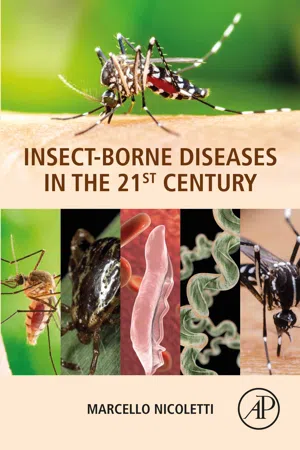
Insect-Borne Diseases in the 21st Century provides a comprehensive look at the most notorious diseases carried by insects. It offers an assessment of current and potential insect-vectored diseases as they relate to human health and agricultural and livestock production. Written by a leading expert in insect-borne diseases, it examines the history of insect-borne diseases, beginning with those that have been well-known to scientists for decades, also including recent outbreaks like Zika. The book takes into consideration environmental conditions and climate change and explores the bionetworks and system biology of potential new superorganisms, offering preventative and protective solutions.
This is a must-have resource for entomology researchers and students who seek the most up-to-date information on disease-causing pathogens transmitted by insects. This book will also serve as a resource for ordinary people whose lives may be affected by such diseases.
- Details the leading insect-transmitted diseases, including malaria, West Nile, Zika, dengue, yellow fever and Xylella
- Examines containment issues, including resistance phenomena among insects and microorganisms
- Offers alternative solutions to protection and prevention, including natural and environmentally-friendly insecticides
Information
Chapter One: Past, present, and future of insect-borne diseases
Abstract
The progressive emergence of resistant populations is now a common feature for insecticides and antibiotics, as a consequence of overuse and/or incorrect utilization. The phenomenon is changing the scenario of the battle against micropathogens and parasites, as well as the control of the vectors, requiring solutions to new forms of old problems. These solutions must ignore the axiom “kill the target with the best weapon” and consider all the consequences of counteractions. In this changing point of view, the environment plays a central role, being the main driving force of any biological change and interconnected with the living systems. From the latter consideration, the concept of a “superorganism” allows an interpretation of insect-borne diseases as the convergent and coordinate action of several types of organisms, which are also very different and taxonomically distant. This chapter is dedicated to the presentation of the general concepts leading the results and experimental data further reported. The resistance phenomenon is the central argument. Considering the complexity of the matter and links with other items, resistance will considered several times during the chapter, increasing the level of information each time.
Keywords
DDT; Resistance; Insecticides; Superbugs; Post-antibiotic era; Homeostasis

Listening to the silence
We start with two books, which contain seeds of the further arguments. The first one is The Silent Spring by Rachel Carson (Carlson, 1962). The second one is The Origin of Species by Means of Natural Selection by Charles R. Darwin (Darwin, 2003). Both had deep cultural and scientific influences, for different reasons, and nowadays they must be considered as the starting points of theories about habitats needing careful consideration.
In 1962, Rachel Carson published The Silent Spring, intending to document the effects on the environment of the indiscriminate use of synthetic pesticides, starting from the absence of the usual songs of birds in spring. The book explicitly identifies DDT and other pesticides as responsible for enormous damage to the environment, causing in general threat to wildlife and a series of negative effects like the increase of cancer cases in humans. Carson directly evidences the responsibility of the chemical industry not only in its excessive use of chemicals, but also by covering its activity through spreading misleading information about the consequences, in collaboration with public officials. Chemical companies reacted by masking and justifying their actions, but the book had a great impact on the American public, acting as a seminal event for the environmental movement and generating a strong debate about habitat care. The policy on the utilization of chemical insecticides was in part affected and another consequence was the creation of national agencies in defense of environmental equilibria. The argument is still totally open, since the effects of neonicotinoids on honeybees and birds are nowadays under consideration. However, the most interesting point is arguably that until The Silent Spring was published, all the above issues were considered acceptable and even normal.
Probably, no ideas were subjected more to misleading and manipulation than the results presented by Charles Darwin about animal social behaviors. A clear example of a diverted utilization of scientific theories by people, who never had read one word of his books. Some interpretations of Darwinism gave the impression of a giant omnipresent struggle among organisms for surviving and winning the competition for resources and reproduction, obtaining sexual advantages. However, we know that there are innumerable examples of cooperation, mutual help, positive coexistence, and symbiosis between very different organisms. However, there are also example of slavery by an organism for another to satisfy personal needs, and examples of clear sloth (as reported also by Darwin). This is probably the key to understand several factors affecting the future of the environment and humankind, from the gut microbiome to the Angiosperms reproduction.
In several examples, selecting those related to insect-borne diseases, the integration and incorporation between very different organisms—i.e., bacteria, insects, plants, and fungi—gives rise to a complete network, working as a natural mechanism, wherein each organism has a precise and defined role.
We are in the midst of epochal planetary changes, whose consequences are becoming more and more evident in the developing scenarios. The powerful weapons utilized by humans to control insect-borne diseases, consisting of chemical-made antibiotics and insecticides, are becoming useless. For a long time, the pathogen organisms were easily killed and controlled. Insects and microorganisms, thanks also to other allied organisms, after a long period of passivity are finally reacting properly to the lethal continuous attacks by humans, whose minimum goal was the complete extermination of these insects and microorganisms. So far, the counteractions by microorganism and insects have been mainly defensive and limited, but they are ready to become brutal and offensive, and perhaps decisive.
The counteraction by target organisms is the most obvious in any war: nullify the enemy’s weapons by resistance, and fight back. This resistance is already being worked on, and is ready to become very effective on a large scale. The incoming front of the resistance's phenomenon is based also on more efficient methods of diffusion, including organisms so far latent and in a revision of strategies to survive and diffuse. Insect-borne diseases are evolving in this scenario and therefore they are ready to play again their central role in the never-ending fight for survival (Mehlhorn, 2015a,b; Mahmud et al., 2017).
Entomology will need to play an important role. However, it is necessary to reconsider its goals, which have too often focused on taxonomic problems, and consider the needs for new and original approaches able to face novel challenges. It is time to revise several dominating axioms on the light of the occurrence of a series of important phenomenons, which are acting as current motors of radical changes. In this book, we will introduce the key concepts of superorganisms, system biology, and bionetwork, and present some examples to verify these approaches. Examples must consider the several aspects involved, including target organisms or selectivity effects. It is necessary to understand what is going on and the role played by each organism. Several examples will be presented and their related solutions, based on current or recent episodes of public concern, including health and production of food. Therefore, the philosophy and the strategies reported will generally find their evidence and concreteness in selected cases.
The main goal of the book consists in encouraging readers to consider the possibility of thinking in another way, without accepting the dominant paradigms. The book will also ask each reader to contribute where possible to another possible style of living, considering surrounding organisms, such as insects or bacteria, to be not annoyances to be removed, but potential allies to play a daily and fascinating scenario with alternative costs and new hopes.
In this chapter, the two main actors of an insect-borne disease, the microparasite and the vector, will be examined, considering in particular their current evolution and consequent effects on the occurrence of diseases. Let us start with the parasite, in consideration of its key responsibility in the disease.
Several signals of changes are converging to create a new environmental scenario. The 21st century announced its advent with radical planetary events disclosing enormous impacts. Among the main influencing factors, the enormous advances obtained by technology are changing any aspect of our life. The instantaneous planetary connection is opening the door to a planet globalization of the information, but not only the news are travelling everywhere. Therefore, continuous innovations in ordinary life are fueled by a progressive dependence on the artificial intelligence, allowing the possibility to exchange everything can be moved, like ideas and materials of any kind, including pathogens and parasited. Changes are rapidly affecting quality of life and health, including deep evolvements in social organization, evident in the crisis of the tribal and family models. Continuous and rapid challenges of dominant paradigms inside the global network are actively changing the planet, but with different effects in each part. Most people consider these changes to be simple collateral effects of scientific advancements, whereas everything is still moved by the usual eternal motivations: the possibility of surviving and growing in the best environmental conditions, the research of habitat sources to be utilized efficiently in the best way, in total indifference of the consequences necessary to achieve the expected goal. Now, as ever, climate changes generate migrations of humans and animals, moved by their usual needs. In some cases, organisms move to conquer territories previously closed to them, disrupting previous equilibria. Migration is a natural phenomenon, and always has consequences (Bezirtzoglou et al., 2011; Lamb, 1995; Cook, 1992; Wigley et al., 1981).
Environmental changes can offer new possibilities, not only damages. Survival needs, or simply homeostasis rules and imperatives, push organisms to find better territories or more favorable living conditions. It is a thermodynamic contest, like water moving freely from two containers or the equilibration of the temperatures between two adjoining rooms. Continuously, the brave vanguard of any organism try out the boundary of their territory in search of opportunities. When movements are successful, they become massive and overflow, finding resistance from previous native inhabitants, but defensive damage is largely counterbalanced by the absence of the usual natural enemies remaining in the old territory. The fight for natural sources is open. Therefore, the alien species enlarges its distribution as soon as possible, whereas autochthonous species experience difficulties and the whole environment is highly affected.
It is important to focus on the mechanism of the migration. During the first steps of the migration, some epigenetic changes can occur, generating more aggressive populations, and these are more motivated to move. Several genotypes of the alien species can move in sequence and the strongest one takes supremacy during the starting step. When the rooting is completed and the migrant alien population is integrated and favorable, the second step, consisting of diffusion, can start with increasing efficiency, causing the dramatic diffusion, like an expansion of the oil stain can start with increasing efficiency, causing the dramatic diffusion, like an expansion of the oil stain. Therefore, the epidemic stage, so large, abundant, and evident at the height of its manifestation, is the result of the action of a super-selected vanguard. The success of the initial step is crucial, and explains why for a long time the invasion was not possible. The route of the invading species in the whole phenomenon, from the starting initial territory to the final one, can be visualized in the form of an hourglass. Over time, the sand in the upper glass tube (the starting population of the species in its territory) will decrease in favor of the other one (the new habitat), but it is necessary to satisfy the initial condition of flowing.
The environmental changes influence our ordinary...
Table of contents
- Cover image
- Title page
- Table of Contents
- Copyright
- About the author
- Foreword
- Preface
- Chapter One: Past, present, and future of insect-borne diseases
- Chapter Two: New scenarios arising from radical changes in diseases
- Chapter Three: Novel challenges require new solutions
- Chapter Four: Bionetworks, system biology, and superorganisms
- Chapter Five: Three scenarios in insect-borne diseases
- Chapter Six: Novel solutions to insect-borne diseases in action
- Chapter Seven: New solutions using natural products
- Index
Trusted by 375,005 students
Access to over 1.5 million titles for a fair monthly price.
Study more efficiently using our study tools.
Frequently asked questions
Yes, you can cancel anytime from the Subscription tab in your account settings on the Perlego website. Your subscription will stay active until the end of your current billing period. Learn how to cancel your subscription
No, books cannot be downloaded as external files, such as PDFs, for use outside of Perlego. However, you can download books within the Perlego app for offline reading on mobile or tablet. Learn how to download books offline
Perlego offers two plans: Essential and Complete
- Essential is ideal for learners and professionals who enjoy exploring a wide range of subjects. Access the Essential Library with 800,000+ trusted titles and best-sellers across business, personal growth, and the humanities. Includes unlimited reading time and Standard Read Aloud voice.
- Complete: Perfect for advanced learners and researchers needing full, unrestricted access. Unlock 1.5M+ books across hundreds of subjects, including academic and specialized titles. The Complete Plan also includes advanced features like Premium Read Aloud and Research Assistant.
We are an online textbook subscription service, where you can get access to an entire online library for less than the price of a single book per month. With over 1.5 million books across 990+ topics, we’ve got you covered! Learn about our mission
Look out for the read-aloud symbol on your next book to see if you can listen to it. The read-aloud tool reads text aloud for you, highlighting the text as it is being read. You can pause it, speed it up and slow it down. Learn more about Read Aloud
Yes! You can use the Perlego app on both iOS and Android devices to read anytime, anywhere — even offline. Perfect for commutes or when you’re on the go.
Please note we cannot support devices running on iOS 13 and Android 7 or earlier. Learn more about using the app
Please note we cannot support devices running on iOS 13 and Android 7 or earlier. Learn more about using the app
Yes, you can access Insect-Borne Diseases in the 21st Century by Marcello Nicoletti in PDF and/or ePUB format, as well as other popular books in Biological Sciences & Entomology. We have over 1.5 million books available in our catalogue for you to explore.