eBook - ePub
Interpretation of Micromorphological Features of Soils and Regoliths
- 752 pages
- English
- ePUB (mobile friendly)
- Available on iOS & Android
eBook - ePub
Interpretation of Micromorphological Features of Soils and Regoliths
About this book
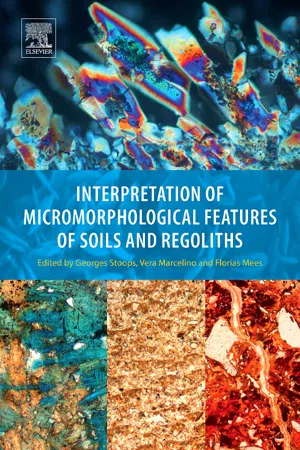
Interpretation of Micromorphological Features of Soils and Regolith, 2nd edition, provides researchers and students with a global tool for interpretation of micromorphological features of regoliths and soils. After an introduction and general overview by the editors, micromorphological aspects of regoliths (e.g. saprolites, unconsolidated sediments, transported materials) are highlighted, followed by a systematic and coherent discussion of the micromorphological expression of various pedogenic processes. This is done by discussing diagnostic horizons, materials and processes. The following topics are also treated: freeze-thaw features, redoximorphic features, calcareous and gypsiferous formations, textural features, spodic and oxic horizons, andic and volcanic materials, organic and surface horizons, laterites, surface crusts, salts, biogenic and inorganic siliceous materials, authigenic silicates, phosphates, thionic and derived materials, and features related to faunal activity. The last chapters address the impact of anthropic activities, with regard to archaeology and palaeopedology.
Interpretation of Micromorphological Features of Soils and Regolith, 2nd edition, is written by a team of well-known, global experts in the field who all used a single set of concepts and terminology, making it a valuable interdisciplinary reference.
- The first exhaustive publication on interpretation of micromorphological features
- Covers related topics, making micromorphology more attractive and accessible for geographers, archaeologists and quaternary geologists
- Thematic treatment of a range of soil micromorphology fields broadens the content's applications
- Authored by a multi-disciplinary team, ensuring thorough coverage of archaeological, geological, and earth science disciplines
Information
Subtopic
Agronomy1 Micromorphology as a Tool in Soil and Regolith Studies
Georges Stoops *
Ghent University, Ghent, Belgium
1 Introduction
The aim of micropedology is to contribute to solving problems related to the genesis, classification and management of soils, including soil characterization in palaeopedology and archaeology. The interpretation of features observed in thin sections is the most important part of this type of research, based on an objective detailed analysis and description.
Attempts to understand soil genesis by the study of thin sections were already made in the beginning of the 20th century by Delage and Lagatu (1904) and Agafonoff (1929, 1935/1936), but it was only after the publication of the book Micropedology (Kubiëna, 1938) that a real start was made. The use of micromorphology was promoted further by Kubiëna’s later books on soil genesis and classification (Kubiëna, 1948, 1953). New methodologies to prepare large thin sections with cold-setting resins (Borchert, 1961; Altemüller, 1962; Jongerius & Heintzberger, 1962) allowed the study of microstructures and other relatively large features. In the course of the following years much progress was made in methods of thin section description (Brewer, 1964; Bullock et al., 1985) and quantitative analyses (Kubiëna, 1967; Jongerius, 1974; Mermut & Norton, 1992). The interpretation of micromorphological features of various soil and regolith materials advanced as well, but no general overview of these achievements has yet been compiled.
Several difficulties are encountered when making a synthesis of existing literature data on micromorphological characteristics of materials and horizons in relation to their genesis and classification (Stoops, 2001):
- - Most published micromorphological descriptions are unavoidably incomplete, mentioning only the most relevant, striking or ‘diagnostic’ features, or only those that the author was able to recognize. The most complete information can be found in reports and dissertations.
- - The micromorphological terminology used is frequently not sufficiently precise, in some cases partly consisting of an author’s own descriptive system without well-defined concepts. The use of a standardized and uniform terminology is therefore very important. The influential system of Brewer (1964) is still in use by some authors, but more widely accepted modern terminology (Bullock et al., 1985; Stoops, 2003) is nowadays to be recommended.
- - Soils or materials studied in thin sections are often not sufficiently precisely identified (e.g. ‘a brown soil’) or they are classified according to often poorly accessible national systems. The many changes through time in classification criteria used in different versions of the FAO-WRB and USDA systems also strongly hinder correlation between soil type and micromorphological characteristics, based on papers published over periods of several decades.
- - Horizons or layers that are not considered as diagnostic or interesting are generally not described. For instance, practically no micromorphological information is available on cambic horizons occurring together with other diagnostic horizons in a same profile, or on aspects of surface horizons other than microstructure characteristics.
- - In several publications only interpretations are given, not supported by detailed descriptions, and therefore making it impossible to use the data for comparison or for database construction.
The general significance of certain micromorphological features can be explained rather easily, for example when relating the presence of clay coatings to the process of clay illuviation. For many other features the interpretation is less straightforward. In many cases the combined occurrence of features, or the absence of a certain feature, is more diagnostic than the presence of individual features. For instance, fine granular microstructures and an undifferentiated b-fabric are found in oxic, andic and spodic materials. The absence of volcanic components rules out andic materials, and the absence of weatherable components suggests an oxic nature.
For all these reasons it is not possible to relate, in a simple way, micromorphological characteristics with genesis, classification or physical, chemical and mineralogical properties. Much systematic research is therefore still needed.
2 Soil and Regolith Genesis
Micromorphology has been applied mainly in view of disentangling processes of soil and regolith formation.
Review papers on the micromorphological characteristics of different soil types can be found in Bullock and Murphy (1983) and Douglas and Thompson (1985). More recent reviews are scarce, and scattered over various scientific journals and congress proceedings. Many reviews suffer from the fact that their authors are acquainted only with the literature published in their own language or country. There is also a considerable risk that in future reviews only publications that are registered or available online will be taken into consideration. As a result, much useful information risks being lost. Early Russian knowledge on the interpretation of soil micromorphology was summarized by Parfenova and Yarilova (1965) and widely used after translation, whereas no translation is available of the more recent volume by Romeshkevich and Gerasimova (1982). The English-language book by Gerasimova et al. (1996) on Russia and adjacent countries has not been widely distributed.
The interpretation of micromorphological features has been based essentially on comparison between thin section observations, macromorphological features and laboratory data. The most probable hypothesis is then accepted, and in many cases gradually considered as a proven fact, rather than a supposition. Interpretation is also often based on the authority of an author, as it is anyway also the case in many other natural sciences. Especially in the early days of micromorphology, the opinion of Kubiëna was often taken for granted, although generally not supported by laboratory analyses.
In several cases the genesis of specific features or fabrics remains controversial, such as the origin of the small rounded aggregates in Oxisols (see Marcelino et al., 2010, this book), Andosols (see Sedov et al., 2010, this book) and Spodic horizons (see Wilson & Righi, 2010, this book).
Interpretation can also be based on experimental work in the laboratory or in the field (see Section 7), or on field observations. A good example of the latter is the correlation between determinations of hydromorphic conditions in the field and the resulting micromorphological features (Veneman et al., 1976).
Regolith genesis as a result of weathering has been studied in thin sections by petrographers since the first part of the 20th century (e.g. Harrison, 1933). In the 1950s, pedologists also began using this technique to study weathering, saprolite formation and pedoplasmation, especially in Africa by ORSTOM (IRD) researchers (see also Stoops & Schaefer, 2010; Zauyah et al., 2010, this book). This resulted in numerous publications in journals and congress proceedings, besides a large number of unpublished reports and dissertations. Much of this material has been summarized in books by Nahon (1991), Tardy (1993) and especially Delvigne (1998).
3 Soil and Regolith Classification
In the genetic soil classification system of Kubiëna (1948, 1953), micromorphology was important to distinguish soil types such as Braunlehm and Terra Rossa or humus layers such as Mor and Anmoor. In modern soil classification systems only the one of FitzPatrick (2005) considers micromorphological features as important criteria for the identification of some horizons. In WRB (IUSS Working Group WRB, 2006), micromorphological characteristics are used to a limited extent in the identification of horizons.
One difficulty in relating micromorphological data to classification criteria is that in most soil classification systems (e.g. WRB, Soil Taxonomy), diagnostic horizons or materials are defined not only on a morphological basis, but also on the basis of chemical or physical characteristics. Moreover, some horizons are defined not only by their own characteristics but by differences with other parts of the same profile. Other horizons comprise a very broad and heterogeneous group of materials, such as the mollic and cambic horizons in Soil Taxonomy (Soil Survey Staff, 1999). Also, non-morphological properties, such as climate, often play a dominant role, keying out soils before their morphology is considered (e.g. Aridisols). It is worth mentioning that various international commissions on soil classification (e.g. ICOMAND, ICOMID, ICOMOX) intensively used micromorphology in their discussions, but these micromorphological data were never published in peer-reviewed journals.
In few cases direct information on soil type is obtained from thin section observations. For example, the presence of fine clay coatings points to an argillic horizon, whereas other types of coatings indicate natric or agric horizons. However, not all argillic horizons clearly show the occurrence of clay illuviation in thin sections (e.g. most Red Mediterranean soils), and not all clay illuviation features are the result of vertical transport from an E- to a Bt-horizon (see Kühn et al., 2010, this book). Similar considerations are possible for other horizons such as the gypsic (see Poch et al., 2010, this book) and calcic (see Durand et al., 2010, this book). Other horizons, such as the oxic, display a characteristic combination of clearly recognizable micromorphological features (see Marcelin...
Table of contents
- Cover
- Title Page
- Copyright
- Table of Contents
- Contributors
- Preface
- List of Abbreviations
- Chapter 1: Micromorphology as a Tool in Soil and Regolith Studies
- Chapter 2: Micromorphological Features and Their Relation to Processes and Classification
- Chapter 3: Colluvial and Mass Wasting Deposits
- Chapter 4: Saprolites
- Chapter 5: Pedoplasmation
- Chapter 6: Frost Action
- Chapter 7: Vertic Features
- Chapter 8: Redoximorphic Features
- Chapter 9: Calcium Carbonate Features
- Chapter 10: Gypsic Features
- Chapter 11: Textural Pedofeatures and Related Horizons
- Chapter 12: Spodic Materials
- Chapter 13: Regoliths and Soils on Volcanic Ash
- Chapter 14: Oxic and Related Materials
- Chapter 15: Lateritic and Bauxitic Materials
- Chapter 16: Topsoils – Mollic, Takyric and Yermic Horizons
- Chapter 17: Soil Organic Matter
- Chapter 18: Features Related to Faunal Activity
- Chapter 19: Physical and Biological Surface Crusts and Seals
- Chapter 20: Salt Minerals in Saline Soils and Salt Crusts
- Chapter 21: Pedogenic and Biogenic Siliceous Features
- Chapter 22: Authigenic Silicate Minerals – Sepiolite-Palygorskite, Zeolites and Sodium Silicates
- Chapter 23: Phosphatic Features
- Chapter 24: Sulphidic and Sulphuric Materials
- Chapter 25: Anthropogenic Features
- Chapter 26: Archaeological Materials
- Chapter 27: Palaeosoils and Relict Soils
- Author Index
- Subject Index
Trusted by 375,005 students
Access to over 1.5 million titles for a fair monthly price.
Study more efficiently using our study tools.
Frequently asked questions
Yes, you can cancel anytime from the Subscription tab in your account settings on the Perlego website. Your subscription will stay active until the end of your current billing period. Learn how to cancel your subscription
No, books cannot be downloaded as external files, such as PDFs, for use outside of Perlego. However, you can download books within the Perlego app for offline reading on mobile or tablet. Learn how to download books offline
Perlego offers two plans: Essential and Complete
- Essential is ideal for learners and professionals who enjoy exploring a wide range of subjects. Access the Essential Library with 800,000+ trusted titles and best-sellers across business, personal growth, and the humanities. Includes unlimited reading time and Standard Read Aloud voice.
- Complete: Perfect for advanced learners and researchers needing full, unrestricted access. Unlock 1.5M+ books across hundreds of subjects, including academic and specialized titles. The Complete Plan also includes advanced features like Premium Read Aloud and Research Assistant.
We are an online textbook subscription service, where you can get access to an entire online library for less than the price of a single book per month. With over 1.5 million books across 990+ topics, we’ve got you covered! Learn about our mission
Look out for the read-aloud symbol on your next book to see if you can listen to it. The read-aloud tool reads text aloud for you, highlighting the text as it is being read. You can pause it, speed it up and slow it down. Learn more about Read Aloud
Yes! You can use the Perlego app on both iOS and Android devices to read anytime, anywhere — even offline. Perfect for commutes or when you’re on the go.
Please note we cannot support devices running on iOS 13 and Android 7 or earlier. Learn more about using the app
Please note we cannot support devices running on iOS 13 and Android 7 or earlier. Learn more about using the app
Yes, you can access Interpretation of Micromorphological Features of Soils and Regoliths by Georges Stoops,Vera Marcelino,Florias Mees in PDF and/or ePUB format, as well as other popular books in Technology & Engineering & Agronomy. We have over 1.5 million books available in our catalogue for you to explore.