- 222 pages
- English
- ePUB (mobile friendly)
- Available on iOS & Android
eBook - ePub
Biometals in Autism Spectrum Disorders
About this book
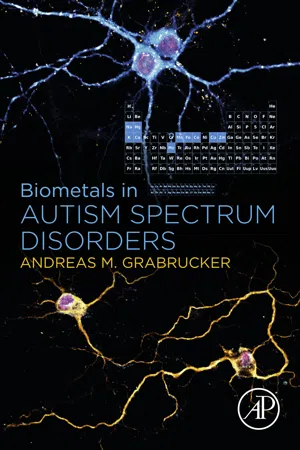
Biometals in Autism Spectrum Disorders focuses on trace metals and autism. Compared to other references examining ASDs or metallomics, this book presents findings of abnormal metal homeostasis in ASD, providing an overview of current findings on trace metal biology, its role in ASD etiology, and how abnormal trace metal biology may be a common factor of several genetic and non-genetic causes of ASDs that were once considered unrelated. This comprehensive resource opens new vistas for the development of new therapies based on the targeted manipulation of trace metal homeostasis that will generate new awareness surrounding trace metal levels during pregnancy.
- Reviews the role of trace metals in brain development
- Summarizes research linking trace metals and autism
- Explores heterogenous phenotypes as a factor of genetic and non-genetic factors
- Includes animal and human stem research
- Contains many useful diagrams, tables and flow charts
- Proposes future therapies based on biometal homeostasis
Information
Chapter 1
Introduction to metallomics: the science of biometals
Abstract
The human body contains a plethora of elements classified as metals. Their concentrations vary across several orders, a magnitude starting with the common elements such as calcium and magnesium, trace metals such as zinc and copper, and ultratrace elements such as vanadium or gallium. Together the occurrence and levels of metals determine the metallome of a compartment at a particular time. Although a characteristic metallome exists for different tissues, cells, and subcellular compartments, the metallome is dynamic and influenced by genetic and environmental factors. Among the metals found in our body, some have a clear biological function (biometals) and may even be crucial for survival (essential metals), while others have no effects or can even be toxic already at low concentrations. Thus, abnormal metal profiles may cause or facilitate the development of pathologies. Here, a general introduction to the field of metallomics will be given as well as an introduction into the metal composition of our body and the classification of metals.
Keywords
Biometal; Element; Essential; Metalloid; Metallome; Trace metal
Introduction to metallomics
Elements of the periodic table can be classified as nonmetals, metalloids, and metals (Fig. 1.1A). In fact, most of the elements are metals. Elements in this group of metals are further categorized as alkali metals, alkaline earth metals, transition metals, posttransition metals, and the lanthanides and actinides (Fig. 1.1B). At a certain time point in our life, looking at the whole body or different compartments of the body such as organs, cells, or subcellular compartments such as mitochondria, synapses, etc., it is possible to detect a number of these metals that occur in different concentrations. Some of these metals are found because they play a critical role in the physiology of our body, being essential to sustain our life (essential metals, Fig. 1.1C). Others may be found in our bodies as a result of environmental exposure and insufficient mechanisms for export. Together, they build the “metallome,” a term coined by Williams, who referred to it as equilibrium concentrations of free metal ions or as a free element content in a cellular compartment, cell, or organism (Williams, 2001).
Metallomics is the study of the metallome, “the entirety of metal and metalloid species present in a cell or tissue type, their identity, quantity and localization” (Mounicou et al., 2009). Dependent on the method used, total metal levels (free ions and protein-bound metals) or only free ions are measured (see Chapter 2).
The metallome is dynamic. Similar to the proteome, where the abundance of specific proteins will negatively or positively affect the levels of others over time by promoting their degradation, altering rates of mRNA expression and translation, or altering transport, the levels of certain metals will have an impact on the abundance of others. Thus, although metal homeostasis (the metallome) in a cell and tissue is established at some point, the metallome may vary dependent on the agonistic and antagonistic effects of increasing or decreasing a metal and the knock-on effects on others (Fig. 1.2). From this, different stable metal profiles arise, some of which may be characteristic for certain disorders, where the altered metal profiles may be a biomarker but also play a causative or modulatory role (Pfaender and Grabrucker, 2014). ASD, for example, has been frequently associated with a trace metal profile that shows high Cu, Hg, Pb levels, while the levels of Zn, Fe, and Mn are reduced in comparison to individuals without ASD (Pfaender and Grabrucker, 2014).


Table of contents
- Cover image
- Title page
- Table of Contents
- Copyright
- Preface
- Acknowledgments
- Chapter 1. Introduction to metallomics: the science of biometals
- Chapter 2. Measuring biometals
- Chapter 3. The history of metals in autism spectrum disorders
- Chapter 4. Essential trace metals and their function in brain development
- Chapter 5. Nonessential metals and their brain pathology
- Chapter 6. Biometals and nutrition in autism spectrum disorders
- Chapter 7. Linking trace metal abnormalities to autism—insights from epidemiological studies
- Chapter 8. The specific role of zinc in autism spectrum disorders
- Chapter 9. Animal models for trace metal abnormalities—links to autism
- Chapter 10. Animal models for autism—links to biometal abnormalities
- Chapter 11. Human stem cell models linking biometal abnormalities and autism
- Chapter 12. Extracerebral biometals in autism spectrum disorders: the gut–brain axis
- Chapter 13. Biometal homeostasis as a therapeutic strategy in autism spectrum disorders
- Chapter 14. Future perspectives: autism, a disorder of biometal imbalance?
- Index
Trusted by 375,005 students
Access to over 1.5 million titles for a fair monthly price.
Study more efficiently using our study tools.
Frequently asked questions
Yes, you can cancel anytime from the Subscription tab in your account settings on the Perlego website. Your subscription will stay active until the end of your current billing period. Learn how to cancel your subscription
No, books cannot be downloaded as external files, such as PDFs, for use outside of Perlego. However, you can download books within the Perlego app for offline reading on mobile or tablet. Learn how to download books offline
Perlego offers two plans: Essential and Complete
- Essential is ideal for learners and professionals who enjoy exploring a wide range of subjects. Access the Essential Library with 800,000+ trusted titles and best-sellers across business, personal growth, and the humanities. Includes unlimited reading time and Standard Read Aloud voice.
- Complete: Perfect for advanced learners and researchers needing full, unrestricted access. Unlock 1.5M+ books across hundreds of subjects, including academic and specialized titles. The Complete Plan also includes advanced features like Premium Read Aloud and Research Assistant.
We are an online textbook subscription service, where you can get access to an entire online library for less than the price of a single book per month. With over 1.5 million books across 990+ topics, we’ve got you covered! Learn about our mission
Look out for the read-aloud symbol on your next book to see if you can listen to it. The read-aloud tool reads text aloud for you, highlighting the text as it is being read. You can pause it, speed it up and slow it down. Learn more about Read Aloud
Yes! You can use the Perlego app on both iOS and Android devices to read anytime, anywhere — even offline. Perfect for commutes or when you’re on the go.
Please note we cannot support devices running on iOS 13 and Android 7 or earlier. Learn more about using the app
Please note we cannot support devices running on iOS 13 and Android 7 or earlier. Learn more about using the app
Yes, you can access Biometals in Autism Spectrum Disorders by Andreas Grabrucker in PDF and/or ePUB format, as well as other popular books in Psychology & Developmental Psychology. We have over 1.5 million books available in our catalogue for you to explore.