eBook - ePub
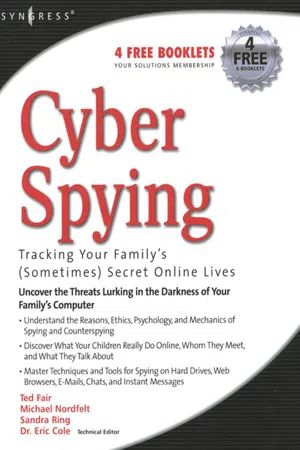
Cyber Spying Tracking Your Family's (Sometimes) Secret Online Lives
- 400 pages
- English
- ePUB (mobile friendly)
- Available on iOS & Android
eBook - ePub
Cyber Spying Tracking Your Family's (Sometimes) Secret Online Lives
About this book
Cyber Spying Tracking Your Family's (Sometimes) Secret Online Lives shows everyday computer users how to become cyber-sleuths. It takes readers through the many different issues involved in spying on someone online. It begins with an explanation of reasons and ethics, covers the psychology of spying, describes computer and network basics, and takes readers step-by-step through many common online activities, and shows what can be done to compromise them. The book's final section describes personal privacy and counter-spy techniques. By teaching by both theory and example this book empowers readers to take charge of their computers and feel confident they can be aware of the different online activities their families engage in.
- Expert authors have worked at Fortune 500 companies, NASA, CIA, NSA and all reside now at Sytex, one of the largest government providers of IT services
- Targets an area that is not addressed by other books: black hat techniques for computer security at the personal computer level
- Targets a wide audience: personal computer users, specifically those interested in the online activities of their families
Information
Chapter 1
Why Spy?
“A special feature of the structure of our book is the monstrous but perfectly organic part that eavesdropping plays in it.”—1958, A Hero of Our Time, Vladimir Nabokov
Topics in This Chapter:

Introduction to Spying
We have worked for quite a variety of places over the last 10 years, from university newspapers to Fortune 500 companies, to NASA, the NSA, and the place where we all met, the CIA. Each place had its own culture and collection of personalities. During our time at these wildly different companies, we discovered a few common traits between what would appear to be an uncategorizable variety of humans. These traits can be simply summed up as man’s desire to snoop, and man’s desire to stray. This book aims to satisfy the former and hopefully help to prevent the latter.
These two traits mentioned, the desire to snoop and the desire to stray, aren’t exactly what they seem to be at first. We’re using them in a slightly different context, so we’ll aim to clear up our definitions right now. For the purposes of this book, we refer to snooping as the curiosity to learn more about something you’re interested in, not any of the more voyeuristic definitions that can be applied to it. As you read these words, you’re probably thinking, “Not Me” I would never snoop on anyone. Before you proceed with condemning us and burning this book, take a second to stop and think about a few things. Have you ever gossiped about someone, ever? Ever gone to your neighbor’s open house just to see how they decorated? Ever read an e-mail over someone’s shoulder, or quickly glanced at a document on someone’s desk? If you answered yes to any of these, like it or not you’ve definitely snooped at some time in your life. Most of us have done these things and realize that a curiosity about your surroundings and others is part of fundamental human nature. Not snooping at all is ignorance, taking it too far is voyeurism, a balanced approach is intelligence collection, and that is what this book is about.
For the second of the traits that we’ll be discussing, straying, our definition of it does not directly correspond with Webster’s. We view straying not as literal infidelity, but the desire for any person to investigate their dark side. This can include but is not limited to cheating on a partner, drug or alcohol problems, gambling, gang participation, cheating in school, or almost any other illegal or unethical activity. We define this as “straying” since we feel most people want to and choose to do the right thing. Only occasionally or under the wrong influence do they embark on these activities. Straying isn’t always a bad thing either, but if it is your loved one is doing this, it is something you should probably know about. Even if you don’t choose to stop or limit this behavior, it is often worth monitoring to ensure that the perpetrators do not harm themselves, you, or others within their lives.
In all of these places we’ve worked and lived, we’ve come to realize that there are two fundamental lessons you can almost always count on: the abundance of human drama and results of having, or not having, the right information. These two lessons go hand in hand. Whether you live and work as a roofer in Baltimore, Domino’s Pizza in Alabama, or the Central Intelligence Agency in Washington, D.C., you encounter the same situations over and over. People’s spouses cheat, people have divorces, people or their children do drugs, fall in with the wrong crowd, and develop gambling or addiction problems. In every single case we discovered that the individuals who were aware of these issues or had prior knowledge of these events fared much better than those who did not. We’ve seen people worked over in divorces and parents completely stunned by their children when they failed to notice the problems.
The different aspects of human drama that we’ve described (divorce, drug use, infidelity, etc.) have been around for a long time. These are the same problems that couples and parents have struggled with for years. The widespread popularity and use of the Internet has added a new twist to these problems. They now can occur faster and easier as people are aided by the wealth of knowledge, instant connectivity, and perceived feeling of anonymity it offers. At one time an individual’s social circle consisted of who they lived with, worked with, went to school with and had direct personal contact with. Now, with direct personal contact not longer a necessity, it often consists of dozens of people spread around the world, some of questionable nature. New social circles are now generally an order of magnitude larger, and far more geographically diverse. In addition the relative anonymity of the Internet makes it far more difficult to judge the character or identity of a person’s Internet contact. How does one know if that twenty-two-year-old woman they’re talking to is really twenty-two, or even a woman?
As a result of this new connectivity the same events that have plagued us for ages are now occurring with the speed and power of the information age. More and more people are using their computers as enabling tools to assist them as they stray. People meet many possible new coconspirators online. In recent years a larger percentage of extramarital affairs have occurred as a result of people first meeting online. Even if the catalyst for the undesirable activity isn’t found online, it is quite common to use the expanded connectivity of the Internet to communicate with them. For example in 2003 several gangs in Plano, Texas, coordinated a big brawl using an online chat room. This demonstrates the pervasiveness of the Internet into almost all aspects of life, even such seemingly unlikely ones like gang activity.
During most of our careers we’ve been in highly technical offices, and worked with highly technical people. These people, like everyone else in the world, had to deal with infidelity, drug use, and other problems. In addition they were also dealing with the influence of computers in these areas. But unlike most of the world, our coworkers had extensive training in computer sec...
Table of contents
- Cover
- Title page
- Table of Contents
- Copyright
- Acknowledgments
- Authors
- Technical Editor
- Foreword
- Chapter 1: Why Spy?
- Chapter 2: Spying Basics
- Chapter 3: Technology Overview: Computer Basics
- Chapter 4: Network Basics
- Chapter 5: Taking Control
- Chapter 6: Spying on the PC
- Chapter 7: Spying on Web Browsing
- Chapter 8: Spying on E-mail
- Chapter 9: Spying on Chat and Instant Messages
- Chapter 10: Advanced Techniques
- Chapter 11: Counterspy: Are You Being Watched?
- Index
Trusted by 375,005 students
Access to over 1.5 million titles for a fair monthly price.
Study more efficiently using our study tools.
Frequently asked questions
Yes, you can cancel anytime from the Subscription tab in your account settings on the Perlego website. Your subscription will stay active until the end of your current billing period. Learn how to cancel your subscription
No, books cannot be downloaded as external files, such as PDFs, for use outside of Perlego. However, you can download books within the Perlego app for offline reading on mobile or tablet. Learn how to download books offline
Perlego offers two plans: Essential and Complete
- Essential is ideal for learners and professionals who enjoy exploring a wide range of subjects. Access the Essential Library with 800,000+ trusted titles and best-sellers across business, personal growth, and the humanities. Includes unlimited reading time and Standard Read Aloud voice.
- Complete: Perfect for advanced learners and researchers needing full, unrestricted access. Unlock 1.5M+ books across hundreds of subjects, including academic and specialized titles. The Complete Plan also includes advanced features like Premium Read Aloud and Research Assistant.
We are an online textbook subscription service, where you can get access to an entire online library for less than the price of a single book per month. With over 1.5 million books across 990+ topics, we’ve got you covered! Learn about our mission
Look out for the read-aloud symbol on your next book to see if you can listen to it. The read-aloud tool reads text aloud for you, highlighting the text as it is being read. You can pause it, speed it up and slow it down. Learn more about Read Aloud
Yes! You can use the Perlego app on both iOS and Android devices to read anytime, anywhere — even offline. Perfect for commutes or when you’re on the go.
Please note we cannot support devices running on iOS 13 and Android 7 or earlier. Learn more about using the app
Please note we cannot support devices running on iOS 13 and Android 7 or earlier. Learn more about using the app
Yes, you can access Cyber Spying Tracking Your Family's (Sometimes) Secret Online Lives by Eric Cole,Michael Nordfelt,Sandra Ring,Ted Fair in PDF and/or ePUB format, as well as other popular books in Computer Science & Cyber Security. We have over 1.5 million books available in our catalogue for you to explore.