eBook - ePub
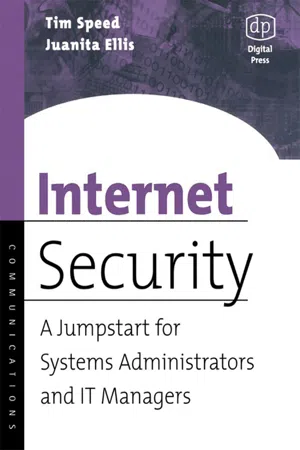
Internet Security
A Jumpstart for Systems Administrators and IT Managers
- 398 pages
- English
- ePUB (mobile friendly)
- Available on iOS & Android
eBook - ePub
About this book
Internet Security incorporates not only the technology needed to support a solid security strategy but also those policies and processes that must be incorporated in order for that strategy to work.New methods of breaking into corporate networks are resulting in major losses. This book provides the latest information on how to guard against attacks and informs the IT manager of the products that can detect and prevent break-ins. Crucial concepts such as authentication and encryption are explained, enabling the reader to understand when and where these technologies will be useful. Due to the authors' experiences in helping corporations develop secure networks, they are able to include the newest methods for protecting corporate data.·Shield data from both the internal and external intruder·Discover products that can detect and prevent these break-ins ·Protect against major losses with the latest incident handling procedures for detecting and recovering data from new viruses·Get details of a full security business review from performing the security risk analysis to justifying security expenditures based on your company's business needs
Information
1
The Internet and Security

Hacker, on the run—with your data!
1.1 The history of the Internet
1.1.1 The Internet
Back in 1866, the Wild West was “the future utopia” to Americans who were already in what was originally supposed to be “the land of opportunity.” Civil War, reconstruction, and corruption in the White House were the current headlines of the day. Thus, eyes turned to the West for opportunity and new beginnings. The Wild West was supposed to be a place where everyone could go for cheap land, free gold, and a good beach (and eventually surfing, if they made it to the coast). The Wild West was often not this ideal, as demonstrated by the word “Wild.” Many used it and abused it for the purpose of pillaging, robbing, lawlessness, and bordellos. It is not so different with today’s Internet. The Internet is supposed to be a network that links thousands, millions, or even billions of computers together in order to send and receive data in perfect tranquility. First, the Internet is not a single network and, as you may have guessed, it is not always safe. The Internet is changing by the day, by the hour, by the minute, and has changed the face of technology and business both in just under three decades. The Internet is more than 27 years old. The WWW (World Wide Web, e.g., www.lookatmywebpage.com1) is actually less than 10 years old. Before the WWW, there was WORM, the first of which burrowed through the Internet in 1988. As you can see, the Internet has been around for quite some time. Web sites developed more recently. The Internet is not a single agency, a network, or a company. It is a collection of networks and authorities. Following are a few dates (and decades) to tell you how it became as it is today.
In 1858, a telegram of 98 words from Queen Victoria to President James Buchanan of the United States opened a new era in global communication. The queen’s message of congratulation took 16½ hours to transmit through the new transatlantic telegraph cable. The president then sent a reply of 143 words back to the queen. Normally, without the cable, a dispatch in one direction would have taken perhaps 12 days by the speediest combination of inland telegraph and fast steamer.
Just a bit more than 100 years later, we see the creation of a new medium of communication, based on the same basic technology of the telegraph, electrons, and wires2. Starting in the early 1960s, we see the creation of ARPANET, the beginning of the Vietnam War, and the rise of bell-bottoms and ring pops. A lot happened in the 1960s that has helped develop the Internet into the Ebays, Amazons, AOLs, and hotornots that we know, love, and sometimes hate.
July, 1961: At MIT, Leonard Kleinrock (i.e., ubernerd) published the first paper on the packet switching theory. Kleinrock convinced his peers that communication using packets, rather than circuits, was not only feasible but also practical. Experiments followed, but only circuit type connections were tested. Thus, the results of these experiments demonstrated the need for packet communications.
August, 1962: Memos written by J. C. R. Licklider of MIT discussed the possibility and use of networked computers. The concept was titled, “The Galactic Network,” by Licklider. Yes, he came up with this term before Star Trek was on the air. Licklider envisioned a globally interconnected set of computers through which everyone could access data and programs, no matter where they were physically. He became the first head of the computer research program at DARPA.
Mid-1960s: People began writing all types of papers on the subject of networks. One of the first papers on the ARPANET3 was published by Lawrence G. Roberts4. Also at this time were papers on packet switching. One such paper was written by a good gentleman known as Donald Davies. Donald is the English inventor of packet switching. He theorized at the British National Physical Laboratory (NPL) about building a network of computers to test his packet switching concepts. At about the same time, 1964 (besides the Beatles and James Bond), Paul Baran and others at the RAND group had written a paper on packet switching networks for secure voice in the military. With all of these papers being floated around, it happened that the work at MIT5 (1961–1967), the work at the RAND corporation (1962–1965) and the work at the NPL (1964–1967) had occurred all at the same time and without any of the researchers knowing about the others’ work. The word packet was adopted from the work at the NPL. A packet is a unit of data that is routed between a network source and a network destination on any network.
August, 1968: An RFQ (Request for Quote) was released by DARPA6 for the development of the key components for the ARPANET. The RFQ included the definition and creation of a device known as the IMP7. The IMP’s job was to manage the packets and provide an interface to the computer at each site. A group headed by Frank Heart at Bolt Beranek and Newman (BBN) won the job in 1968. The team at BBN worked on the IMP with Bob Kahn, thus playing a major role in the overall ARPANET architectural design. The N...
Table of contents
- Cover image
- Title page
- Table of Contents
- Copyright
- Dedication
- Foreword
- Acknowledgments
- Introduction
- Chapter 1: The Internet and Security
- Chapter 2: The Security Review Process
- Chapter 3: Cryptography
- Chapter 4: Secure Networks
- Chapter 5: Protecting Your Intranet from the Extranet and Internet
- Chapter 6: Authentication and Authorization
- Chapter 7: E-Commerce: Public Key Infrastructure
- Chapter 8: Messaging Security
- Chapter 9: What Are We Doing Here?
- Chapter 10: Disaster Recovery
- Appendix 1: Security Tools
- Appendix 2: The CERT Report
- Glossary
- References
- Index
Trusted by 375,005 students
Access to over 1.5 million titles for a fair monthly price.
Study more efficiently using our study tools.
Frequently asked questions
Yes, you can cancel anytime from the Subscription tab in your account settings on the Perlego website. Your subscription will stay active until the end of your current billing period. Learn how to cancel your subscription
No, books cannot be downloaded as external files, such as PDFs, for use outside of Perlego. However, you can download books within the Perlego app for offline reading on mobile or tablet. Learn how to download books offline
Perlego offers two plans: Essential and Complete
- Essential is ideal for learners and professionals who enjoy exploring a wide range of subjects. Access the Essential Library with 800,000+ trusted titles and best-sellers across business, personal growth, and the humanities. Includes unlimited reading time and Standard Read Aloud voice.
- Complete: Perfect for advanced learners and researchers needing full, unrestricted access. Unlock 1.5M+ books across hundreds of subjects, including academic and specialized titles. The Complete Plan also includes advanced features like Premium Read Aloud and Research Assistant.
We are an online textbook subscription service, where you can get access to an entire online library for less than the price of a single book per month. With over 1.5 million books across 990+ topics, we’ve got you covered! Learn about our mission
Look out for the read-aloud symbol on your next book to see if you can listen to it. The read-aloud tool reads text aloud for you, highlighting the text as it is being read. You can pause it, speed it up and slow it down. Learn more about Read Aloud
Yes! You can use the Perlego app on both iOS and Android devices to read anytime, anywhere — even offline. Perfect for commutes or when you’re on the go.
Please note we cannot support devices running on iOS 13 and Android 7 or earlier. Learn more about using the app
Please note we cannot support devices running on iOS 13 and Android 7 or earlier. Learn more about using the app
Yes, you can access Internet Security by Tim Speed,Juanita Ellis in PDF and/or ePUB format, as well as other popular books in Business & Business intelligence. We have over 1.5 million books available in our catalogue for you to explore.