eBook - ePub
Managing Systems Migrations and Upgrades
Demystifying the Technology Puzzle
- 320 pages
- English
- ePUB (mobile friendly)
- Available on iOS & Android
eBook - ePub
Managing Systems Migrations and Upgrades
Demystifying the Technology Puzzle
About this book
Managing Systems Migrations and Upgrades is the perfect book for technology managers who want a rational guide to evaluating the business aspects of various possible technical solutions. Enterprises today are in the middle of the R&D race for technology leadership, with providers who increasingly need to create markets for new technologies while shortening development, implementation, and life cycles. The cost for the current tempo of technology life cycles is endless change-management controls, organizational chaos, production use of high-risk beta products, and greater potential for failure of existing systems during migration.Burkey and Breakfield help you answer questions such as, "Is the only solution open to me spending more that the industry average in order to succeed?" and "What are the warning signs that tell me to pass on a particular product offering?" as well as "How can my organization avoid the 'technical death marches' typical of the industry?" This book will take the confusion out of when to make shifts in your systems and help you evaluate the value proposition of these technology changes.·Provides a methodology for decision making and implementation of upgrades and migrations·Avoids marketing hype and the "technical herding" instinct·Offers a tool to optimize technology changes for both staff and customers
Information
1
Outside Looking In
Enterprises are faced with rising costs in technology and difficulty deciding what changes to make and which technology to embrace. The volatility of the stock market over the last few years, together with the spread of blame from telecom, to technology, to dotcoms, compounds the confusion. The practice of stepping back and reviewing a situation or seeing it through someone else’s eyes often helps clarify the view. Issues and concerns are worldwide and many groups are wrestling with how to master the use of technology. Mistakes are natural and they are either dealt with or ignored. It is important to look at what is happening all around to gain a better insight of the choices available that present the best options.
Business leaders meet annually to discuss the directions of business in the global economy. Insights from these enterprise leaders indicate that technology is spawning new challenges, as well as opportunities for change, not only in how business is conducted now, but how it needs to position itself to conduct business in the future. Rapid changes brought on by the Internet’s ability to level the playing field for business is part of the solution and part of the problem. Building the foundations within an organization to battle the new competitors and maintain a reasonable profit margin is difficult in these times. Understanding the leading issues can help determine the position of the enterprise relative to other global organizations.
The largest concern to the technology group within any enterprise is the reliability of the services provided to internal and external users. Customers, vendors, and staff need to know the information required is available and accurate. Existing systems that cast doubt on performance or access to information are not acceptable. Increasing the ability to automate mundane functions while freeing up human resources to deal with problems and resolve issues is critical. An enterprise’s ability to respond reliably to the needs of its users is poised to face today’s global challenges businesses.
Once positioned for technology changes, an enterprise must remember that all changes require careful planning. The changes that result from mergers and acquisitions are the most difficult to mesh from a technology standpoint. Review of the cost, time, impact on the organization, interoperability within the environment, and reliability is critical to success. Changes, especially in the area of technology, impact the enterprise at many levels from internal functionality to end-customer interactions. Information technology professionals are asking for failure when they take on changes that are poorly thought out or planned on the fly. From the foundational information provided in this section, one can gain insight as to what enterprises are facing and the reality of changes over the last 20 years that are impacting businesses. A big picture view of the evolution of technology and where to go from here is a part of being outside and looking in.
1.1 Problem signs and how we got here
To the person on the street, the world of technology must seem a confusing, even mysterious, stream of events, breakthrough announcements, product introductions, initial public offerings (IPOs), and acquisitions. Computerized day traders push and pull the NASDAQ index up and down by invading, then retreating against, technology stocks. While visiting a Web-based day-trading company, a manager exclaimed, “Oh no, the technology stock I put my mother-in-law in just fell through the floor. Oh well.” Then, he asked associates if they knew of the company and what its business focus was. It is not surprising to hear novices, boasting of their latest trades, indicate that the neat technology advertising efforts drove the stock-trading frenzy. If asked questions about a particular company’s technology and whether it played a part in the selection process or even the importance of the stated earning per share, most typical responses include a blank stare. Technology is moving too fast, and now the impact is too great to simply accept directions. The shift in the telecom market segment between 1998 and 2000, as indicated in Figure 1.1, is in line with the shift in the technology market overall.
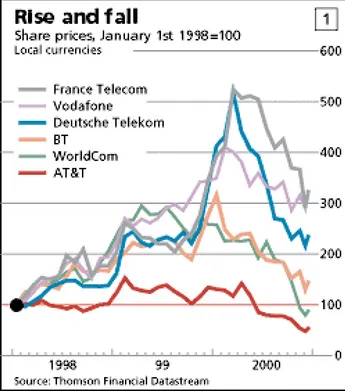
Figure 1.1 Telecom industry market shift, 1998 to 2000.
For these novices, the herding instinct is very strong. They know very little of the underlying technology, but they want very much to participate in the action. Unfortunately, the underlying explanation of what is really going on in an exciting and very enigmatic industry does not mean much to those outside the technical industry. Many technology-savvy professionals find it difficult to qualify or explain their jobs to outsiders, and when asked what they do, they might say they manage 1s and 0s rather than try to explain in detail. Even within the confines of the technology industry, professionals are introduced as gurus for particular technologies or processes. As a result, the depth and breadth of technology is unclear to outsiders, but it is terribly interesting as well as something that everyone is talking about.
With regard to particular products or unique technologies, the drill is usually to enlist a specialist’s input as the final word on the subject. Since there are so many specialty technologies and because no one can be an authority on everything, enterprises have come to depend upon these technical gunslingers to deliver the final word, and all decisions flow from that event. The problem becomes quite troublesome when technical knowledge is replaced by personal charisma. When this happens, CEOs of technical companies make directional or visionary statements that tend to be accepted at face value by enterprises. This is not to say that these industry leaders are being intentionally deceptive, merely that they are trying to forward technology focus for profitability. When decisions are made with a limited knowledge base to evaluate what is being said, the tendency is to accept such statements and operate as though the decisions are absolute.
Since the advent of the computer age, with its promise to make things better as well as easier, people have been compelled to accept the promise of technology’s contribution as a market mainstay. There is an old joke about a bank statement calculation extracted from a computer and given to a customer who exclaimed, “This can’t be right!” The teller calmly states that the statement has just been pulled off the computer and how could the computer be wrong? The customer goes away shaking his head saying, “Yeah, how could the computer be wrong?”
Actually, there are several ways. Do you recall the computational error in the first-generation Intel Pentium chips? What if the input was incorrect or the output was tampered with? If you accept the output source as flawless and 100% accurate all the time, then the information must also be flawless. If you have no way to check the output or to gauge its accuracy, you are stuck. Nontechnology people today are forced to accept statements from technology professionals without question, because they lack the necessary background information to challenge those who are in a position to know. Humans have long recognized that they cannot know everything about everything. Therefore, they depend upon experts and leaders to provide missing information to make appropriate decisions. In the case of technology, which is advancing at such rapid rates, one needs to ask the following questions. Where do the experts and industry leaders get their information? What happens when the experts disagree or contradict one another?
The old adage is true: people don’t buy from companies; they buy from people, particularly from people they believe and trust. That, however, does not mean that those people are always correct in their advice. The analysts today review the status of technology providers and offer insight to the public on what is right and wrong. If the information is not reviewed from multiple perspectives, then the accuracy of the decision is questionable. Investment in technology, either for a personal portfolio or as the next step in an enterprise’s technology expansion, must be based on accurate information.
1.2 Outside review for problem identification
Globally, enterprise leaders are assessing the status of their particular industries and enterprises. The measurement for the assessment is based on many factors, with the strongest focus being on competitive position. Currently the competitive focus is looking toward the Internet and its increasing promise to level the playing field for enterprises to compete fairly worldwide. The importance of the Internet to workers, peer enterprises, and competitors is strongest in the European and the Asia-Pacific markets, where greater speed and flexibility are in higher demand. As a consequence of the Internet, technology is transforming industries and commerce overnight with enhanced business productivity and customer value-added functionality. Enterprises are trying to harness new technologies, adapt products, respond to customer needs, and expand mergers and alliances rapidly, while retaining and expanding their customer bases. Clearly, those enterprises that can effectively apply technology changes will survive.
For example, help-desk costs are skyrocketing in most organizations. With the increasing complexity of distributed assets and the proliferation of mobile users, organizations are looking for ways to minimize costs for user support without compromising high-level service expectations. Table 1.1 lists some ways to reduce help-desk support costs.
Table 1.1
Help-Desk Tools to Explore
Implement software and processes for scanning PCs remotely on demand to improve the help-desk staff’s efficiency and ability to solve user problems without making a trip to the desktop.
Develop and publish standard desktop configurations.
Identify and remove nonstandard installed hardware or software.
Use remote control (i.e., Timbuktu) to avoid visits to the desktop to solve more problems more quickly.
In a survey conducted by The Conference Board of 506 CEOs around the world in late 2000, 33% of responders cited downward pressure on prices and 32% reported maintaining technology-skilled workers as major obstacles. Conference attendees agreed the three fronts requiring battle plans by enterprises over the next 5 years were, not surprisingly, increasing competition from all sectors, the Internet, and the effects of consolidation. To one degree or another, each of these fronts was marked as a major cause of growth obstacles. This survey also indicates that the global regional impacts are varied owing to the respective economic and globalization changes. Industry restructuring by consolidation efforts and the impact of the Internet affect economic growth, market expansion, and ultimately the demand for technology-skilled workers. The trends are toward smaller, focused business units situated closer to the ...
Table of contents
- Cover image
- Title page
- Table of Contents
- Copyright
- Dedication
- Introduction
- Chapter 1: Outside Looking In
- Chapter 2: Marketplace Pulse
- Chapter 3: Selling Cycle
- Chapter 4: Development Cycle
- Chapter 5: The Migration Process
- Chapter 6: Technology Shortfall Impact
- Chapter 7: Support Issues
- Chapter 8: Move-Forward Model
- Chapter 9: Summary Findings
- A: Glossary
- B: References
- Attributations
- Index
- About the Authors
Trusted by 375,005 students
Access to over 1.5 million titles for a fair monthly price.
Study more efficiently using our study tools.
Frequently asked questions
Yes, you can cancel anytime from the Subscription tab in your account settings on the Perlego website. Your subscription will stay active until the end of your current billing period. Learn how to cancel your subscription
No, books cannot be downloaded as external files, such as PDFs, for use outside of Perlego. However, you can download books within the Perlego app for offline reading on mobile or tablet. Learn how to download books offline
Perlego offers two plans: Essential and Complete
- Essential is ideal for learners and professionals who enjoy exploring a wide range of subjects. Access the Essential Library with 800,000+ trusted titles and best-sellers across business, personal growth, and the humanities. Includes unlimited reading time and Standard Read Aloud voice.
- Complete: Perfect for advanced learners and researchers needing full, unrestricted access. Unlock 1.5M+ books across hundreds of subjects, including academic and specialized titles. The Complete Plan also includes advanced features like Premium Read Aloud and Research Assistant.
We are an online textbook subscription service, where you can get access to an entire online library for less than the price of a single book per month. With over 1.5 million books across 990+ topics, we’ve got you covered! Learn about our mission
Look out for the read-aloud symbol on your next book to see if you can listen to it. The read-aloud tool reads text aloud for you, highlighting the text as it is being read. You can pause it, speed it up and slow it down. Learn more about Read Aloud
Yes! You can use the Perlego app on both iOS and Android devices to read anytime, anywhere — even offline. Perfect for commutes or when you’re on the go.
Please note we cannot support devices running on iOS 13 and Android 7 or earlier. Learn more about using the app
Please note we cannot support devices running on iOS 13 and Android 7 or earlier. Learn more about using the app
Yes, you can access Managing Systems Migrations and Upgrades by Charles Breakfield,Roxanne Burkey in PDF and/or ePUB format, as well as other popular books in Computer Science & Information Technology. We have over 1.5 million books available in our catalogue for you to explore.