
- 320 pages
- English
- ePUB (mobile friendly)
- Available on iOS & Android
eBook - ePub
About this book
UML, the Universal Modeling Language, was the first programming language designed to fulfill the requirement for "universality." However, it is a software-specific language, and does not support the needs of engineers designing from the broader systems-based perspective. Therefore, SysML was created. It has been steadily gaining popularity, and many companies, especially in the heavily-regulated Defense, Automotive, Aerospace, Medical Device and Telecomms industries, are already using SysML, or are plannning to switch over to it in the near future. However, little information is currently available on the market regarding SysML. Its use is just on the crest of becoming a widespread phenomenon, and so thousands of software engineers are now beginning to look for training and resources. This book will serve as the one-stop, definitive guide that provide an introduction to SysML, and instruction on how to implement it, for all these new users.
- SysML is the latest emerging programming language--250,000 estimated software systems engineers are using it in the US alone!
- The first available book on SysML in English
- Insider information! The author is a member of the SysML working group and has written sections of the specification
- Special focus comparing SysML and UML, and explaining how both can work together
Information
CHAPTER 1 Introduction
Technology evolves from the primitive over the complicated to the simple.
(Antoine de Saint-Exupéry)
When you have read this chapter you can answer the following questions:1

1.1 Preliminaries
“Things had been much simpler in the past. You had been able to put something up and get it running with just a handful of people. Today the number of people you need quickly runs up to a hundred to develop a decent system. And even then they don’t normally get things right … With all those experts from all kinds of disciplines …”
I hear such and similar talk increasingly often. As a trainer and consultant, I meet a lot of people from most different industries. But the tone is always the same. What’s the reason? Very simple: progress.
We have reached a point where what’s needed are complex and distributed systems, but where conventional development methods are not yet ready to make such systems available fast enough and at acceptable cost.
We cannot expect to develop increasingly progressive, larger, and better systems while continue using the same tools. Our approach, the modeling languages we use, and the development environments have to be part of this progress and evolve in line with it.
In software development, e.g., this evolution can be seen quite clearly. Development tools have known increasingly larger components (from 0/1 to classes/objects) from the times we used punch cards, and then Assembler, and then procedural programming languages, and eventually object-oriented languages, thus facilitating the description of complex systems. The evolution to the next generation has already begun: The graphical Unified Modeling Language (UML) has become increasingly popular for developing software systems, and it is being used to solve more and more tasks that had been previously done with conventional programming languages (Figure 1.1).
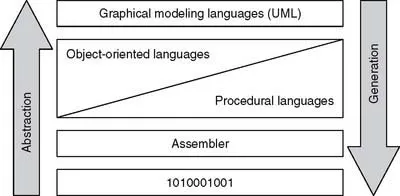
FIGURE 1.1 Increasing abstraction of programming languages.
In systems engineering (system development) the boundaries between the different disciplines continue to blur. Especially software is used in more and more fields. These hybrid systems represent a particular challenge to the development.
We can use proven methods to efficiently develop individual components of a complete system. However, the complete system is more than the sum of its components. The interplay between all the elements can be extremely complex and hard to control.
The need for a holistic line of thinking is particularly strong in the software development field. Embedding a piece of software in a system is a critical complexity factor. The consequence is that both approach models and notations are required to be able to develop these systems effectively. Otherwise the development cost will rise out of proportion compared with an acceptable price in the near future.
Systems engineering has been dealing with this problem for quite some time. The development of large systems in which many different disciplines participate requires holistic lines of thinking. This means that the requirements and structures of a system are looked at totally detached from the knowledge of specific details. The entire lifecycle from the idea to the disposal is planned to develop a system that fulfills the wishes of all participants.
Software development can learn a lot from systems engineering. But there is no taking without giving. Systems engineering can also learn from software development, where highly developed modeling tools and methods are available. The Unified Modeling Language (UML™) is a modeling language from this field. It has established itself as a worldwide standard. What systems engineering has been lacking is a standardized modeling language. This situation will change with the new Systems Modeling Language (OMG SysML™). SysML is based on UML and is supported by leading organizations from the systems engineering industry, including the International Council on Systems Engineering (INCOSE).
1.1.1 Is This Book for Me?
This book will be interesting and helpful to you if you
This book will introduce you to a toolbox you can use to take a uniform road all the way from the idea of...
Table of contents
- Cover image
- Title page
- Table of Contents
- Morgan Kaufmann OMG Press
- Copyright
- Foreword by Richard M. Soley
- Author Biography
- Chapter 1: Introduction
- Chapter 2: The Pragmatic SYSMOD Approach
- Chapter 3: UML—Unified Modeling Language
- Chapter 4: SysML—The Systems Modeling Language
- Chapter 5: Systems Engineering Profile—SYSMOD
- Glossary
- References
- Index
Trusted by 375,005 students
Access to over 1.5 million titles for a fair monthly price.
Study more efficiently using our study tools.
Frequently asked questions
Yes, you can cancel anytime from the Subscription tab in your account settings on the Perlego website. Your subscription will stay active until the end of your current billing period. Learn how to cancel your subscription
No, books cannot be downloaded as external files, such as PDFs, for use outside of Perlego. However, you can download books within the Perlego app for offline reading on mobile or tablet. Learn how to download books offline
Perlego offers two plans: Essential and Complete
- Essential is ideal for learners and professionals who enjoy exploring a wide range of subjects. Access the Essential Library with 800,000+ trusted titles and best-sellers across business, personal growth, and the humanities. Includes unlimited reading time and Standard Read Aloud voice.
- Complete: Perfect for advanced learners and researchers needing full, unrestricted access. Unlock 1.5M+ books across hundreds of subjects, including academic and specialized titles. The Complete Plan also includes advanced features like Premium Read Aloud and Research Assistant.
We are an online textbook subscription service, where you can get access to an entire online library for less than the price of a single book per month. With over 1.5 million books across 990+ topics, we’ve got you covered! Learn about our mission
Look out for the read-aloud symbol on your next book to see if you can listen to it. The read-aloud tool reads text aloud for you, highlighting the text as it is being read. You can pause it, speed it up and slow it down. Learn more about Read Aloud
Yes! You can use the Perlego app on both iOS and Android devices to read anytime, anywhere — even offline. Perfect for commutes or when you’re on the go.
Please note we cannot support devices running on iOS 13 and Android 7 or earlier. Learn more about using the app
Please note we cannot support devices running on iOS 13 and Android 7 or earlier. Learn more about using the app
Yes, you can access Systems Engineering with SysML/UML by Tim Weilkiens in PDF and/or ePUB format, as well as other popular books in Computer Science & Programming Languages. We have over 1.5 million books available in our catalogue for you to explore.