eBook - ePub
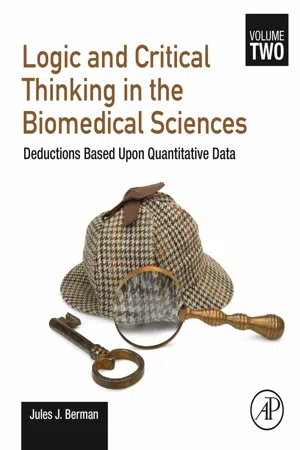
Logic and Critical Thinking in the Biomedical Sciences
Volume 2: Deductions Based Upon Quantitative Data
- 290 pages
- English
- ePUB (mobile friendly)
- Available on iOS & Android
eBook - ePub
Logic and Critical Thinking in the Biomedical Sciences
Volume 2: Deductions Based Upon Quantitative Data
About this book
All too often, individuals engaged in the biomedical sciences assume that numeric data must be left to the proper authorities (e.g., statisticians and data analysts) who are trained to apply sophisticated mathematical algorithms to sets of data. This is a terrible mistake. Individuals with keen observational skills, regardless of their mathematical training, are in the best position to draw correct inferences from their own data and to guide the subsequent implementation of robust, mathematical analyses. Volume 2 of Logic and Critical Thinking in the Biomedical Sciences provides readers with a repertoire of deductive non-mathematical methods that will help them draw useful inferences from their own data.Volumes 1 and 2 of Logic and Critical Thinking in the Biomedical Sciences are written for biomedical scientists and college-level students engaged in any of the life sciences, including bioinformatics and related data sciences.
- Demonstrates that a great deal can be deduced from quantitative data, without applying any statistical or mathematical analyses
- Provides readers with simple techniques for quickly reviewing and finding important relationships hidden within large and complex sets of data
- Using examples drawn from the biomedical literature, discusses common pitfalls in data interpretation and how they can be avoided
Information
1
Learning what counting tells us
Abstract
The act of counting objects is a difficult and underappreciated task. Many of the entrenched misconceptions in science come from sloppy counting protocols. Knowing the number and diversity of data objects (i.e., how many classes of objects are present in the data set and how many members belong to each of those classes) tells us a great deal about the nature of biological data. This chapter teaches us that the process of counting biological objects (e.g., organisms, species, genes, proteins, and variants thereof) will often reveal or clarify profound biological mysteries. Examples will include why there are at least 50 million species of living organisms on earth; the significance of having just a handful of species belonging to the monotremes, while there are many thousands of species of beetles; why there is only a small number of general classes of body plans; what we learn by comparing the number of herbivorous mammals to the number of carnivorous mammals; acquired diseases are more common than genetic diseases why rare diseases are biologically, not just numerically, different from common diseases.
Keywords
Counting; Speciation; Biological diversification; Mutation rate; Mutation burden; Disease incidence
“Not everything that counts can be counted, and not everything that can be counted counts.”
William Bruce Cameron.
Section 1.1 Science is mostly about counting stuff
Much of what we know about reality comes from counting. We count the number of occurrences of disease, the number of days that a disease persists, the number of working days lost to the disease, the number of emergency room visits prompted by the disease, and so on. Once we have all those counts, we need somewhere to put them, so we invent classifications into which we assign the various types of things that we’ve counted. Explained this way, our most common scientific pursuit seems trivial, but without those counts, we would never understand much of anything.
When we take a short break from counting things (e.g., when measuring sizes or looking for patterns), we typically use our preliminary observations as the basis for new counting projects. For example, we can set up weather stations with equipment that continuously monitors the temperature, humidity, barometric pressure, and wind velocity at multiple locations. Each of these measurements produces a waveform, demonstrating how a variable changes over time. Typically, analysts will take the waveform data and transform it into counted items, such as the number of days in the year wherein the temperature exceeded 37°C, or the number of instances wherein the humidity exceeded 80% while the wind velocity fell below 4 miles per hour. In the field of digital signal processing, signals are commonly transformed from the time domain (e.g., waveforms) to the frequency domain (counts of occurrences of a particular type) for the purpose of analysis and manipulation. [Glossary Digital signal processing, Signal, Time, Waveform]
In the realm of bioinformatics, we like to think that we have moved beyond merely counting things and into a new realm of analysis unlocked by the genetic code. The sequence of nucleotides determines the function of a gene, not the quantity of each component nucleotide. Nonetheless, counting retains a position of paramount importance in molecular biology. When we find a gene pattern or motif of significance, we count how often it appears in the genome. When we observe a gene variant, we look to see how often it occurs in the population and whether it correlates with any specific biological feature (e.g., trait and disease). We found that gene expression is best determined by counting the number of expressed (i.e., mRNA) and translated (i.e., protein) sequences. It’s always the same story; just as soon as we discover anything of merit at the molecular level, we proceed to count what we’ve found.
Section 1.2 Never count on an accurate count
Most people would agree that the simple act of counting data is something that can be done accurately and reproducibly from laboratory to laboratory. Actually, this is not the case. Counting is fraught with errors. Consider the problem of counting words in a paragraph, it seems straightforward, until you start asking yourself how you might deal with hyphenated words. “De-identified” is certainly one word. “Under-represented” is probably one word, but sometimes the hyphen is replaced by a space, and then it is certainly two words. How about the term “military-industrial, “which seems as though it should be two words? When a hyphen occurs at the end of a line, should we force a concatenation between the syllables at the end of one line and the start of the next?
Slashes are a tougher nut to crack than hyphens. How should we count terms that combine two related words by a slash, such as “medical/pharmaceutical,” one word or two words? If we believe that the slash is a word separator (i.e., slashes mark the end of one word and the beginning of another), then we would need to parse Web addresses into individual words. [Glossary Parsing]
For example:
- www.science.com/stuff/neat_stuff/super_neat_stuff/balloons.htm
The Web address could be broken into a string of words if the “.” and “_” characters could be considered valid word separators. In that case the single Web address would consist of 11 words: www, science, com, stuff, neat, stuff, super, neat, stuff, balloons, and htm. If you were only counting words that match entries in a standard dictionary, then the split Web address would contain eight words: science, stuff, neat, stuff, super, neat, stuff, and balloons. If we defined a word as a string bounded by a space or a part-of-sentence separator (e.g., period, comma, colon, semicolon, question mark, exclamation mark, and end-of-line character), then the unsplit Web address would count as one word. If the word must match a dictionary term, then the unsplit Web address would count as zero words. So, which is it: 11 words, or 8 words, or 1 word or 0 words? [Glossary String]
This is just the start of the problem. How shall we deal with abbreviations1, 2? Should abbreviations be counted as one word, or as the sum of words represented by the abbreviation? Is “U.S.” one word or two words? Suppose, before counting words, the text is preprocessed to expand abbreviations (i.e., every instance of “U.S.” becomes an instance of United States, and UCLA would count as four words). This would yield an artificial increase in the number of words in the document. How would the word counter deal with abbreviations that look like words, such as “mumps,” which could be the name of a viral disease of childhood, or it could be an abbreviation for a computer language ...
Table of contents
- Cover image
- Title page
- Table of Contents
- Copyright
- Other books by Jules J. Berman
- Dedication
- About the author
- Preface
- 1: Learning what counting tells us
- 2: Drawing inferences from absences of data values
- 3: Drawing inferences from data ranges
- 4: Drawing inferences from outliers and exceptions
- 5: What we learn when our data are abnormal
- 6: Using time to solve cause and effect dilemmas
- 7: Heuristic methods that use random numbers
- 8: Estimations for biomedical data
- Index
Trusted by 375,005 students
Access to over 1.5 million titles for a fair monthly price.
Study more efficiently using our study tools.
Frequently asked questions
Yes, you can cancel anytime from the Subscription tab in your account settings on the Perlego website. Your subscription will stay active until the end of your current billing period. Learn how to cancel your subscription
No, books cannot be downloaded as external files, such as PDFs, for use outside of Perlego. However, you can download books within the Perlego app for offline reading on mobile or tablet. Learn how to download books offline
Perlego offers two plans: Essential and Complete
- Essential is ideal for learners and professionals who enjoy exploring a wide range of subjects. Access the Essential Library with 800,000+ trusted titles and best-sellers across business, personal growth, and the humanities. Includes unlimited reading time and Standard Read Aloud voice.
- Complete: Perfect for advanced learners and researchers needing full, unrestricted access. Unlock 1.5M+ books across hundreds of subjects, including academic and specialized titles. The Complete Plan also includes advanced features like Premium Read Aloud and Research Assistant.
We are an online textbook subscription service, where you can get access to an entire online library for less than the price of a single book per month. With over 1.5 million books across 990+ topics, we’ve got you covered! Learn about our mission
Look out for the read-aloud symbol on your next book to see if you can listen to it. The read-aloud tool reads text aloud for you, highlighting the text as it is being read. You can pause it, speed it up and slow it down. Learn more about Read Aloud
Yes! You can use the Perlego app on both iOS and Android devices to read anytime, anywhere — even offline. Perfect for commutes or when you’re on the go.
Please note we cannot support devices running on iOS 13 and Android 7 or earlier. Learn more about using the app
Please note we cannot support devices running on iOS 13 and Android 7 or earlier. Learn more about using the app
Yes, you can access Logic and Critical Thinking in the Biomedical Sciences by Jules J. Berman in PDF and/or ePUB format, as well as other popular books in Medicine & Pharmaceutical, Biotechnology & Healthcare Industry. We have over 1.5 million books available in our catalogue for you to explore.