For many years, various editions of Smallman's Modern Physical Metallurgy have served throughout the world as a standard undergraduate textbook on metals and alloys. In 1995, it was rewritten and enlarged to encompass the related subject of materials science and engineering and appeared under the title Metals & Materials: Science, Processes, Applications offering a comprehensive amount of a much wider range of engineering materials. Coverage ranged from pure elements to superalloys, from glasses to engineering ceramics, and from everyday plastics to in situ composites, Amongst other favourable reviews, Professor Bhadeshia of Cambridge University commented: "Given the amount of work that has obviously gone into this book and its extensive comments, it is very attractively priced. It is an excellent book to be recommend strongly for purchase by undergraduates in materials-related subjects, who should benefit greatly by owning a text containing so much knowledge."The book now includes new chapters on materials for sports equipment (golf, tennis, bicycles, skiing, etc.) and biomaterials (replacement joints, heart valves, tissue repair, etc.) - two of the most exciting and rewarding areas in current materials research and development. As in its predecessor, numerous examples are given of the ways in which knowledge of the relation between fine structure and properties has made it possible to optimise the service behaviour of traditional engineering materials and to develop completely new and exciting classes of materials. Special consideration is given to the crucial processing stage that enables materials to be produced as marketable commodities. Whilst attempting to produce a useful and relatively concise survey of key materials and their interrelationships, the authors have tried to make the subject accessible to a wide range of readers, to provide insights into specialised methods of examination and to convey the excitement of the atmosphere in which new materials are conceived and developed.
In everyday life we encounter a remarkable range of engineering materials: metals, plastics and ceramics are some of the generic terms that we use to describe them. The size of the artefact may be extremely small, as in the silicon microchip, or large, as in the welded steel plate construction of a suspension bridge. We acknowledge that these diverse materials are quite literally the stuff of our civilization and have a determining effect upon its character, just as cast iron did during the Industrial Revolution. The ways in which we use, or misuse, materials will obviously also influence its future. We should recognize that the pressing and interrelated global problems of energy utilization and environmental control each has a substantial and inescapable ‘materials dimension’.
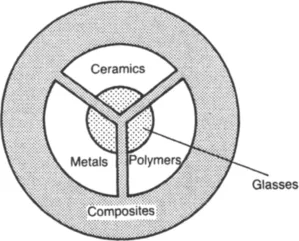
The engineer is primarily concerned with the function of the component or structure, frequently with its capacity to transmit working stresses without risk of failure. The secondary task, the actual choice of a suitable material, requires that the materials scientist should provide the necessary design data, synthesize and develop new materials, analyse failures and ultimately produce material with the desired shape, form and properties at acceptable cost. This essential collaboration between practitioners of the two disciplines is sometimes expressed in the phrase ‘Materials Science and Engineering (MSE)’. So far as the main classes of available materials are concerned, it is initially useful to refer to the type of diagram shown in Figure 1.1. The principal sectors represent metals, ceramics and polymers. All these materials can now be produced in non-crystalline forms, hence a glassy ‘core’ is shown in the diagram. Combining two or more materials of very different properties, a centuries-old device, produces important composite materials: carbon-fibre-reinforced polymers (CFRP) and metal-matrix composites (MMC) are modern examples.
Figure 1.1 The principal classes of materials (after Rice, 1983).
Adjectives describing the macroscopic behaviour of materials naturally feature prominently in any language. We write and speak of materials being hard, strong, brittle, malleable, magnetic, wear-resistant, etc. Despite their apparent simplicity, such terms have depths of complexity when subjected to scientific scrutiny, particularly when attempts are made to relate a given property to the internal structure of a material. In practice, the search for bridges of understanding between macroscopic and microscopic behaviour is a central and recurrent theme of materials science. Thus Sorby’s metallurgical studies of the structure/property relations for commercial irons and steel in the late nineteenth century are often regarded as the beginning of modern materials science. In more recent times, the enhancement of analytical techniques for characterizing structures in fine detail has led to the development and acceptance of polymers and ceramics as trustworthy engineering materials.
Having outlined the place of materials science in our highly material-dependent civilization, it is now appropriate to consider the smallest structural entity in materials and its associated electronic states.
1.2 The free atom
1.2.1 The four electron quantum numbers
Rutherford conceived the atom to be a positively-charged nucleus, which carried the greater part of the mass of the atom, with electrons clustering around it. He suggested that the electrons were revolving round the nucleus in circular orbits so that the centrifugal force of the revolving electrons was just equal to the electrostatic attraction between the positively-charged nucleus and the negatively-charged electrons. In order to avoid the difficulty that revolving electrons should, according to the classical laws of electrodynamics, emit energy continuously in the form of electromagnetic radiation, Bohr, in 1913, was forced to conclude that, of all the possible orbits, only certain orbits were in fact permissible. These discrete orbits were assumed to have the remarkable property that when an electron was in one of these orbits, no radiation could take place. The set of stable orbits was characterized by the criterion that the angular momenta of the electrons in the orbits were given by the expression nh/2π, where h is Planck’s constant and n could only have integral values (n = 1, 2, 3, etc.). In this way, Bohr was able to give a satisfactory explanation of the line spectrum of the hydrogen atom and to lay the foundation of modern atomic theory.
In later developments of the atomic theory, by de Broglie, Schrödinger and Heisenberg, it was realized that the classical laws of particle dynamics could not be applied to fundamental particles. In classical dynamics it is a prerequisite that the position and momentum of a particle are known exactly: in atomic dynamics, if either the position or the momentum of a fundamental particle is known exactly, then the other quantity cannot be determined. In fact, an uncertainty must exist in our knowledge of the position and momentum of a small particle, and the product of the degree of uncertainty for each quantity is related to the value of Planck’s constant (h = 6.6256 × 10⁻³⁴ J s). In the macroscopic world, this fundamental uncertainty is too small to be measurable, but when treating the motion of electrons revolving round an atomic nucleus, application of Heisenberg’s Uncertainty Principle is essential.
The consequence of the Uncertainty Principle is that we can no longer think of an electron as moving in a fixed orbit around the nucleus but must consider the motion of the electron in terms of a wave function. This function specifies only the probability of finding one electron having a particular energy in the space surrounding the nucleus. The situation is further complicated by the fact that the electron behaves not only as if it were revolving round the nucleus but also as if it were spinning about its own axis. Consequently, instead of specifying the motion of an electron in an atom by a single integer n, as required by the Bohr theory, it is now necessary to specify the electron state using four numbers. These numbers, known as electron quantum numbers, are n, l, m and s, where n is the principal quantum number, l is the orbital (azimuthal) quantum number, m is the magnetic quantum number and s is the spin quantum number. Another basic premise of the modern quantum theory of the atom is the Pauli Exclusion Principle. This states that no two electrons in the same atom can have the same numerical values for their set of four quantum numbers.
If we are to understand the way in which the Periodic Table of the chemical elements is built up in terms of the electronic structure of the atoms, we must now consider the significance of the four quantum numbers and the limitations placed upon the numerical values that they can assume. The most important quantum number is the principal quantum number since it is mainly responsible for determining the energy of the electron. The principal quantum number can have integral values beginning with n = 1, which is the state of lowest energy, and electrons having this value are the most stable, the stability decreasing as n increases. Electrons having a principal quantum number n can take up integral values of the orbital quantum number l between 0 and (n − 1). Thus if n = 1, l can only have the value 0, while for n = 2, l = 0 or 1, and for n = 3, l = 0, 1 or 2. The orbital quantum number is associated with the angular momentum of the revolving electron, and determines what would be regarded in non-quantum mechanical terms as the shape of the orbit. For a given value of n, the electron having the lowest value of l will have the lowest energy, and the higher the value of l, the greater will be the energy.
The remaining two quantum numbers m and s are concerned, respectively, with the orientation of the electron’s orbit round the nucleus, and with the orientation of the direction of spin of the electron. For a given value of l, an electron may have integral values of the inner quantum number m from +l through 0 to −l. Thus for l = 2, m can take on the values +2, + 1, 0, −1 and −2. The energies of electrons having the same values of n and l but different values of m are the same, provided there is no magnetic field present. When a magnetic field is applied, the energies of electrons having different m values will be altered slightly, as is shown by the splitting of spectral lines in the Zeeman effect. The spin quantum number s may, for an electron having the same values of n, l and m, take one of two values, that is,
or
. The fact that these are non-integral values need not concern us for the present purpose. We need only remember that two electrons in an atom can have the same values for the three quantum numbers n, l and m, and that these two electrons will have their spins oriented in opposite directions. Only in a magnetic field will the energies of the two electrons of opposite spin be different.
...
Table of contents
Cover image
Title page
Table of Contents
About the authors
Copyright
Preface
Chapter 1: The structure and bonding of atoms
Chapter 2: Atomic arrangements in materials
Chapter 3: Structural phases: their formation and transitions
Chapter 4: Defects in solids
Chapter 5: The characterization of materials
Chapter 6: The physical properties of materials
Chapter 7: Mechanical behaviour of materials
Chapter 8: Strengthening and toughening
Chapter 9: Modern alloy developments
Chapter 10: Ceramics and glasses
Chapter 11: Plastics and composites
Chapter 12: Corrosion and surface engineering
Chapter 13: Biomaterials
Chapter 14: Materials for sports
Appendices
Index
Trusted by 375,005 students
Access to over 1.5 million titles for a fair monthly price.
Study more efficiently using our study tools.
Frequently asked questions
Yes, you can cancel anytime from the Subscription tab in your account settings on the Perlego website. Your subscription will stay active until the end of your current billing period. Learn how to cancel your subscription
No, books cannot be downloaded as external files, such as PDFs, for use outside of Perlego. However, you can download books within the Perlego app for offline reading on mobile or tablet. Learn how to download books offline
Perlego offers two plans: Essential and Complete
Essential is ideal for learners and professionals who enjoy exploring a wide range of subjects. Access the Essential Library with 800,000+ trusted titles and best-sellers across business, personal growth, and the humanities. Includes unlimited reading time and Standard Read Aloud voice.
Complete: Perfect for advanced learners and researchers needing full, unrestricted access. Unlock 1.5M+ books across hundreds of subjects, including academic and specialized titles. The Complete Plan also includes advanced features like Premium Read Aloud and Research Assistant.
Both plans are available with monthly, semester, or annual billing cycles.
We are an online textbook subscription service, where you can get access to an entire online library for less than the price of a single book per month. With over 1.5 million books across 990+ topics, we’ve got you covered! Learn about our mission
Look out for the read-aloud symbol on your next book to see if you can listen to it. The read-aloud tool reads text aloud for you, highlighting the text as it is being read. You can pause it, speed it up and slow it down. Learn more about Read Aloud
Yes! You can use the Perlego app on both iOS and Android devices to read anytime, anywhere — even offline. Perfect for commutes or when you’re on the go. Please note we cannot support devices running on iOS 13 and Android 7 or earlier. Learn more about using the app
Yes, you can access Modern Physical Metallurgy and Materials Engineering by R. E. Smallman,R J Bishop in PDF and/or ePUB format, as well as other popular books in Technology & Engineering & Mining Engineering. We have over 1.5 million books available in our catalogue for you to explore.