- 338 pages
- English
- ePUB (mobile friendly)
- Available on iOS & Android
eBook - ePub
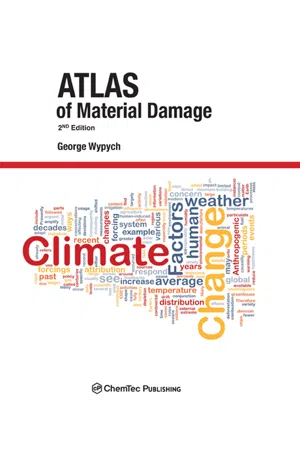
Atlas of Material Damage
About this book
Atlas of Material Damage, Second Edition provides a systematic analysis of the modes of damage and morphology of damaged material, and compares the experiences of different industries to provide insight into the most frequently encountered failures, reasons for these failures, and potential improvements to prevent future materials failure. Product reliability is a critical aim of materials scientists and engineers. Uninterrupted performance of manufactured products at typical and extreme conditions of use is the major goal of product development and the most important indicator of material quality.
This atlas has microscopic pictures, schematic diagrams, and graphs which show how materials fail, how they are produced to not fail, and how they are designed to perform particular functions to make outstanding products. Findings presented by each illustration are fully explained in the text and labeled.
Materials increasingly must have optimal structure and specially designed morphology. The book offers numerous examples of how this special morphology can be achieved in electronics, the plastics industry, the pharmaceutical industry, aerospace, automotive applications, medicine, dentistry, and many other fields. This book provides information on defect formation and materials damage; discusses effect of composition, morphological features and structure of different materials on material performance, durability, and resilience; and analyses the cause of material damage and degradation, and the effect of processing conditions on material damage.
- Includes data and images for many material types, making this a hard-working reference guide for engineers working in a range of different market sectors
- Provides core data related to the field
- Explains the range of test and imaging techniques available, enabling engineers and scientists to take optimal and cost effective decisions
- Offers an essential tool for identifying material damage and implementing successful maintenance and replacement regimes
Information
Topic
Physical SciencesSubtopic
Physical & Theoretical Chemistry1
INTRODUCTION
New design features and material damage are two main reasons that make products obsolete. The first is the way by which industry competes for new and existing customers, and, in some industries (e.g., electronics, fashion, etc.), it contributes, in some estimates, to 90% of cases of product replacement. This reason is mostly controlled by market and marketing and has nothing to do with technology which is the main concern in this book.
Material damage is the worst nightmare and the source of unpredictable expenses for any manufacturer of products. It usually triggers additional expenses related to the product replacement, installation, and lost reputation, and for this reason it may exceed by a number of times the initial cost of raw materials, production, and profit, and as such it may cause substantial loss of the financial position of the manufacturer, frequently leading to bankruptcy.
Reasons and mechanisms by which materials become damaged are the main subject of this book, which is primarily focused on the generation of information which then can be used for prevention and prediction of such occurrences.
There are many different groups of products. In this book we will consider more than 60 major groups of such products, for example, coatings, sealants, pipes, pharmaceutical or medical products. Each group has some specific reasons and mechanisms of degradation but all have common principles of degradation, and these differences and commonalities are explored in this book.
The publication program is designed to consist of two parts: one which exploits commonalities and one which characterizes typical changes for a particular group of materials. This is planned to be achieved by publications in two different formats: a book which characterizes common principles of damage and monographic chapters for different groups, each characterizing damage peculiar to the particular group of the materials.
This book constitutes the first part and it will discuss the following points:
1. Effect of composition, morphological features, and structure of different materials on material performance, durability, and resilience
2. Analysis of the causes of material damage and degradation
3. Effect of processing conditions on material damage
4. Effect of combined action of different degradants on industrial products
5. Systematic analysis of existing knowledge regarding the modes of damage and morphology of damaged material
6. Methods of analysis of material damage
7. Comparison of experiences generated in different sectors of industry regarding the most frequently encountered failures, reasons for these failures, and potential improvements preventing future damage
The name “Atlas” was selected to indicate the emphasis of the book on illustration with many real examples of the damaged products and discussion of causes of the damage and potential for material improvements.
There is no good estimation of the percentage of products which are replaced because they have been damaged and there is no breakdown of different methods of damage, indicating which are the most important causes. Also, selection of one method of damage will form an idealized picture which is not adequate, as in the natural environment many different degradants work in combination. Therefore understanding their individual mechanisms and potentials for their combined action and the results of such combinations of different forces is very important for the design of appropriate protection. One known example comes to mind which characterizes such a combination: American manufactured automobiles transported by ships to foreign buyers, usually from the port in Jacksonville, Florida. Florida is known for strong sun and high humidity but automotive coatings were routinely tested for these conditions in various parts of the United States and were designed to withstand these conditions. It came as a surprise that transported vehicles showed signs of severe damage to their coating. It was soon discovered that the damage was caused by a combination of sun rays, humidity and mist containing sea salt and pollutants found in the industrial centers. Further studies helped to develop products which were able to withstand such conditions but before this happened, large loses were encountered by the car manufacturing industry in the United States. This is obviously not an isolated case and many similar cases may have been avoided later because of this experience and research, but perhaps many such combinations still damage products due to the lack of awareness.
For these reasons, one of the main goals of this publication is to analyze the causes of damage, their potential mechanisms, and the methods of prevention in a single source. The cover of this book was designed to show this commitment. There many degrading forces which may affect product performance alone or in combination. These include:
• mechanical forces (elastic-brittle fracture, elastic-plastic deformation, fatigue, creep, and their combination, impact, shear, compression, and bending)
• electric forces (conductivity, tracking, arcing, flooding, and drying-out)
• humidity and water penetration (e.g., pinholes, cracks, hydrophilic properties)
• temperature (process heat, conditions of performance, infrared, frictional heat, freeze-and-thaw)
• radiation (UV, ionizing, gamma, laser beam, cosmic rays, plasma)
• chemical reactions (oxidation, ozone, sulfur dioxide, nitronous oxides, hydrogen embrittlement, particulate matter)
• solubility (effect of solvents with and without mechanical forces)
• biological forces (biodeterioration, body fluids, enzymatic reactions)
In most instances we have very little control over combinations encountered by products in their real life performance but we can make predictions based on the practice and observations, as well as we can estimate the range of forces which may be encountered. Based on these estimations we can design materials which can perform better under these conditions.
This leads us to the material composition, its structure, and morphological features, as well as, their changes throughout the useful life of the product. Dynamic analysis of properties has to be emphasized here because changes in the structure, composition and morphology lead to the eventual demise of the product. For example, some sealants failed because they were subjected to a compression set which affected their elastic properties; refrigerator insulation became less effective because the initial gas was replaced by air which had lower insulating qualities; automotive paint failed because of mar and scratch caused by car washing, etc.
Before products are exposed to the conditions of their performance they are already damaged during the production process in which they were exposed to the elevated temperatures and pressures for variable periods of time. They are extensively sheared, depending on the process conditions and their characteristic viscoelastic properties. The product undergoes structure formation because of crystallization from melt, orientation during the process, and stress formed on the deformation after processing. All these affect composition, structure and morphology, and they may lead to the less durable material or the improved product, depending on the process conditions. But such a broad range of the potential outcomes underscores the importance of the “material history” which contributes to the material performance.
In summary, raw materials, their compositions, and the method of processing contribute to the formation of product which has characteristic initial properties, which are then modified until the product eventually fails to perform. Failure may not be the reason for product disposal (see the first paragraph), but manufacturers are still interested in the terminal conditions of the product because they determine its method of reprocessing and feasibility of recycling. For example, it was determined that PVC cables were only marginally changed during long-term use (for 20 and more years). Frequently, the post-consumer cables are available because of building reconstruction or demolishing. PVC coating was found to be in almost original condition and it required only a small addition of thermal stabilizer or even basic filler to be reprocessed into a brand new product.1 Various other methods of reprocessing can be devised but the condition of the product at the end of its useful life has to be known. The outcome and the cost of reprocessing frequently determines the popularity and applications of polymers for different applications because it is an element of the total cost, which is more frequently determined now by the entire life-cycle. This must be emphasized because material stability is not routinely considered in environmental protection, usually over-burdened with estimation of its durability in landfill sites and contribution of toxic wastes to environment, whereas recovered resins are almost as valued by the processor as neat polymers and frequently even more searched for because of their premium price.
In addition, this volume will contain discussion of methods used in the damage assessment and prevention as these very methods contribute to the knowledge required to reduce waste caused by the premature failure of material.
Discussion of all of the above topics should result in creation of a comprehensive source on material damage as it occurs in the natural environment under the effect of the combination of many factors. The idea of this book came from a publication entitled An Atlas of Polymer Damage published 36 years ago.2 It must have affected the minds of two generations of scientists, including this author. The book2 was limited to polymers and the morphology of their damage, and not all other aspects mentioned above were included. All causes of damage will become part of the present work. The Atlas2 was heavily illustrated by microphotographs of damage, which came from research conducted by the authors of the book. In spite of the fact that the Atlas is 36 years old, it is still an excellent illustration of changes which are experienced by materials and should be reviewed by readers of this book because the contents of this previous research will not be repeated here. The results presente...
Table of contents
- Cover image
- Title page
- Table of Contents
- Copyright
- Chapter 1: INTRODUCTION
- Chapter 2: MATERIAL COMPOSITION, STRUCTURE AND MORPHOLOGICAL FEATURES
- Chapter 3: EFFECT OF PROCESSING ON MATERIAL STRUCTURE
- Chapter 4: SCALE OF DAMAGE. BASIC CONCEPT
- Chapter 5: MICROSCOPIC MECHANISMS OF DAMAGE CAUSED BY DEGRADANTS
- INDEX
Trusted by 375,005 students
Access to over 1.5 million titles for a fair monthly price.
Study more efficiently using our study tools.
Frequently asked questions
Yes, you can cancel anytime from the Subscription tab in your account settings on the Perlego website. Your subscription will stay active until the end of your current billing period. Learn how to cancel your subscription
No, books cannot be downloaded as external files, such as PDFs, for use outside of Perlego. However, you can download books within the Perlego app for offline reading on mobile or tablet. Learn how to download books offline
Perlego offers two plans: Essential and Complete
- Essential is ideal for learners and professionals who enjoy exploring a wide range of subjects. Access the Essential Library with 800,000+ trusted titles and best-sellers across business, personal growth, and the humanities. Includes unlimited reading time and Standard Read Aloud voice.
- Complete: Perfect for advanced learners and researchers needing full, unrestricted access. Unlock 1.5M+ books across hundreds of subjects, including academic and specialized titles. The Complete Plan also includes advanced features like Premium Read Aloud and Research Assistant.
We are an online textbook subscription service, where you can get access to an entire online library for less than the price of a single book per month. With over 1.5 million books across 990+ topics, we’ve got you covered! Learn about our mission
Look out for the read-aloud symbol on your next book to see if you can listen to it. The read-aloud tool reads text aloud for you, highlighting the text as it is being read. You can pause it, speed it up and slow it down. Learn more about Read Aloud
Yes! You can use the Perlego app on both iOS and Android devices to read anytime, anywhere — even offline. Perfect for commutes or when you’re on the go.
Please note we cannot support devices running on iOS 13 and Android 7 or earlier. Learn more about using the app
Please note we cannot support devices running on iOS 13 and Android 7 or earlier. Learn more about using the app
Yes, you can access Atlas of Material Damage by George Wypych in PDF and/or ePUB format, as well as other popular books in Physical Sciences & Physical & Theoretical Chemistry. We have over 1.5 million books available in our catalogue for you to explore.