- 300 pages
- English
- ePUB (mobile friendly)
- Available on iOS & Android
eBook - ePub
About this book
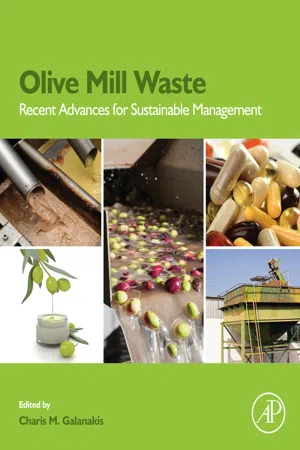
Olive Mill Waste: Recent Advances for Sustainable Management addresses today's most relevant topics in olive oil industry sustainable management. Emphasizing recent advisable practices, the book explores the potential of reutilizing OMW to power the mill itself, the reuse of OMW as soil amendment, aerobic biological treatment of OMW and compost production, the case study of OMW within the biorefinery concept, the recovery of bioactive compounds from OMW, and their applications in food products and cosmetics.
Recent research efforts have concluded that the successful management of OMW focuses on three main routes: (a) reuse of water, (b) reuse of polyphenols, and (c) reuse of nutrients. Following this consideration, the book covers sustainable practices in the olive oil industry, revealing opportunities for reutilizing the water of OMW within the process or as s soil amendment.
At the same time, it explores all the possibilities of recovering polyphenols and reutilizing them in target products, such as foods and cosmetics. In addition, the book presents successful cases of industrial OMW valorization through real world experiences.
- Covers the most recent advances in the field of olive mill waste management following sustainability principles
- Fills the gap of transfer knowledge between academia and industry
- Explores the advantages, disadvantages and real potential of processes and products in the market
Information
Table of contents
- Cover
- Title page
- Table of Contents
- Copyright
- List of Contributors
- Preface
- Chapter 1: Olive oil production sector: environmental effects and sustainability challenges
- Chapter 2: Olive mill waste: recent advances for the sustainable development of olive oil industry
- Chapter 3: The biorefinery concept for the industrial valorization of residues from olive oil industry
- Chapter 4: Energy recovery alternatives for the sustainable management of olive oil industry
- Chapter 5: Reuse of olive mill waste as soil amendment
- Chapter 6: Industrial case studies on the detoxificaton of OMWW using Fenton oxidation process followed by biological processes for energy and compost production
- Chapter 7: Integrated biological treatment of olive mill waste combining aerobic biological treatment, constructed wetlands, and composting
- Chapter 8: Cocomposting of olive mill waste for the production of soil amendments
- Chapter 9: The use of olive mill waste to promote phytoremediation
- Chapter 10: Recovery of bioactive compounds from olive mill waste
- Chapter 11: Applications of recovered bioactive compounds in food products
- Chapter 12: Applications of recovered bioactive compounds in cosmetics and health care products
- Index
Trusted by 375,005 students
Access to over 1.5 million titles for a fair monthly price.
Study more efficiently using our study tools.
Frequently asked questions
Yes, you can cancel anytime from the Subscription tab in your account settings on the Perlego website. Your subscription will stay active until the end of your current billing period. Learn how to cancel your subscription
No, books cannot be downloaded as external files, such as PDFs, for use outside of Perlego. However, you can download books within the Perlego app for offline reading on mobile or tablet. Learn how to download books offline
Perlego offers two plans: Essential and Complete
- Essential is ideal for learners and professionals who enjoy exploring a wide range of subjects. Access the Essential Library with 800,000+ trusted titles and best-sellers across business, personal growth, and the humanities. Includes unlimited reading time and Standard Read Aloud voice.
- Complete: Perfect for advanced learners and researchers needing full, unrestricted access. Unlock 1.5M+ books across hundreds of subjects, including academic and specialized titles. The Complete Plan also includes advanced features like Premium Read Aloud and Research Assistant.
We are an online textbook subscription service, where you can get access to an entire online library for less than the price of a single book per month. With over 1.5 million books across 990+ topics, we’ve got you covered! Learn about our mission
Look out for the read-aloud symbol on your next book to see if you can listen to it. The read-aloud tool reads text aloud for you, highlighting the text as it is being read. You can pause it, speed it up and slow it down. Learn more about Read Aloud
Yes! You can use the Perlego app on both iOS and Android devices to read anytime, anywhere — even offline. Perfect for commutes or when you’re on the go.
Please note we cannot support devices running on iOS 13 and Android 7 or earlier. Learn more about using the app
Please note we cannot support devices running on iOS 13 and Android 7 or earlier. Learn more about using the app
Yes, you can access Olive Mill Waste by Charis M. Galanakis in PDF and/or ePUB format, as well as other popular books in Business & Agribusiness. We have over 1.5 million books available in our catalogue for you to explore.