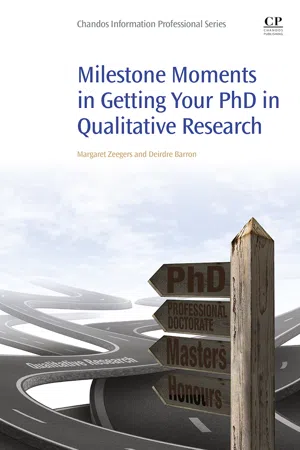
eBook - ePub
Milestone Moments in Getting your PhD in Qualitative Research
- 152 pages
- English
- ePUB (mobile friendly)
- Available on iOS & Android
eBook - ePub
Milestone Moments in Getting your PhD in Qualitative Research
About this book
Milestone Moments in Getting your PhDin Qualitative Research is a guide for research students completing higher degrees with a focus on the importance of language and terminology of the theoretical and practical requirements of a given research program. The book responds to a lack of preparedness among many entrants into higher-degrees in contemporary higher education. The need among non-traditional entrants into higher-degrees for a strong background in core academic principles is made pressing due to the lack of preparation many students undergo prior to enrolment. This book might be consulted by research students as they proceed through the various milestones that may form part of a higher-degree.
- Offers guidance to research students working through the stages of a higher degree
- Provides practical advice on terminology and language
- Give examples of methodologies, their advantages and disadvantages
- Grounded in real student experience to offer a practical edge
Information
Topic
EducationSubtopic
Higher EducationPart One
Establishing the basis for the PhD
1
Milestone 1
Clearing the decks
Abstract
If you are enrolled in a Masters by Research, Professional Doctorate, or Doctor of Philosophy (PhD) program then you are considered a Higher Degree Research (HDR) student. What you are doing is called an HDR because it is based on research. This is also the case when you are doing the research component of Honors. Research is not just reading everything that everybody has written on a given topic. It is generating new knowledge or using existing knowledge in new ways (which is in effect generating new knowledge) on the topic that you have selected for close study. You may have any number of what you consider to be good reasons for not doing your HDR, but an examination of the reasons for not doing it may enable you to clear the decks so that you can proceed with confidence.
Keywords
Research
Reasons for not doing research degree
Reasons for doing a research degree.
We come to the idea of doing a PhD through a variety of ways. For some of us, it is purely opportunistic, in getting a good Honors degree outcome, for example, and taking a further step in enrolling in a PhD. Others of us, particularly professionals in a given field, may have been thinking for some time about doing that degree. And for some of us, possibly lower order academics, the idea is thrust upon us and we have had to be talked into it. The idea has its appeal, but it does seem like an enormous undertaking, a bit like starting out on the Great Wall of China in the middle of the Gobi Desert, with Beijing a long way off, and far too many steps to take before getting there. It may seem like this, but it is not. There is a given number of milestones to reach, and each one takes you closer to your destination. What is involved in getting any Higher Degree by Research (HDR), like the Professional Doctorate and the Masters, is very similar to getting a PhD. If you are enrolled in the Masters by Research, Professional Doctorate, or Doctor of Philosophy (PhD) program then you are considered a Higher Degree Research candidate. In some countries, governments refer to their universities' Higher Degree Research programs as Research Training Degrees, or Research Training Schemes, so the terms may be used interchangeably. It is a matter of tradition that students enrolled in a HDR are referred to as a candidate. Because of the similarities involved in achieving any HDR, we will use the milestones toward achieving a PhD to identify and illustrate the milestones toward achieving one.
Reasons for not doing your PhD
You may have more reasons for NOT doing this PhD than you have for doing one, and we will start by addressing these.
Reason 1: “I will be (insert appropriate age here: 37, 42, 58, 60) years old by the time I finish.”
Spoiler 1: You will be that age whether you have a PhD or not. Better to get to that age with a PhD than without one.
Reason 2: “It will take years to complete.”
Spoiler 2: Of course it will. Your first degree probably took 3 or 4 years, and you managed that all right. Remember how quickly those years went by though. Your PhD will take 3 years, with a possible extension up to 4 years full time or the equivalent of this part time. The time allowed is not negotiable; there is a set duration of a Higher Degree by Research candidature. Your university is accredited and funded on completion rates and times. The normal period of candidature for doctoral candidates is 3 years, in some cases 4, and for masters' candidates 2 or 3 years. But it is not like when you were 12 and had to wait a whole year before you could be 13, an interminable age at that time. Now that you are grown up, you have yourself been despairing of the swiftness of the years going past. The time taken doing your PhD will pass just as swiftly, perhaps even more swiftly than you would like. In our experience as supervisors, we have found that people who follow the steps that we outline and write at the rate that we suggest complete within 3 years.
Reason 3: “I haven't the time.”
Spoiler 3: Nobody does. We are all adults with adult responsibilities: mortgages or rent, work, shopping, cooking, cleaning, hobbies, sport, recreation, recalcitrant partners, spoiled children, demanding in-laws, aged parents, eccentric aunts and uncles, community involvement…and this is the list for only ONE person. With parents no longer organizing our lives to free us up for studies as they did when we were at school, we take on all the responsibility ourselves. But you had that with your first degree, so you have some experience in this.
Reason 4: “I'm not smart enough.”
Spoiler 4: Not so. If you can get through Grade 4 at primary school, you can get through your PhD. There is no magic or mystery involved. There are conventions to be observed, regulations to be complied with, specific tasks to be done, and that's it. You take it Milestone by Milestone, with some overlap, until you finish. What helps many of us through the PhD process is looking around us at the obvious dopes that do have their PhDs, and knowing that we are at least as smart, if not smarter, than they.
Reason 5: “I resent having to do a PhD when my years of experience, and my breadth and depth of knowledge, enable me to do my job exceptionally well.”
Spoiler 5: Resent it as much as you like, but this will not help you when it comes to the jobs that are available to you at your current level of education, or promotions that stipulate that a PhD or substantial progress toward getting one as a requirement of the position. We would also point out that practical knowledge, valuable as it is, is not the same as the knowledge generated by research. A teacher who develops and implements excellent programs for their students, who then achieve excellent outcomes, is no doubt a great teacher. They are not considered education researchers, though.
Reason 6: “I object to the creeping credentialism of my workplace and absolutely refuse to submit to this.”
Spoiler 6: So who are you hurting by taking this stance? Your own silent protest is quite ineffectual and does not do a thing to prevent the creeping at all. You are the only one being adversely affected. The creeping credentialism that put a stop to butcher surgeons and hairdresser dentists has been a boon to us all, not a disadvantage.
Reason 7: “I do all right as I am. I got jobs ahead of others more qualified than I and have gone ahead faster than just about everybody else.”
Spoiler 7: That's wonderful for you, but you are going to hit a brick wall any day now because there is a point beyond which you cannot proceed until you get your PhD. You will watch those others that you passed on your way up, who knuckled down and did their PhDs, now start passing you on their onward and upward journeys. At the same time, though, if you do not need it and do not want it, don't do it. You need read no further.
Reason 8: “Everybody else has already researched my field. I have nothing that I could add.”
Spoiler 8: That's not what a PhD is about. You are not going to be covering a whole field, but a part of it. People may have written an awful lot about things that are important in your field, but not in relation to your particular position within that field. There are things that may have been overlooked, and what you have in mind may present a different perspective that may challenge, enhance, or expand accepted knowledge within that field.
Reason 9: “I hated my major studies in my first degree. The last thing I want to do is get involved with that stuff again.”
Spoiler 9: If this is so, look for areas within that field that are more interesting and worthy of further exploration. A PhD is a way to cross fields. You may have studied Economics the first time around, and use this to study the position of the anonymous and unnamed servants in Jane Austen's books. Whether you decide to research in the area in which you want to work, or you take up a position within an established research project that interests you, you may make your own decisions about where you want your PhD to take you.
Reason 10: “I can't afford it.”
Spoiler 10: If we all took that approach, we would have no education at all. It is always expensive, because it is so valuable. The government of your country recognizes the importance of postgraduate studies and their timely completions, and will have policy in place to encourage postgraduate studies. This policy may include student loans, scholarship provision, waived fees, student stipends, or a combination of these developed to optimize the likely successful completion of a candidate's program of study, support the development of graduate attributes as specified by governments and taken up by universities, and comply with government requirements in general.
You will probably find that your local university is rather keen to take on PhD candidates to benefit its own standing in the research community and with its funding bodies and will have its plans in place to attract such candidates. They may waive the tuition fees, offer part or full scholarships, and so on. Where your country's government offers scholarships, there will be published criteria and guidelines for applying for these, so it is worthwhile investigating them, and positioning yourself according to the published criteria. Your university of preference may offer its own forms of scholarships, with application dates at various times of the year, and you may also position yourself for one of these: Do they have points system, for example, for progress in studies, an Honors or Masters degree (or both), a number of publications in scholarly and professional journals? Or something different: practice in the field, consultancies, advisory committee work? Or a combination of these? Be familiar with the requirements, and work towards meeting the requirements (by having work published and so on) before the closing date.
You could probably come up with more reasons, indeed you might already have, and they would be quite reasonable in your circumstances. It is also probable that you could come up with spoilers yourself and give yourself very good reasons for going ahead with your PhD. Going ahead with it means taking up the idea of research and its contribution to knowledge.
What research is
At the very start, you need to come to terms with just what this sort of degree is. It is called an HDR because it is based on research. The Shorter Oxford English Dictionary (OED) defines research as an “endeavour to discover new or collate old facts etc. by scientific study of a subject, [or] course of ...
Table of contents
- Cover image
- Title page
- Table of Contents
- Copyright
- Dedication
- Acknowledgments
- About the authors
- Introduction
- Part One: Establishing the basis for the PhD
- Part Two: Getting the PhD done
- References
- Index
Trusted by 375,005 students
Access to over 1.5 million titles for a fair monthly price.
Study more efficiently using our study tools.
Frequently asked questions
Yes, you can cancel anytime from the Subscription tab in your account settings on the Perlego website. Your subscription will stay active until the end of your current billing period. Learn how to cancel your subscription
No, books cannot be downloaded as external files, such as PDFs, for use outside of Perlego. However, you can download books within the Perlego app for offline reading on mobile or tablet. Learn how to download books offline
Perlego offers two plans: Essential and Complete
- Essential is ideal for learners and professionals who enjoy exploring a wide range of subjects. Access the Essential Library with 800,000+ trusted titles and best-sellers across business, personal growth, and the humanities. Includes unlimited reading time and Standard Read Aloud voice.
- Complete: Perfect for advanced learners and researchers needing full, unrestricted access. Unlock 1.5M+ books across hundreds of subjects, including academic and specialized titles. The Complete Plan also includes advanced features like Premium Read Aloud and Research Assistant.
We are an online textbook subscription service, where you can get access to an entire online library for less than the price of a single book per month. With over 1.5 million books across 990+ topics, we’ve got you covered! Learn about our mission
Look out for the read-aloud symbol on your next book to see if you can listen to it. The read-aloud tool reads text aloud for you, highlighting the text as it is being read. You can pause it, speed it up and slow it down. Learn more about Read Aloud
Yes! You can use the Perlego app on both iOS and Android devices to read anytime, anywhere — even offline. Perfect for commutes or when you’re on the go.
Please note we cannot support devices running on iOS 13 and Android 7 or earlier. Learn more about using the app
Please note we cannot support devices running on iOS 13 and Android 7 or earlier. Learn more about using the app
Yes, you can access Milestone Moments in Getting your PhD in Qualitative Research by Margaret Zeegers,Deirdre Barron in PDF and/or ePUB format, as well as other popular books in Education & Higher Education. We have over 1.5 million books available in our catalogue for you to explore.