eBook - ePub
Extractive Metallurgy of Copper
- 472 pages
- English
- ePUB (mobile friendly)
- Available on iOS & Android
eBook - ePub
Extractive Metallurgy of Copper
About this book
This multi-author new edition revises and updates the classic reference by William G. Davenport et al (winner of, among other awards, the 2003 AIME Mineral Industry Educator of the Year Award "for inspiring students in the pursuit of clarity"), providing fully updated coverage of the copper production process, encompassing topics as diverse as environmental technology for wind and solar energy transmission, treatment of waste by-products, and recycling of electronic scrap for potential alternative technology implementation. The authors examine industrially grounded treatments of process fundamentals and the beneficiation of raw materials, smelting and converting, hydrometallurgical processes, and refining technology for a mine-to-market perspective - from primary and secondary raw materials extraction to shipping of rod or billet to customers. The modern coverage of the work includes bath smelting processes such as Ausmelt and Isasmelt, which have become state-of-the-art in sulfide concentrate smelting and converting.
- Drawing on extensive international industrial consultancies within working plants, this work describes in depth the complete copper production process, starting from both primary and secondary raw materials and ending with rod or billet being shipped to customers
- The work focuses particularly on currently-used industrial processes used to turn raw materials into refined copper metal rather than ideas working 'only on paper'
- New areas of coverage include the environmentally appropriate uses of copper cables in power transmission for wind and solar energy sources; the recycling of electronic scrap as an important new feedstock to the copper industry, and state-of-the-art Ausmelt and Isasmelt bath smelting processes for sulfide concentrate smelting and converting
Information
Chapter 1. Overview
1.1. Introduction
Copper is most commonly present in the earth's crust as copper–iron–sulfide and copper sulfide minerals, such as chalcopyrite (CuFeS2) and chalcocite (Cu2S). The concentration of these minerals in an ore body is low. Typical copper ores contain from 0.5% Cu (open pit mines, Fig. 1.1) to 1 or 2% Cu (underground mines). Pure copper metal is mostly produced from these ores by concentration, smelting, and refining (Fig. 1.2).
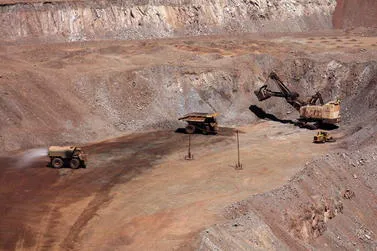 |
| FIGURE 1.1 Open pit Cu mine. Note the new blast holes, top right, and blasted ore to the left of them. The shovel is placing blasted ore in the truck from where it will go to processing. The water truck is suppressing dust. The front end loader is cleaning up around the shovel. The shovel is electric. Its power wire mostly lies on the surface except over the wire bridge under which all vehicles travel to and from the shovel. (Photo courtesy of Freeport-McMoRan Copper & Gold Inc.). |
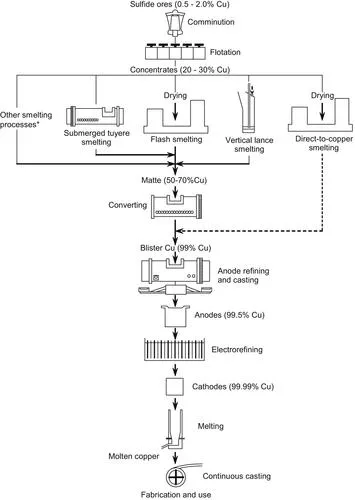 |
| FIGURE 1.2 Main processes for extracting copper from sulfide ores. Parallel lines indicate alternative processes. ∗Principally Mitsubishi and Vanyukov smelting. |
Copper also occurs to a lesser extent in oxidized minerals (carbonates, oxides, hydroxy-silicates, sulfates). Copper metal is usually produced from these minerals by leaching, solvent extraction, and electrowinning (Fig. 1.3). These processes are also used to treat chalcocite (Cu2S).
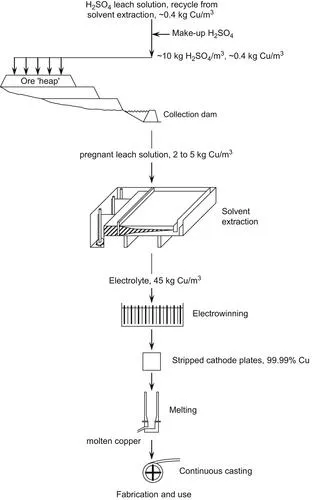 |
| FIGURE 1.3 Flowsheet for leaching oxide and Cu2S ores. The dissolved Cu is recovered by solvent extraction purification/strengthening then electrowinning. Leaching accounts for ~20% of primary (from ore) copper production. |
A third major source of copper is scrap copper and copper alloys. Production of copper from recycled used objects is 10 or 15% of mine production. In addition, there is considerable re-melting/re-refining of scrap generated during fabrication and manufacture. Total copper production in 2010 (mined and from end-of-use scrap) was ~20 million tonnes.
This chapter introduces the principal processes by which copper is extracted from ore and scrap. It also indicates the relative industrial importance of each.
1.2. Extracting Copper from Copper–Iron–Sulfide Ores
About 80% of the world's copper-from-ore originates in Cu–Fe–S ores. Cu–Fe–S minerals are not easily dissolved by aqueous solutions, so the vast majority of copper extraction from these minerals is pyrometallurgical. The extraction entails:
(a) Isolating the Cu–Fe–S and Cu–S mineral particles in an ore to a concentrate by froth flotation
(b) Smelting this concentrate to molten high-Cu sulfide matte
(c) Converting (oxidizing) this molten matte to impure molten copper
(d) Fire- and electrorefining this impure copper to ultra-pure copper.
1.2.1. Concentration by Froth Flotation (Chapter 3 and Chapter 4)
The copper ores being mined in 2010 are too lean in copper (0.5–2% Cu) to be smelted directly. Heating and melting their huge quantity of waste rock would require prohibitive amounts of hydrocarbon fuel. Fortunately, the Cu–Fe–S and Cu–S minerals in an ore can be isolated by physical means into high-Cu concentrate, which can then be smelted economically.
The most effective method of isolating the Cu minerals is froth flotation. This process causes the Cu minerals to become selectively attached to air bubbles rising through a slurry of finely ground ore in water (Fig. 1.4). Selectivity of flotation is created by using reagents, which make Cu minerals water repellent while leaving waste minerals wetted. In turn, this water repellency causes Cu minerals to float on rising bubbles while the other minerals remain un-floated. The floated Cu-mineral particles overflow the flotation cell in a froth to become concentrate containing ~30% Cu.
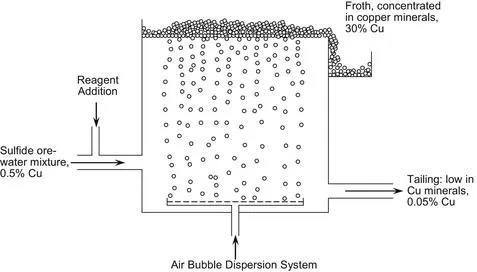 |
| FIGURE 1.4 Schematic view of flotation cell. Reagents cause Cu–Fe sulfide and Cu sulfide minerals in the ore to attach to rising air bubbles, which are then collected in a short-lived froth. This froth is de-watered to become concentrate. The un-floated waste passes through several cells before being discarded as a final tailing. Many types and sizes (up to 300 m3) of cell are used. |
Flotation is preceded by crushing and grinding the mined Cu ore into small (~50 μm) particles. Its use has led to adoption of smelting processes which efficiently smelt finely ground material.
1.2.2. Matte Smelting (Chapter 5, Chapter 6 and Chapter 9)
Matte smelting oxidizes and melts flotation concentrate in a large, hot (1250 °C) furnace (FIGURE 1.2 and FIGURE 1.5). The objective of the smelting is to oxidize S and Fe from the Cu–Fe–S concentrate to produce a Cu-enriched molten sulfide phase (matte). The oxidant is almost always oxygen-enriched air.
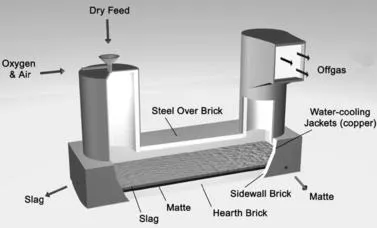 |
| FIGURE 1.5 Outokumpu oxygen-enriched air flash furnace. Flash furnaces are typically 20 m long and 7 m wide. They smelt 1000–3000 to... |
Table of contents
- Cover image
- Table of Contents
- Frontmatter
- Copyright
- Preface
- Preface to the Fourth Edition
- Preface to the Third Edition
- Preface to the Second Edition
- Preface to the First Edition
- Chapter 1. Overview
- Chapter 2. Production and Use
- Chapter 3. Production of High Copper Concentrates – Introduction and Comminution
- Chapter 4. Production of Cu Concentrate from Finely Ground Cu Ore
- Chapter 5. Matte Smelting Fundamentals
- Chapter 6. Flash Smelting
- Chapter 7. Submerged Tuyere Smelting
- Chapter 8. Converting of Copper Matte
- Chapter 9. Bath Matte Smelting
- Chapter 10. Direct-To-Copper Flash Smelting
- Chapter 11. Copper Loss in Slag
- Chapter 12. Capture and Fixation of Sulfur
- Chapter 13. Fire Refining (S and O Removal) and Anode Casting
- Chapter 14. Electrolytic Refining
- Chapter 15. Hydrometallurgical Copper Extraction
- Chapter 16. Solvent Extraction
- Chapter 17. Electrowinning
- Chapter 18. Collection and Processing of Recycled Copper
- Chapter 19. Chemical Metallurgy of Copper Recycling
- Chapter 20. Melting and Casting
- Chapter 21. Byproduct and Waste Streams
- Chapter 22. Costs of Copper Production
- Index
Trusted by 375,005 students
Access to over 1.5 million titles for a fair monthly price.
Study more efficiently using our study tools.
Frequently asked questions
Yes, you can cancel anytime from the Subscription tab in your account settings on the Perlego website. Your subscription will stay active until the end of your current billing period. Learn how to cancel your subscription
No, books cannot be downloaded as external files, such as PDFs, for use outside of Perlego. However, you can download books within the Perlego app for offline reading on mobile or tablet. Learn how to download books offline
Perlego offers two plans: Essential and Complete
- Essential is ideal for learners and professionals who enjoy exploring a wide range of subjects. Access the Essential Library with 800,000+ trusted titles and best-sellers across business, personal growth, and the humanities. Includes unlimited reading time and Standard Read Aloud voice.
- Complete: Perfect for advanced learners and researchers needing full, unrestricted access. Unlock 1.5M+ books across hundreds of subjects, including academic and specialized titles. The Complete Plan also includes advanced features like Premium Read Aloud and Research Assistant.
We are an online textbook subscription service, where you can get access to an entire online library for less than the price of a single book per month. With over 1.5 million books across 990+ topics, we’ve got you covered! Learn about our mission
Look out for the read-aloud symbol on your next book to see if you can listen to it. The read-aloud tool reads text aloud for you, highlighting the text as it is being read. You can pause it, speed it up and slow it down. Learn more about Read Aloud
Yes! You can use the Perlego app on both iOS and Android devices to read anytime, anywhere — even offline. Perfect for commutes or when you’re on the go.
Please note we cannot support devices running on iOS 13 and Android 7 or earlier. Learn more about using the app
Please note we cannot support devices running on iOS 13 and Android 7 or earlier. Learn more about using the app
Yes, you can access Extractive Metallurgy of Copper by Mark E. Schlesinger,Kathryn C. Sole,William G. Davenport in PDF and/or ePUB format, as well as other popular books in Technology & Engineering & Mining Engineering. We have over 1.5 million books available in our catalogue for you to explore.