- 478 pages
- English
- ePUB (mobile friendly)
- Available on iOS & Android
eBook - ePub
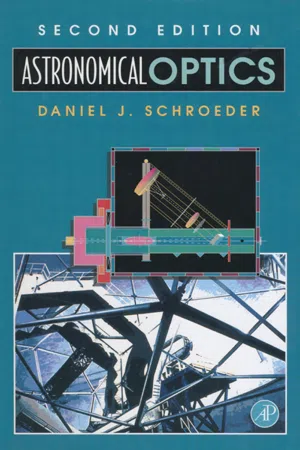
Astronomical Optics
About this book
This book provides a unified treatment of the characteristics of telescopes of all types, both those whose performance is set by geometrical aberrations and the effect of the atmosphere, and those diffraction-limited telescopes designed for observations from above the atmosphere. The emphasis throughout is on basic principles, such as Fermat's principle, and their application to optical systems specifically designed to image distant celestial sources.
The book also contains thorough discussions of the principles underlying all spectroscopic instrumentation, with special emphasis on grating instruments used with telescopes. An introduction to adaptive optics provides the needed background for further inquiry into this rapidly developing area.
- Geometrical aberration theory based on Fermat's principle
- Diffraction theory and transfer function approach to near-perfect telescopes
- Thorough discussion of 2-mirror telescopes, including misalignments
- Basic principles of spectrometry; grating and echelle instruments
- Schmidt and other catadioptric telescopes
- Principles of adaptive optics
- Over 220 figures and nearly 90 summary tables
Information
Topic
Sciences physiquesSubtopic
Astronomie et astrophysiqueChapter 1
Introduction
The increasing rate of growth in astronomical knowledge during the past few decades is a direct consequence of the increase in the number and size of telescopes and the efficiency with which they are used. Most celestial sources are intrinsically faint and observations with small refracting telescopes and insensitive photographic plates that required hours of observing time are now done in minutes with large reflecting telescopes and efficient solid-state detectors. The increased efficiency with which photons are collected and recorded by modern instruments has indeed revolutionized the field of observational astronomy.
1.1 A BIT OF HISTORY
Early in the 1900s the desire for larger light gathering power led to the design and construction of the 100-in Hooker telescope located on Mount Wilson in California. This reflecting telescope and its smaller predecessors were built following the recognition that refracting telescopes, such as the 36-in one at Lick Observatory in California and the 40-in one at Yerkes Observatory, in Wisconsin, had reached a practical limit in size. With the 100-in telescope, it was possible to start systematic observations of nearby galaxies and start to attack the problem of the structure of the universe.
Although the 100-in telescope was a giant step forward for observational astronomy, it was recognized by Hale that still larger telescopes were necessary for observations of remote galaxies. Due largely to his efforts, work began on the design and construction of a 200-in (5-m) telescope in the late 1920s. The Hale telescope was put into operation in the late 1940s and remained the world’s largest until a 6-m telescope was built in Russia in the mid-1970s.
The need for more large telescopes became acute in the 1960s as the boundaries of observational astronomy were pushed outward. Plans made during this decade and the following one resulted in the construction of a number of optical telescopes in the 4-m class during the 1970s and 1980s in both hemispheres. These telescopes, equipped with efficient detectors, fueled an explosive growth in observational astronomy.
Large reflectors are well-suited for observations of small parts of the sky, typically a fraction of a degree in diameter, but they are not suitable for surveys of the entire sky. A type of telescope suited for survey work was first devised by Schmidt in the early 1930s. The first large Schmidt telescope was a 1.2-m instrument covering a field about 6° across, and put into operation on Palomar Mountain in the early 1950s. Several telescopes of this type and size have since been built in both hemispheres. The principle of the Schmidt telescope has also been adapted to cameras used in many spectrometers.
While construction of telescopes was underway during the 1970s and 1980s, astronomers were already planning for the next generation of large reflectors. In the quest for still greater light-gathering power, attention turned to the design of arrays of telescopes and segmented mirrors, and to new techniques for casting and figuring single mirrors with diameters in the 8-m range. The fruits of these labors became apparent in the late 1990s with the coming online of a significant number of telescopes in the 8- to 10-m class.
The array concept was first implemented with the completion of the Multiple-Mirror Telescope (MMT) on Mount Hopkins, Arizona, a telescope with six 1.8-m telescopes mounted in a common frame and an aperture equivalent to that of a single 4.5-m telescope. Beams of the separate telescopes were directed to a common focal plane and either combined in a single image or placed side-by-side on the slit of a spectrometer. Although the MMT concept proved workable, advances in mirror technology prompted the replacement of the separate mirrors with a single 6.5-m mirror in the same telescope structure and building.
The segmented mirror approach was the choice for the Keck Ten-Meter Telescope (TMT), with 36 hexagonal segments the equivalent of a single filled aperture. This approach requires active control of the positions of the segments to maintain mirror shape and image quality. Even before the first TMT had been pointed to its first star, its twin was under construction on Mauna Kea, Hawaii, and together these two telescopes are obtaining dramatic observational results. Another segmented mirror telescope is the Hobby-Eberly Telescope designed primarily for spectroscopy.
Although it seemed in the 1980s that multiple and segmented mirrors were the wave of the future, new techniques for making large, “fast” primary mirrors and controlling their optical figure in a telescope led to the design and construction of several 8-m telescopes. Among these are the Very Large Telescopes (VLT) of the European Southern Observatory, the Gemini telescopes, Subaru, and Large Binocular Telescope (LBT). Used singly or as components of an interferometric array (for the VLT and LBT), observations are possible that could only be dreamed of in the 1970s.
Instrumentation used on large telescopes has also shown dramatic changes since the time of the earliest reflectors. Noting first the development in spectrometers, small prism instruments were replaced by larger grating instruments at both Cassegrain and coude focus positions to meet the demands for higher spectral resolution. In recent years many of these high resolution coude instruments have, in turn, been replaced by echelle spectrometers at the Cassegrain focus. On the largest telescopes, such as the TMT and VLT, most large instrumentation is at the Nasmyth focus position on a platform that rotates with the telescope. Nearly all spectrographic instruments and imaging cameras now use solid-state electronic detectors of high quantum efficiency that, coupled with these telescopes, make possible observations of still fainter celestial objects.
Although developments of ground-based optical telescopes and instruments during the last three decades of the 20th century have been dramatic, the same can also be said of Earth-orbiting telescopes in space. Since the first Orbiting Astronomical Observatory in the late 1960s, with its telescopes of 0.4-m and smaller, the size and complexity of orbiting telescopes have increased markedly. The 2.4-m Hubble Space Telescope (HST), once its problem of spherical aberration was fixed, has made observations not possible with ground-based telescopes. Although its light gathering power is significantly smaller than that of many ground-based telescopes, its unique capability of observing sources in spectral regions absorbed by our atmosphere and of imaging to the diffraction limit are leading the revolution in astronomy.
Because of the high cost of a telescope in space, there has been significant effort to improve the quality of images of ground-based telescopes. These efforts include controlling the thermal conditions within telescope enclosures and incorporating active and adaptive optics systems into telescopes. With these techniques it becomes possible to obtain images of near-diffraction-limited quality, at least over small fields and for brighter objects.
This brief excursion into the development of telescopes and instruments up to the present and into the near future is by no means complete. It is intended only to illustrate the range of tools now available to the observational astronomer.
1.2 APPROACH TO SUBJECT
Most of the optical principles that serve as the starting point in the design and use of any optical instrument have been known for a long time. In intermediate-level optics texts these principles are usually divided into two categories: geometrical optics and physical optics. Elements from both of these fields are required for full descriptions of the characteristics of optical systems.
The theory of geometrical optics is concerned with the paths taken by light rays as they pass through a system of lenses and/or mirrors. Although the ray paths can be calculated by simple application of the laws of refraction and reflection, a much more powerful approach is one that starts with Fermat’s Principle. With the aid of this approach it is possible to determine both the first-order characteristics of an optical system and deviations from these characteristics. The latter leads to the theory of aberrations or image defects, a subject to be discussed in detail.
The theory of physical optics includes the effects of the finite wavelength of light and such topics as interference, diffraction, and polarization. Analyses of the characteristics of diffraction gratings, interferometers, and telescopes such as the Hubble Space Telescope require an understanding of these topics. The basics of this theory are introduced prior to our discussions of these types of optical systems.
The approach, therefore, is to emphasize the basic principles of a variety of systems and to illustrate these principles with specific designs. Although the specifics of telescopes and instruments have changed, and will continue to change, the basic optical principles are the same.
1.3 OUTLINE OF BOOK
The 17 chapters that follow the Introduction can be grouped into six distinct categories. Chapters 2 through 5 cover the elements of geometrical optics needed for the discussion of optical systems. The first three chapters of this group are an introduction to this part of optics seen from the point of view of Fermat’s Principle, with Chapter 5 a detailed treatment of aberrations based on this principle.
Chapters 6 through 11 cover the characteristics of a variety of telescopes and cameras, including auxiliary optics used with them. The characteristics of diffraction-limited telescopes are covered in the last two chapters of this group, with application to the Hubble Space Telescope.
Chapters 12 through 15 are a discussion of the principles of spectrometry and their application to a variety of dispersing systems, with the emphasis on diffraction gratings. In this group Chapter 14 is the counterpart of Chapter 5, a treatment of grating aberrations from the point of view of Fermat’s Principle.
The remaining three chapters (16, 17, and 18) are distinct in themselves with each chapter drawing upon results given in preceding chapters and applying these results to selected types of observations for both ground-based and space-based systems.
A closer look at the contents of each chapter is now in order. Chapter 2 is an introduction to the basic ideas of geometrical optics, and the reader who is well versed in these ideas can cover it quickly. One topic covered in this chapter, not part of the usual course in optics, is the definition of normalized parameters for two-mirror telescopes.
Chapter 3 is an introduction to Fermat’s Principle with a number of examples illustrating its utility, including a brief discussion of atmospheric refraction and atmospheric turbulence. Chapter 4 is an introduction to aberrations, with emphasis on spherical aberration. The concept of aberration compensation is introduced and applied to two optical systems.
The discussions of the preceding three chapters set the stage for an in-depth discussion of the theory of third-order aberrations in Chapter 5. The results of the analysis are summarized in tables for easy reference.
In Chapter 6 we draw on the results from Chapter 5 to derive the characteristics of a number of types of reflecting telescopes. Comparisons of image quality are given for several of these types, including examples of image quality for misaligned two-mirror telescopes. Chapter 7 covers the characteristics of Schmidt systems, including a discussion of the achromatic Schmidt and solid and semisolid cameras.
Chapter 8 covers various types of catadioptric systems, including Schmidt-Cassegrain telescopes and cameras with meniscus correctors substituted for aspheric plates. The following chapter (9) is a discussion of various types of auxiliary optics used with telescopes, including field ...
Table of contents
- Cover image
- Title page
- Table of Contents
- Copyright
- Dedication
- Preface
- Errata: ASTRONOMICAL OPTICS, 2nd Edition
- Chapter 1: Introduction
- Chapter 2: Preliminaries: Definitions and Paraxial Optics
- Chapter 3: Fermat’s Principle: An Introduction
- Chapter 4: Introduction to Aberrations
- Chapter 5: Fermat’s Principle and Aberrations
- Chapter 6: Reflecting Telescopes
- Chapter 7: Schmidt Telescopes and Cameras
- Chapter 8: Catadioptric Telescopes and Cameras
- Chapter 9: Auxiliary Optics for Telescopes
- Chapter 10: Diffraction Theory and Aberrations
- Chapter 11: Transfer Functions; Hubble Space Telescope
- Chapter 12: Spectrometry: Definitions and Basic Principles
- Chapter 13: Dispersing Elements and Systems
- Chapter 14: Grating Aberrations; Concave Grating Spectrometers
- Chapter 15: Plane Grating Spectrometers
- Chapter 16: Adaptive Optics: An Introduction
- Chapter 17: Detectors, Signal-to-Noise, and Detection Limits
- Chapter 18: Large Mirrors and Telescope Arrays
- Table of Symbols
- Index
Trusted by 375,005 students
Access to over 1.5 million titles for a fair monthly price.
Study more efficiently using our study tools.
Frequently asked questions
Yes, you can cancel anytime from the Subscription tab in your account settings on the Perlego website. Your subscription will stay active until the end of your current billing period. Learn how to cancel your subscription
No, books cannot be downloaded as external files, such as PDFs, for use outside of Perlego. However, you can download books within the Perlego app for offline reading on mobile or tablet. Learn how to download books offline
Perlego offers two plans: Essential and Complete
- Essential is ideal for learners and professionals who enjoy exploring a wide range of subjects. Access the Essential Library with 800,000+ trusted titles and best-sellers across business, personal growth, and the humanities. Includes unlimited reading time and Standard Read Aloud voice.
- Complete: Perfect for advanced learners and researchers needing full, unrestricted access. Unlock 1.5M+ books across hundreds of subjects, including academic and specialized titles. The Complete Plan also includes advanced features like Premium Read Aloud and Research Assistant.
We are an online textbook subscription service, where you can get access to an entire online library for less than the price of a single book per month. With over 1.5 million books across 990+ topics, we’ve got you covered! Learn about our mission
Look out for the read-aloud symbol on your next book to see if you can listen to it. The read-aloud tool reads text aloud for you, highlighting the text as it is being read. You can pause it, speed it up and slow it down. Learn more about Read Aloud
Yes! You can use the Perlego app on both iOS and Android devices to read anytime, anywhere — even offline. Perfect for commutes or when you’re on the go.
Please note we cannot support devices running on iOS 13 and Android 7 or earlier. Learn more about using the app
Please note we cannot support devices running on iOS 13 and Android 7 or earlier. Learn more about using the app
Yes, you can access Astronomical Optics by Daniel J. Schroeder in PDF and/or ePUB format, as well as other popular books in Sciences physiques & Astronomie et astrophysique. We have over 1.5 million books available in our catalogue for you to explore.