eBook - ePub
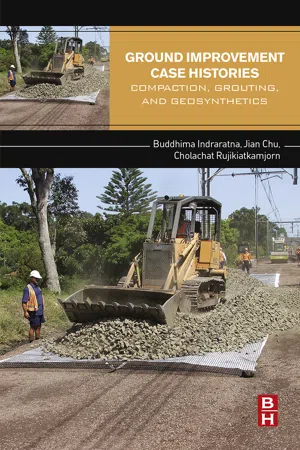
Ground Improvement Case Histories
Compaction, Grouting and Geosynthetics
- 796 pages
- English
- ePUB (mobile friendly)
- Available on iOS & Android
eBook - ePub
Ground Improvement Case Histories
Compaction, Grouting and Geosynthetics
About this book
Written by an international group of contributors, Ground Improvement Case Histories: Compaction, Grouting and Geosynthetics provides over 700 pages of international case-histories. Each case-history provides an overview of the specific technology followed by applications, with some cases offering a comprehensive back-analysis through numerical modelling. Specific case-histories include: The Use of Alternative and Improved Construction Materials and Geosynthetics in Pavements, Case Histories of Embankments on Soft Soils and Stabilisation with Geosynthetics, Ground Improvement with Geotextile Reinforcements, Use of Geosynthetics to aid Construction over Soft Soils and Soil Improvement and Foundation Systems with Encased Columns and Reinforced Bearing Layers.
- Comprehensive analysis methods using numerical modelling methods
- Features over 700 pages of contributor generated case-histories from all over the world
- Offers field data and clear observations based on the practical aspects of the construction procedures and treatment effectiveness
Information
Topic
Physical SciencesSubtopic
Geology & Earth SciencesPart One
Physical Modification Methods Including Grouting, Compaction, and Drainage
Chapter 1
Ground Improvement for Mitigating Liquefaction-Induced Geotechnical Hazards
Dharma Wijewickreme1,2; Upul D. Atukorala2 1 Department of Civil Engineering, University of British Columbia, Vancouver, B.C., Canada
2 Golder Associates Ltd., Vancouver, B.C., Canada
2 Golder Associates Ltd., Vancouver, B.C., Canada
Abstract
Liquefaction of foundation soils imposes geotechnical hazards primarily in the form of loss of bearing capacity and permanent ground deformations. Foundations in liquefiable soils need to be designed to withstand these hazards, or ground improvement measures need to be implemented to mitigate the resulting impacts. Five engineering case histories are presented where ground improvement measures were undertaken to minimize the liquefaction-induced geotechnical hazards. The project sites corresponding to the case histories are located within or in the vicinity of the Greater Vancouver region of British Columbia, which is one of the zones of highest seismic risk in Canada. Details pertaining to site seismicity and subsurface conditions together with the design philosophy are presented to provide the necessary background information for the case histories. In addition, details of the construction equipment, postground improvement performance, and structural, geotechnical, and environmental monitoring that were undertaken are presented and discussed. The case histories correspond to ground improvement carried out using vibro-replacement, compaction grouting, and deep dynamic compaction methods. The protected foundations and/or structures belong to key industrial plants, highway systems, and energy networks.
Keywords
Soil Liquefaction
Ground Improvement
Deep Dynamic Compaction
Vibro-Replacement Stone Columns
Compaction Grouting
Gravel Compaction Piles
Acknowledgments
The authors are grateful to the B.C. Ministry of Transportation, Terasen Gas Utility Ltd., and Lafarge Canada Inc. for granting permission to publish the technical information associated with the case histories.
1.1 Introduction
Frequent occurrence of devastating seismic events around the world has resulted in a remarkable increase in the public interest toward earthquake preparedness. The known potential for disruption to structures and facilities has encouraged the owners to protect their assets from earthquake hazards. The seismic evaluation/upgrading programs undertaken over the last 20 years by lifeline owners in North America and Japan serves testimony to the significance of this subject (TCLEE, 1998; Wijewickreme et al., 2005). Experience from past seismic events indicates that earthquake-induced permanent ground displacements and/or loss of bearing capacity are some key geotechnical hazards to structures located at sites underlain by liquefiable soils (O’Rourke and Hamada, 1992; MCEER, 1999). After identification of the geotechnical hazards and the resulting vulnerability of a given structure, a combination of structural retrofitting and/or geotechnical remediation (ground improvement) is often considered in the design of mitigative measures.
Historically, ground improvement has been used as a means of improving the postconstruction bearing capacity and settlement performance of soils under static loading conditions, and a variety of ground improvement techniques have evolved in the past few decades (Mitchell, 1981; Japanese Geological Society, 1998). In addition to resisting static loads, some of the ground improvement measures have been effectively used to retrofit facilities that are located within, or that have foundations supported on, liquefiable soils. These measures include dynamic deep compaction, vibro-replacement using stone columns, compaction piling, explosive compaction, and compaction grouting.
The observed performance of sites following major earthquake events—for example, 1964 Niigata (Niigata, Japan), 1995 Hyogoken Nanbu (Kobe, Japan), 1999 Kocaeli (Turkey), 2001 Nisqually (Washington state, U.S.)—indicates that the sites with improved ground had generally less susceptibility to earthquake-induced ground deformations and resulting damage than the sites that had not been densified (Mitchell et al., 1998; Hausler and Sitar, 2001; Hausler and Koelling, 2004).
Amid these ground improvement efforts, including the examination of past earthquake damage and postearthquake operations, there is a need for more documentation of approaches and illustrative case histories related to the use of ground improvement. Clearly, advances in the state of practice in seismic evaluation and retrofit of facilities require dissemination, particularly within the structural and geotechnical engineering disciplines.
With this background, and drawing from a number of case histories from Greater Vancouver, British Columbia (B.C.), Canada, this chapter illustrates several key facets and considerations in the engineering of ground improvement to mitigate liquefaction-induced geotechnical hazards. The sites of the case histories are situated within one of the zones of highest seismic risk in Canada (NBCC, 1995). The region encompasses significant areas underlain by marine, deltaic, and alluvial soil deposits, some of which are considered to be susceptible to liquefaction and large ground movements when subjected to earthquake shaking. Seismic performance of the structures and lifelines located within such weak ground conditions has been of particular concern to the region at large.
The following aspects are specifically addressed:
• Current approaches for the evaluation of seismic vulnerab...
Table of contents
- Cover image
- Title page
- Table of Contents
- Copyright
- Dedication
- Contributors
- Foreword
- Preface
- Part One: Physical Modification Methods Including Grouting, Compaction, and Drainage
- Part Two: Geosynthetics and Other Inclusions
- Index
Trusted by 375,005 students
Access to over 1.5 million titles for a fair monthly price.
Study more efficiently using our study tools.
Frequently asked questions
Yes, you can cancel anytime from the Subscription tab in your account settings on the Perlego website. Your subscription will stay active until the end of your current billing period. Learn how to cancel your subscription
No, books cannot be downloaded as external files, such as PDFs, for use outside of Perlego. However, you can download books within the Perlego app for offline reading on mobile or tablet. Learn how to download books offline
Perlego offers two plans: Essential and Complete
- Essential is ideal for learners and professionals who enjoy exploring a wide range of subjects. Access the Essential Library with 800,000+ trusted titles and best-sellers across business, personal growth, and the humanities. Includes unlimited reading time and Standard Read Aloud voice.
- Complete: Perfect for advanced learners and researchers needing full, unrestricted access. Unlock 1.5M+ books across hundreds of subjects, including academic and specialized titles. The Complete Plan also includes advanced features like Premium Read Aloud and Research Assistant.
We are an online textbook subscription service, where you can get access to an entire online library for less than the price of a single book per month. With over 1.5 million books across 990+ topics, we’ve got you covered! Learn about our mission
Look out for the read-aloud symbol on your next book to see if you can listen to it. The read-aloud tool reads text aloud for you, highlighting the text as it is being read. You can pause it, speed it up and slow it down. Learn more about Read Aloud
Yes! You can use the Perlego app on both iOS and Android devices to read anytime, anywhere — even offline. Perfect for commutes or when you’re on the go.
Please note we cannot support devices running on iOS 13 and Android 7 or earlier. Learn more about using the app
Please note we cannot support devices running on iOS 13 and Android 7 or earlier. Learn more about using the app
Yes, you can access Ground Improvement Case Histories by Buddhima Indraratna,Jian Chu,Cholachat Rujikiatkamjorn in PDF and/or ePUB format, as well as other popular books in Physical Sciences & Geology & Earth Sciences. We have over 1.5 million books available in our catalogue for you to explore.