- 304 pages
- English
- ePUB (mobile friendly)
- Available on iOS & Android
eBook - ePub
Practical RF Handbook
About this book
Radio Frequency (RF) is the fundamental technology behind a huge range of modern consumer electronics and wireless communication devices, and this book provides a comprehensive and methodical guide to RF for engineers, technicians, enthusiasts and hobbyists with an interest in the electronics behind radio frequency communications.In Practical RF Handbook, Ian Hickman draws upon his own radio engineering background to develop a hands-on guide to the difficulties and pitfalls of RF design with a minimum of maths. A broad coverage includes devices, circuits, equipment, systems, radio propagation and external noise to fully acquaint the reader with the necessary circuit technologies and techniques.The fourth edition brings the book fully up-to-date with new advances in RF, including coverage of OFDM, UWB, WiFi and WiMax.
- Practical coverage of the cutting-edge technology behind the fast-moving world of communications electronics
- Real-world design guide for engineers, technicians and students, covering key principles with a minimum of maths
- Updated throughout, including coverage of recent hot topics such as UWB, WiFi and WiMax
Information
1
Passive components
The passive components used in electronic circuits all make use of one or more of the three fundamental phenomena of resistance, capacitance and inductance. Some components depend for their operation on the interaction between one of these electrical properties and a mechanical property, e.g. crystals used as frequency standards, piezo-electric sounders, etc. The following sections look at components particularly in the light of their suitability for use at RFs, and at how they can be inter-connected for various purposes.
Resistance and resistors
Some substances conduct electricity well; these substances are called conductors. Others called insulators, such as glass, polystyrene, wax, PTFE, etc., do not, in practical terms, conduct electricity at all: their resistivity is about 1018 times that of metals. Even though metals conduct electricity well, they still offer some resistance to the passage of an electric current, which results in the dissipation of heat in the conductor. In the case of a wire of length l metres and cross-sectional area A square metres, the current I in amperes which flows when an electrical supply with an electromotive force (EMF) of E volts is connected across it is given by I = E/((l/A)ρ), where ρ is a property of the material of the wire, called resistivity. The term (l/A)ρ is called the resistance of the wire, denoted by R, so I = E/R; this is known as Ohm’s law. The reciprocal of resistance, G, is known as conductance; G = 1/R, so I = EG.
If a current of I amperes flows through a resistance of R ohms, the power dissipated is given as W = I2R watts (or joules per second). Resistance is often an unwanted property of conductors, as will appear later when we consider inductors. However, there are many applications where a resistor, a resistance of a known value, is useful. Wirewound resistors use nichrome wire (high power types), constantan or manganin wire (precision types). They are available in values from a fraction of an ohm up to about a megohm, and can dissipate more power, size for size, than most other types but are mostly only suitable for use at lower frequencies, due to their self-inductance. For use at high frequencies, film or composition resistors are commonly used. Carbon film resistors were probably the commonest type used in the UK and Europe generally during the twentieth century. They consisted of a pyrolytically deposited film of carbon on a ceramic rod, with pressed-on end caps. Initially, the resistance is a few per cent of the final value: a spiral cut in the film is then made automatically, to raise the resistance to the designed value. Higher power or higher stability requirements can be met by other resistor types using spiralled films of tin oxide or a refractory metal. The spiralling results in some self-inductance, which can be a disadvantage at radio frequencies; perhaps for this reason, carbon composition resistors were popular and widely used in the USA. These were constructed in a phenolic tube with lead-out wires inserted in the ends, and offered good RF performance combined with economy. Cylindrical shaped resistors with axial wire leads, of most types except high power, have now been largely replaced by surface mount resistors. This is especially true of radio frequency equipment, e.g. mobile phones, GPS receivers, etc., where their miniature size and negligible inductance make them the obvious choice. The exception is the development laboratory, where leaded types can still be useful. However, even here the current tendency, when developing a circuit operating at radio frequencies, is to go straight to a printed circuit layout using surface mount components.
Surface mount resistors come in various sizes and ratings. Typical of these are ‘1206’ resistors (0.12 inches long by 0.06 inches wide) rated at 250 mW dissipation and 0603 resistors rated at either 1/16 W or 100 mW, depending upon the manufacturer.
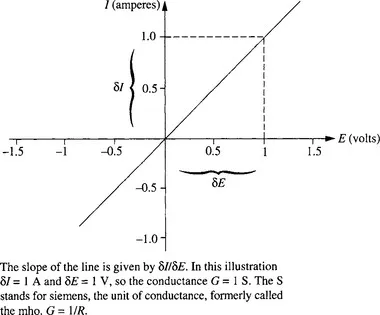
Figure 1.1 Current through a resistor of R ohms as a function of the applied voltage. The relation is linear, as shown, for a perfect resistor. At dc and low frequencies, most resistors are perfect for practical purposes
When two resistors are connected in series, the total resistance is the sum of the two resistances and when two resistors are connected in parallel, the total conductance is the sum of the two conductances. This is summarized in Figure 1.2. Variable resistors have three connections, one to each end of a resistive ‘track’ and one to the ‘wiper’ or ‘slider’. The track may be linear or circular and adjustment is by screwdriver (preset types) or by circular or slider knob. They are mostly used for adjusting dc levels or the amplitude of low frequency signals, but the smaller preset sort can be useful in the lower values up to VHF or beyond.
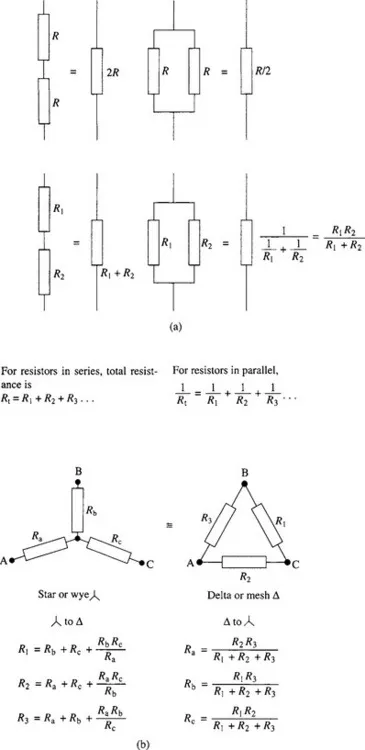
Figure 1.2 Resistors in combination
(a) Series parallel (also works for impedances)
(b) The star-delta transformation (also works for impedances, enabling negative values of resistance effectively to be produced)
Capacitors
The conduction of electricity, at least in metals, is due to the movement of electrons. A current of one ampere means that approximately 6242 × 1014 electrons are flowing past any given point in the conductor each second. This number of electrons constitutes one coulomb of electrical charge, so a current of one ampere means a rate of charge movement of one coulomb per second.
In a piece of metal an outer electron of each atom is free to move about in the atomic lattice. Under the action of an applied EMF, e.g. from a battery, electrons flow through the conductors forming the circuit, towards the positive terminal of the battery (i.e. in the opposite sense to the ‘conventional’ flow of current), to be replaced by other electrons flowing from the battery’s negative terminal. If a capacitor forms part of the circuit, a continuous current cannot flow, since a capacitor consists of two plates of metal separated by a non-conducting medium, an insulator or a vacuum (see Figure 1.3a, b).
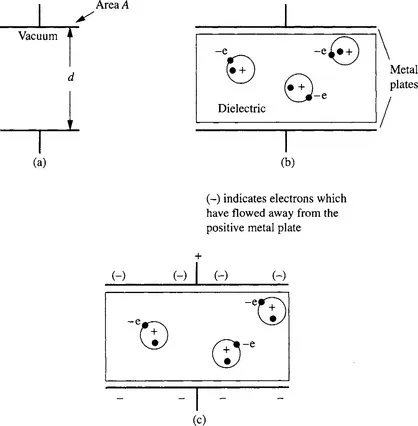
Figure 1.3 Capacitors
A battery connected across the plates causes some electrons to leave the plate connected to its positive terminal...
Table of contents
- Cover image
- Title page
- Table of Contents
- Copyright
- Preface
- Acknowledgements
- Chapter 1: Passive components
- Chapter 2: Passive circuits
- Chapter 3: RF transmission lines
- Chapter 4: RF transformers
- Chapter 5: Couplers, hybrids and directional couplers
- Chapter 6: Active components for RF uses
- Chapter 7: RF small-signal circuitry
- Chapter 8: Modulation and demodulation
- Chapter 9: Oscillators
- Chapter 10: RF power amplifiers
- Chapter 11: Transmitters and receivers
- Chapter 12: Advanced architectures
- Chapter 13: Propagation
- Chapter 14: Antennas
- Chapter 15: Attenuators and equalizers
- Chapter 16: Measurements
- Useful relationships
- S-Parameters
- Attenuators (pads)
- Universal resonance curve
- RF cables
- Wire gauges and related information
- Manufacturers of soft-ferrite† and iron-powder** cores
- Types of modulation – classification
- Quartz crystals
- Elliptic filters
- Screening
- Worldwide minimum external noise levels
- Frequency allocations and designations
- SRDs (Short Range Devices)
- Index
Trusted by 375,005 students
Access to over 1.5 million titles for a fair monthly price.
Study more efficiently using our study tools.
Frequently asked questions
Yes, you can cancel anytime from the Subscription tab in your account settings on the Perlego website. Your subscription will stay active until the end of your current billing period. Learn how to cancel your subscription
No, books cannot be downloaded as external files, such as PDFs, for use outside of Perlego. However, you can download books within the Perlego app for offline reading on mobile or tablet. Learn how to download books offline
Perlego offers two plans: Essential and Complete
- Essential is ideal for learners and professionals who enjoy exploring a wide range of subjects. Access the Essential Library with 800,000+ trusted titles and best-sellers across business, personal growth, and the humanities. Includes unlimited reading time and Standard Read Aloud voice.
- Complete: Perfect for advanced learners and researchers needing full, unrestricted access. Unlock 1.5M+ books across hundreds of subjects, including academic and specialized titles. The Complete Plan also includes advanced features like Premium Read Aloud and Research Assistant.
We are an online textbook subscription service, where you can get access to an entire online library for less than the price of a single book per month. With over 1.5 million books across 990+ topics, we’ve got you covered! Learn about our mission
Look out for the read-aloud symbol on your next book to see if you can listen to it. The read-aloud tool reads text aloud for you, highlighting the text as it is being read. You can pause it, speed it up and slow it down. Learn more about Read Aloud
Yes! You can use the Perlego app on both iOS and Android devices to read anytime, anywhere — even offline. Perfect for commutes or when you’re on the go.
Please note we cannot support devices running on iOS 13 and Android 7 or earlier. Learn more about using the app
Please note we cannot support devices running on iOS 13 and Android 7 or earlier. Learn more about using the app
Yes, you can access Practical RF Handbook by Ian Hickman in PDF and/or ePUB format, as well as other popular books in Technology & Engineering & Industrial Design. We have over 1.5 million books available in our catalogue for you to explore.