- 224 pages
- English
- ePUB (mobile friendly)
- Available on iOS & Android
eBook - ePub
About this book
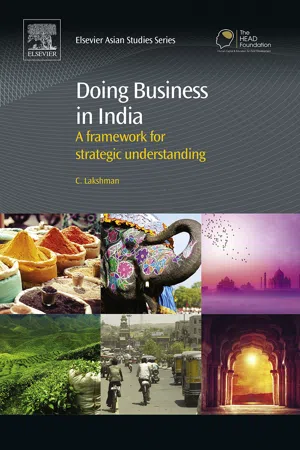
A comprehensive look at understanding India with a strategic framework that can be readily used for doing business in this market is needed. Doing Business in India discusses the cultural and consumer profile of the people of India and how these fit into the macroeconomic context. The analytical framework provided and illustrated with real case examples spans domains such as the institutional context of the country (full of voids and amazing peculiarities) and the interesting federalist political framework in a country with many states. Based on this foundation, the book introduces the business strategies appropriate for both rural and urban markets in India. The following chapters cover the successful implementation of these strategies in India. The remaining chapters focus on successful cross-cultural management of Indian managers and employees, the appropriate types of leadership required for managing the Indian workforce, the types of managerial control systems likely to be successful in this country, and the HRM practices that can help companies to win in this market.
- Offers a unique and exclusive focus on India
- Focus on political particularities in India crucial for understanding success models
- Explores the overall strategic framework for better strategy formulation in context
- Focus on strategy implementation issues (leadership, HRM, organizational systems)
- Includes cases not found in other sources
Information
1
Why India?
Abstract
In this chapter, I provide an understanding of why companies around the world are clamoring to enter India. The best time to enter India is now. India represents one of the biggest and fastest growing markets in the world today. India has the potential to become the third largest economy in the world (in U.S. dollar GDP terms) by 2050, behind only China and the U.S.A. India is an emerging economy that is likely to sustain its growth well into the future; it is run by democratically elected governments open to globalization; it possesses a huge middle class that has sufficient levels of disposable income and is increasingly consumerist; it also provides easy access to a host of countries in the region. This chapter provides a strategic framework to understanding this highly competitive market and provides a roadmap for the rest of the book. The framework should help readers formulate and implement the most appropriate strategies in the Indian context.
Keywords
Indian economy
Indian markets
growth potential
what India offers to the world
framework for strategic understanding
roadmap of subsequent chapters
“India isn’t a sweatshop for hands; it’s a sweatshop for brains.”
Anand Mahindra, CEO, Mahindra & Mahindra
McDonald’s opened its first restaurant in India in October 1996 and by November 2004 had opened a total of 58 restaurants, mostly in the northern and western parts of India. It is now reported to be operating more than 250 outlets in the country.1 Although it opened its first store only in 1996, it spent a full six years, prior to the establishment of the first outlet, studying Indian consumer preferences, developing the local supply chain’s ability to deliver consistently high-quality products on time, and creating its overall business approach to the market characterized by a high level of citizenship (Dash, n.d.). Given that a significant majority of the Indian population does not consume beef or pork-based products, it was important for the company to establish a clear strategic plan that would not hurt the religious sentiments of Indian consumers. More importantly, given the political activism and resistance faced earlier by KFC, it was important for McDonald’s to avoid political confrontation with either the government or one of a range of activist groups, including but not limited to those against globalization or foreign direct investment (FDI), those against Americanization, and environmental and animal activist groups. Instead the company highlighted the employment opportunities it provided, contributed to green movements, promoted sports events and healthy lifestyles, and got involved in community-related projects, mainly involving children. It transferred technology to the different players it helped develop in the supply chain for fast food, making some of them successful exporters of processed food, in an effort to overcome the poor transport and storage infrastructure in the country. Overall, McDonald’s has achieved a great deal of success in this country. This example, however, raises a very important question. Why would a company, whose core competence centers around beef and pork-based products, want to operate in a country where a significant majority of the population does not consume these products? More importantly, why would a company want to go to such great lengths (six years spent in planning activities alone) under such circumstances? This relates to the broader question of why businesses the world over are not only looking at but entering India at the earliest possible opportunity.
The answer, very simply, lies in the fact that, as an emerging market, India represents one of the biggest and fastest growing markets in the world today. Thus, for India to not be part of any company’s strategic plans would simply be anathema to business. According to a Goldman Sachs report, over the next 50 years, Brazil, Russia, India, and China (i.e., the BRIC countries) could become a much larger economic force than the G6 (top 6 economies of today) in U.S. dollar terms. Specifically, India is cited in this report as having the potential to become the third largest economy in the world (in U.S. dollar GDP terms) by 2050, behind only China and the U.S.A. Although this shift in economic terms is likely to be gradual over the course of 50 years, it is likely to be more dramatic in the first 30 years. In the latter part of this 50-year period, although the other three BRIC countries are likely to slow down, only India is likely to grow at a better than 5 percent annual rate over the entire period (Goldman Sachs, 2003). Thus, despite the fact that India is growing at the so-called Hindu rate of growth (Panagiotou and Story, n.d.), this growth is likely to be much more sustained than any of the other emerging markets. The reason India is likely to outperform other BRIC nations and current G6 nations over this time period is that it is the only nation whose population is likely to continue its growth for the next 50 years and the only country where the proportion of working age people will increase for the next 20 years. In addition to real economic growth, the economic force of the BRIC nations, in general, and India, in particular, is likely to be the result of currency appreciation, thereby considerably increasing the purchasing power of consumers in the country by up to 35 times current levels. However, per capita income levels in all the BRIC nations will still be lower than other nations, making life difficult for businesses and their strategy developers. In essence, businesses and their managers the world over will lose out significantly if they continue to ignore India and its markets for too long, notwithstanding the challenges on the road.
The success of McDonald’s in India illustrates the change in social values and attitudes of consumers in Indian society. Although the significant liberalization and privatization program begun in the early 1990s has changed the attitude of successive governments, some experts rank India lower on openness than the other BRIC nations. However, the attitudes of consumers and individuals in society are in complete contrast to the cautious optimism of the government. Indian society is moving away from traditional values of non-materialistic spiritualism and is increasingly reflective of materialism and consumerism. This shift in values is accompanied by higher levels of Westernization and the belief that the West represents and symbolizes innovation, productivity, and progress. The U.S.A. is the largest trade partner although trading relationships with EU countries are also relatively higher than most other nations. Compared to the few decades immediately following independence from the British in 1947, the latter part corresponds to growing acceptance of American and Western values, lifestyles, and general influence. India also contains perhaps the largest pool of English-speaking managerial talent anywhere in the world, in addition to an increasing proportion of the population with a similar capability. Consumers in India have always been interested in global brands – there was a huge black market for these products between 1947 and 1991 when the economy was closed – but buy local brands as well. A growing number of Japanese, Korean, American, and European multinationals have an established presence in the country as a consequence of the increased openness and favorable social attitudes that prevail.
Fast food restaurants such as McDonald’s, Domino’s, Pizza Hut, and KFC have become very popular in the country as a result of their ability to offer consumers products that are not based on beef or pork. Despite the food service industry being the most affected by consumer preferences driven by cultural values and traditions, the potential for success for most multinational businesses in India is great. However, the road is likely to be rough and full of challenges for companies wanting to do business in India. For instance, according to some reports McDonald’s made no profit in the first ten years of operations in India, while it took an average of five to seven years for each McDonald’s outlet in the country to break even. Although this compares favorably to the average of 12–13 years for the company in any new country (Dash, n.d.), it points up the presence of significant challenges and the need for a clear and strategic framework for understanding Indian markets and its consumers. Among the most important of these challenges is the need to understand the local business ecosystem and players that multinational corporations (MNCs) take for granted in their home environments, which are simply non-existent in India (Khanna et al., 2005). This book is aimed at providing a strategic framework for understanding the more critical factors in India’s markets to enable companies to devise effective strategies and to implement them well, given the particularities of Indian business ecosystems.
First, however, one needs to consider the increased levels of openness of the Indian government, its progressive economic policies of privatization and liberalization, and the progressive opening up of different sectors of the economy to global competition. Although India’s economy officially opened up to international competition after a wave of economic policy and regime changes in the early 1990s, the seeds for these changes in government and social attitudes were planted well before that time. The Japanese company Suzuki entered a 50:50 joint venture with the Indian government in 1981 to produce automobiles for the Indian market. The company is now entirely in the private sector and holds the largest market share for automobiles, although it has ceded a portion of its territory to other multinationals like Hyundai, General Motors, Ford, Toyota, Renault-Nissan, and Volkswagen, each of which entered the Indian market in succession, following opening up of the economy. These companies now share the spoils with the local emerging giant Tata Motors, which has benefited immensely from global competition. The entry of global giants into emerging markets transforms the local product and service quality landscape, often with far-reaching consequences (Khanna et al., 2005). Growing political resentment, albeit in pockets, and the resulting strengthening of activism by different political groups in some sectors, and growing aggressiveness in international expansion – Tata’s acquisition of Land Rover and Jaguar, for instance – are examples of such consequences. At the same time as Suzuki formed a joint venture with the government, Honda, Yamaha, and Kawasaki made their entry into the Indian market for motorcycles, which even today is much bigger than that for automobiles. Although all of these companies entered the market through licensing and/or joint ventures in the early 1980s, many of them now run wholly owned subsidiaries in the country, with some of them competing with their former joint venture partners. These examples from the auto industry highlight the long-term possibility of progressively higher profit potentials in the India market for MNCs, although they may come with higher levels of risk, as is the case anywhere else in the world. More importantly, these examples highlight the growing tendency of successive central governments in India to support and sustain a level of openness to global competition, regardless of their political differences.
Consistent with public perceptions, or perhaps as a consequence of them, the global competitiveness report of the World Economic Forum classifies India as a factor-driven economy and thus in the first stage of economic development. Consequently, all the automobile companies cited earlier are operating in India not only to capture future market potential but also to use the country as a base for low-cost operations, thereby lowering their global cost structures. However, the Indian government expects most multinationals to guarantee a certain level of exports from their bases in India, with the objective of keeping a favorable balance of trade position and making economic progress. The fact that India provides a cost advantage to MNCs operating within its borders cannot be demonstrated by a better example than that of the recently launched Orbiter mission to Mars. While the Indian Space Research Organisation (ISRO) successfully put the Orbiter into its first orbit around the Earth on its way to orbiting Mars at a cost of only $74 million dollars, NASA’s Maven satellite which was launched in November 2013 is likely to set NASA back $671 million dollars (Neuman, 2013). Even accounting for purchasing parity differences and specially augmented features and equipment on board, the cost difference is stark. Thus, while India continues to provide a cost advantage (not as much as China, for sure), Orbiter and its launch points up the technological capabilities of the country and the hordes of scientists and engineers it can bring to the table (Kapur and Ramamurti, 2001). The success of Orbiter and its ability to successfully orbit Mars makes one wonder at the bundle of contrasts that India represents and the inherent complexity facing strategic managers in this country of slum dog millionaires. In fact, one theme that will prevail throughout this book is that India is a huge bundle of contrasts. More specifically, this book aims at unpacking this bundle of contrasts to facilitate a clear and strategic understanding of how to win in India.
The political will and ambitious vision of the Indian government, exemplified by its investments in space missions, also transcend domains such as the progressive, though slow opening up of different economic sectors. One such sector is the Indian retail sector, where the government recently managed to obtain approval for majority investment by MNCs in multi-brand retail and 100 percent investment by MNCs in single-brand retail, amid serious activism and potential for political upheaval in the coalition running the government.2 A.T. Kearney (a global management consulting firm) developed the Retail Development Index and has touted it as the bellwether of future global economic growth.3 Some experts suggest that there is immense potential for the development of intermediary firms and indigenous business ecosystems (the kind that McDonald’s lacked in India) if only the country would open up its doors to FDI in retail, noting China as a case in point where this had already happened (Khanna et al., 2005). In India, the fractious nature of politics and the diversity of the country, which is administratively divided into 29 states, necessitated the framing of the recent (December 2012) Retail FDI bill requiring subsequent approval by respective state governments. Thus, although enacted into law by the federal (central) government, both the single-brand and ...
Table of contents
- Cover image
- Title page
- Table of Contents
- Copyright
- List of figures
- List of tables
- Preface
- About the author
- Endorsements
- 1: Why India?
- 2: The institutional context
- 3: The macroeconomic context
- 4: Political particularities in India
- 5: Profile of consumers and markets in India
- 6: Strategies adapted to Indian needs
- 7: Rural India and bottom-of-the-pyramid markets
- 8: Competitive advantage of India
- 9: Leadership of Indian intellectual capital
- 10: Organization and control systems for India
- 11: Successful HRM for India
- References
- Further reading
- Index
Trusted by 375,005 students
Access to over 1.5 million titles for a fair monthly price.
Study more efficiently using our study tools.
Frequently asked questions
Yes, you can cancel anytime from the Subscription tab in your account settings on the Perlego website. Your subscription will stay active until the end of your current billing period. Learn how to cancel your subscription
No, books cannot be downloaded as external files, such as PDFs, for use outside of Perlego. However, you can download books within the Perlego app for offline reading on mobile or tablet. Learn how to download books offline
Perlego offers two plans: Essential and Complete
- Essential is ideal for learners and professionals who enjoy exploring a wide range of subjects. Access the Essential Library with 800,000+ trusted titles and best-sellers across business, personal growth, and the humanities. Includes unlimited reading time and Standard Read Aloud voice.
- Complete: Perfect for advanced learners and researchers needing full, unrestricted access. Unlock 1.5M+ books across hundreds of subjects, including academic and specialized titles. The Complete Plan also includes advanced features like Premium Read Aloud and Research Assistant.
We are an online textbook subscription service, where you can get access to an entire online library for less than the price of a single book per month. With over 1.5 million books across 990+ topics, we’ve got you covered! Learn about our mission
Look out for the read-aloud symbol on your next book to see if you can listen to it. The read-aloud tool reads text aloud for you, highlighting the text as it is being read. You can pause it, speed it up and slow it down. Learn more about Read Aloud
Yes! You can use the Perlego app on both iOS and Android devices to read anytime, anywhere — even offline. Perfect for commutes or when you’re on the go.
Please note we cannot support devices running on iOS 13 and Android 7 or earlier. Learn more about using the app
Please note we cannot support devices running on iOS 13 and Android 7 or earlier. Learn more about using the app
Yes, you can access Doing Business in India by Chandrashekhar Lakshman in PDF and/or ePUB format, as well as other popular books in Business & Management. We have over 1.5 million books available in our catalogue for you to explore.