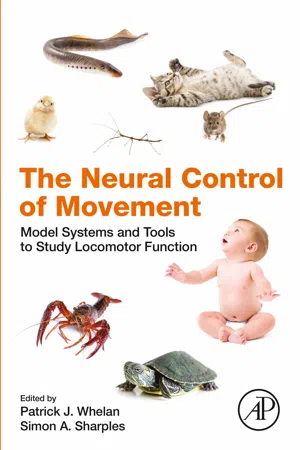
eBook - ePub
The Neural Control of Movement
Model Systems and Tools to Study Locomotor Function
- 484 pages
- English
- ePUB (mobile friendly)
- Available on iOS & Android
eBook - ePub
The Neural Control of Movement
Model Systems and Tools to Study Locomotor Function
About this book
From speech to breathing to overt movement contractions of muscles are the only way other than sweating whereby we literally make a mark on the world. Locomotion is an essential part of this equation and exciting new developments are shedding light on the mechanisms underlying how this important behavior occurs.
The Neural Control of Movement discusses these developments across a variety of species including man. The editors focus on highlighting the utility of different models from invertebrates to vertebrates. Each chapter discusses how new approaches in neuroscience are being used to dissect and control neural networks. An area of emphasis is on vertebrate motor networks and particularly the spinal cord. The spinal cord is unique because it has seen the use of genetic tools allowing the dissection of networks for over ten years. This book provides practical details on model systems, approaches, and analysis approaches related to movement control. This book is written for neuroscientists interested in movement control.
- Provides practice details on model systems, approaches, and analysis approaches related to movement control
- Discusses how recent advances like optogenetics and chemogenetics affect the need for model systems to be modified (or not) to work for studies of movement and motor control
- Written for neuroscientists interested in movement control, especially movement disorders like Parkinson's, MS, spinal cord injury, and stroke
Information
Section II
Vertebrates
Chapter 5: Neural control of swimming in lampreys
François Auclaira; Réjean Dubuca,b a Department of Neurosciences, University of Montreal, Montreal, QC, Canada
b Research Group in Adapted Physical Activity, University of Quebec at Montreal, Montreal, QC, Canada
b Research Group in Adapted Physical Activity, University of Quebec at Montreal, Montreal, QC, Canada
Abstract
Lampreys are basal vertebrates with a nervous system very similar to that of mammals but with a much smaller size and far fewer neurons. The lamprey nervous system can be entirely maintained in vitro for extended periods of time (easily up to 40 h). For these reasons, the lamprey has been considered as a model of choice to characterize the neural mechanisms underlying locomotion at the system, cellular, and subcellular levels since its introduction in the late 1970s by Sten Grillner and his collaborators in Sweden. This chapter summarizes some of the salient discoveries made in lampreys and examines how this animal model will likely be the source of future exciting discoveries on the neural control of locomotion.
Keywords
Lamprey; Spinal cord; Central Pattern Generator; Brainstem; Descending control
Historical perspectives
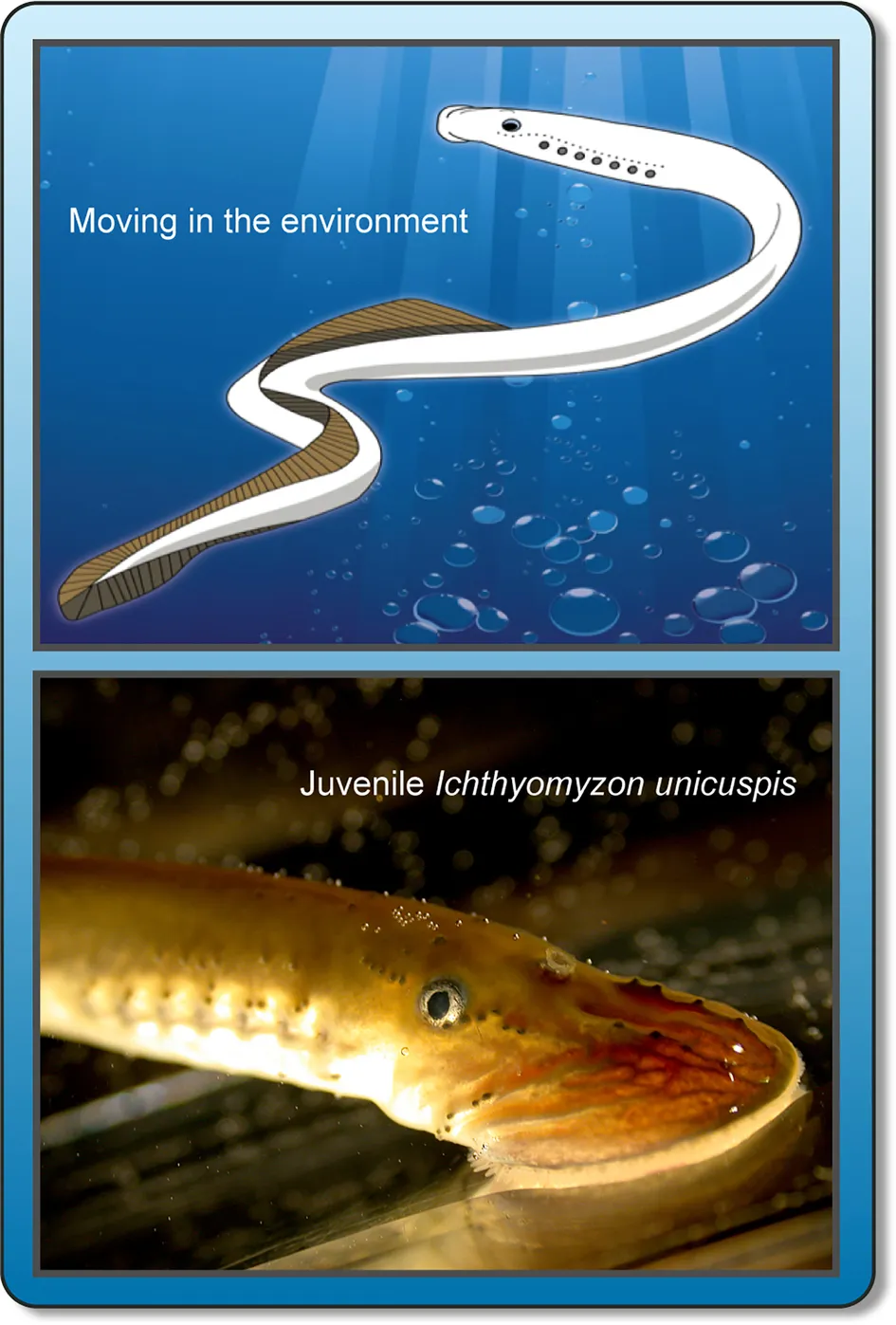
For more than four decades, the lamprey has been an important model organism for defining the neural mechanisms underlying locomotion at the system, network, and cellular levels. The existence of lampreys has been known for a very long time with accounts dating back to the Roman Empire [1]. This species of aquatic animals attracted a lot of attention at first because of its peculiar toothed “round mouth” that gave the name to the vertebrate group they form with hagfishes: the cyclostomes. Lampreys can use their mouth as a sucker to attach to surfaces for resting (Fig. 1), to move rocks on the bed of rivers when building their nest or to latch on fish on which they prey.
In addition to being an excellent animal model to study the neurophysiological mechanisms underlying locomotor behavior, lampreys have been a highly appreciated food for many centuries, particularly among the nobility in Europe. In the Bordeaux region of France, lamprey is served with a red wine sauce as a highly refined dish. King Henry I enjoyed lampreys so much that after eating such large quantities of this rich food he died a few days later. In France, there is a lamprey brotherhood that was founded in the village of Sainte Terre, north of Bordeaux. It comprises members from all sectors of French and international societies, including several scientists with an interest in lamprey locomotion. The brotherhood organizes each year a festival dedicated to the lamprey during which the dish “Lamproie à la bordelaise” is served. Lamprey pie has been served on several occasions to Queen Elizabeth II, first at her coronation in 1953 and then at her Silver, Golden, and Diamond Jubilees. Reference to lamprey pie has also been made in the television series “Game of Thrones,” as a delicacy served at the royal court of King's Landing (https://gameofthrones.fandom.com/wiki/Lamprey_pie).
In North America, one species of lampreys that normally spends its adult life in the Atlantic Ocean, the sea lamprey, or Petromyzon marinus, is considered a pest. In the early 20th century, lampreys invaded the Great Lakes through the St. Lawrence Seaway and adapted to the freshwater environment. As the highly adaptive and efficient predators they are, they have decimated a large proportion of the Great Lakes fish populations. This lamprey invasion had a significant commercial impact on the Great Lakes fisheries. Both Canadian and American Fish and Wildlife agents are hard at work to control sea lamprey populations in and around the Great Lakes.
Biologists now view lampreys as modern aquatic vertebrates that are part of the cyclostomes, the sister group to all other vertebrates (gnathostomes) having evolved separately for the last 500 million years [2]. Although there is no way of knowing for sure, there is a reasonably good chance that some characteristics of lampreys living 500 million years ago were present in a closely related form in the last common ancestor of the cyclostomes and gnathostomes [3]. This idea seems especially plausible since fossilized lampreys dating back 360 million years show many anatomical similarities with modern lampreys [4], an indication that lampreys have changed relatively slowly during evolution. From this, we can expect modern lampreys to have characteristics that are not so different from lampreys living some 500 million years ago and thus, not so different from the last common ancestor to all vertebrates. If one thinks of vertebrate locomotion as an essential and fundamental behavior, it could have already been present in a basic form in the common ancestor to all vertebrates. Because of their unique phylogenetic position, lampreys are well suited to study and understand the most basic neural mechanisms underlying locomotion for all vertebrates. Their neural system is simple, easily accessible and can survive for many hours or even days isolated in vitro, which adds to their value as an animal model.
For all those reasons, lampreys have been the focus of many studies for nearly two centuries. Questions soon arose about their brain and nervous system in general, starting with the work of Johannes Müller in the 1830s. He was the first to identify large “ganglionic corpuscles” in the hindbrain of the lamprey, probably providing the first account of a cellular structure (neuron) in the brain of an animal (see Refs. [5, 6] for excellent reviews of this period in research on the lamprey nervous system). Müller also described large fibers in the spinal cord of the lamprey but did not link this observation to the presence of “ganglionic corpuscles” he had described in the hindbrain. Back then, the concept of the neuron was not understood, and scientists described the neural system as “ganglionic corpuscles” (the cell bodies) and fibers (axons). Still, those were viewed as two different entities that seemed to contact each other. Before his work in the field of psychoanalysis, Sigmund Freud [7] contributed to advance the concept of the neuron by noticing that dorsal cells in the lamprey spinal cord and the fibers in the dorsal roots were continuous and were probably part of the same structure (same cell). His work and the work of other scientists gradually led to the discovery of a clear connection between the large spinal fibers, now called Müllerian fibers by Owsjannikow [8], and the large “ganglionic corpuscles” described initially by Johannes Müller in lampreys [9–12]. Mayer, in 1897 [11], was the first to clearly state that the giant Müller spinal fibers arose from the giant cells in the lamprey brainstem. Johnston confirmed this assertion in 1902 [13].
Once the idea of a connection between the spinal cord and cells in the brain began to take hold, it became clear that this was one simple and efficient way for the brain to control movements. Scientists then began to describe in more detail the cells in the brainstem reticular formation that made connections with neurons in the spinal cord. Because these brainstem neurons were conspicuous and could be easily observed with the means available at the turn of the 20th century, the Müller fibers located in the ventromedial part of the spinal cord, and the brainstem cells that gave rise to them, were the first elements to draw the interest of neuroscientists to the lamprey model. For a long time, confusion remained about which cells of the brainstem were at the origin of the large spinal Müller fibers. With careful observation, brainstem cells with fibers that could be followed to the ventral and medial spinal cord were first described in the mid...
Table of contents
- Cover image
- Title page
- Table of Contents
- Copyright
- Contributors
- About the Editors
- Preface
- Introduction: An interphyletic tool kit to study locomotor function: Past, present, and future directions
- Section I: Invertebrates
- Section II: Vertebrates
- Index
Trusted by 375,005 students
Access to over 1.5 million titles for a fair monthly price.
Study more efficiently using our study tools.
Frequently asked questions
Yes, you can cancel anytime from the Subscription tab in your account settings on the Perlego website. Your subscription will stay active until the end of your current billing period. Learn how to cancel your subscription
No, books cannot be downloaded as external files, such as PDFs, for use outside of Perlego. However, you can download books within the Perlego app for offline reading on mobile or tablet. Learn how to download books offline
Perlego offers two plans: Essential and Complete
- Essential is ideal for learners and professionals who enjoy exploring a wide range of subjects. Access the Essential Library with 800,000+ trusted titles and best-sellers across business, personal growth, and the humanities. Includes unlimited reading time and Standard Read Aloud voice.
- Complete: Perfect for advanced learners and researchers needing full, unrestricted access. Unlock 1.5M+ books across hundreds of subjects, including academic and specialized titles. The Complete Plan also includes advanced features like Premium Read Aloud and Research Assistant.
We are an online textbook subscription service, where you can get access to an entire online library for less than the price of a single book per month. With over 1.5 million books across 990+ topics, we’ve got you covered! Learn about our mission
Look out for the read-aloud symbol on your next book to see if you can listen to it. The read-aloud tool reads text aloud for you, highlighting the text as it is being read. You can pause it, speed it up and slow it down. Learn more about Read Aloud
Yes! You can use the Perlego app on both iOS and Android devices to read anytime, anywhere — even offline. Perfect for commutes or when you’re on the go.
Please note we cannot support devices running on iOS 13 and Android 7 or earlier. Learn more about using the app
Please note we cannot support devices running on iOS 13 and Android 7 or earlier. Learn more about using the app
Yes, you can access The Neural Control of Movement by Patrick J. Whelan,Simon A. Sharples in PDF and/or ePUB format, as well as other popular books in Biological Sciences & Neuroscience. We have over 1.5 million books available in our catalogue for you to explore.