- 312 pages
- English
- ePUB (mobile friendly)
- Available on iOS & Android
eBook - ePub
Corrosion of Steel in Concrete Structures
About this book
Corrosion of reinforcing steel is now recognized as the major cause of degradation of concrete structures in many parts of the world. Despite this, infrastructure expenditure is being unreasonably decreased by sequestration and the incredible shrinking discretionary budget. All components of our infrastructure including highways, airports, water supply, waste treatment, energy supply, and power generation require significant investment and are subjected to degradation by corrosion, which significantly reduces the service life, reliability, functionality of structures and equipment, and safety. Corrosion of Steel in Concrete Structures provides a comprehensive review of the subject, in addition to recent advances in research and technological developments, from reinforcing materials to measurement techniques and modelling.
This book contains not only all the important aspects in the field of corrosion of steel reinforced concrete but also discusses new topics and future trends. Part One of the book tackles theoretical concepts of corrosion of steel in concrete structures. The second part moves on to analyse the variety of reinforcing materials and concrete, including stainless steel and galvanized steel. Part Three covers measurements and evaluations, such as electrochemical techniques and acoustic emission. Part Four reviews protection and maintenance methods, whilst the final section analyses modelling, latest developments and future trends in the field.
The book is essential reading for researchers, practitioners and engineers who are involved in materials characterisation and corrosion of steel in concrete structures.
- Provides comprehensive coverage on a broad range of topics related to the corrosion of steel bars in concrete
- Discusses the latest measuring methods and advanced modeling techniques
- Reviews the range of reinforcing materials and types of concrete
Information
Part One
Theoretical concepts of corrosion of steelin concrete structures
1
An introduction to corrosion of engineering materials
C.M. Hansson Mechanical and Mechatronics Engineering, University of Waterloo, Waterloo, ON, Canada
Abstract
Corrosion is ubiquitous. It occurs in every sector of industry, from farm equipment to nuclear power plants to highway bridges. However, by understanding the specific causes and mechanisms of corrosion, it is possible to limit the rate of deterioration of a part or structure to an acceptable level. This chapter gives a brief introduction to the basic thermodynamics and kinetics of corrosion in general, and the forms of corrosion encountered in reinforced concrete. An account of some early reports on the subject is followed by a discussion of the social, environmental, and financial costs of corrosion.
Keywords
Cost of corrosion; Electrolytic (stray current) corrosion; General corrosion; Pitting; Pourbaix diagrams1.1. Introduction—the ubiquitous nature of corrosion
With isolated exceptions, metals exist in Earth's crust as minerals such as carbonates, sulfides, sulfates, or oxides formed over billions of years. These compounds are therefore considered to be in their equilibrium state—that is, their lowest energy state. Extracting the metals from these compounds requires a significant amount of energy in the form of heat or electrical power. Once extracted, the metals and alloys are in a thermodynamically metastable state and depending on the environment, they will always attempt to revert to a lower energy compound, usually by corrosion or oxidation. Since the Earth's atmosphere contains water and oxygen, and coatings and other barriers are inherently imperfect, it is impossible to completely prevent corrosion. Consequently, all metals and alloys in use today are in a metastable condition.
1.2. Thermodynamics are on the side of corrosion
The stability of a metal is usually described in terms of its electrochemical potential, a thermodynamic function that may be defined in the context of corrosion as “the ease of ionizing an atom of the metal.” Potentials are dependent on the pH of the environment and factors such as oxygen availability. Potentials cannot be determined absolutely, and are generally defined as the potential difference between the metal of interest and that of a reference electrode so chosen to have a stable potential (Revie and Uhlig, 2008). The “standard hydrogen electrode” (SHE) is the reference electrode against which all other electrodes are measured and is given the electrochemical potential of 0.00 V. It is designed so that the reaction: 2H+ + 2e− = H2 is in equilibrium at pH 0 (i.e., 1 M acid solution), 1 atm hydrogen gas, and 25 °C. Because the hydrogen electrode is cumbersome to operate and transport, other electrodes consisting of a metal in contact with a saturated solution of its ions, such as Cu/CuSO4, are used. The different common reference electrode potentials relative to that of the SHE are given in Table 1.1, and conversions are illustrated in Figure 1.1 (Roberge). These electrodes are not generally suitable for embedding in concrete because they become unstable over a short period of time at high pH levels. Therefore, an Mn/MnO2 electrode has been developed specifically for use in concrete (Arup et al., 1997).
Table 1.1
Characteristics of common reference electrodes (Roberge)
| Electrode type | Equilibrium reactions Nernst equation | Conditions (activity) | Potential V vs SHE | Temp. coefficient mV/°C |
| Standard hydrogen electrode (SHE) | 2H+ + 2e− = H2 | pH = 0 | ||
| E0 = 0.059 pH | ||||
| Silver chloride | AgCl + e− = Ag + Cl− | aCl− = 1 | 0.2224 | −0.6 |
| E0 = 0.059log10(aCl−) | 0.1 M KCl | 0.2881 | −0.6 | |
| 1.0 M KCl | 0.235 | −0.6 | ||
| Saturated KCl | 0.199 | −0.6 | ||
| Seawater | ∼0.250 | −0.6 | ||
| Calomel | Hg2Cl2 + 2e− = 2Hg + 2Cl− | aCl− = 1 | 0.268 | |
| E0 − 0.059log10(aCl−) | 0.1 M KCl | 0.3337 | −0.06 | |
| 1.0 M KCl | 0.280 | −0.24 | ||
| Saturated KCl | 0.241 | −0.65 | ||
| Mercurous sulfate | Hg2SO4 + 2e− = 2Hg + SO42− | 0.6151 | ||
| E0 − 0.0295log10(aSO42−) | ||||
| Mercuric oxide | HgO + 2e− + 2H+ = Hg + H2O | 0.926 | ||
| E0 − 0.059 pH | ||||
| Copper sulfate | Cu2+ + 2e− = Cu (SO2 solution | aCu = 1 | 0.340 | |
| E0 + 0.0295log10(aCu2+) | Saturated | 0.318 |

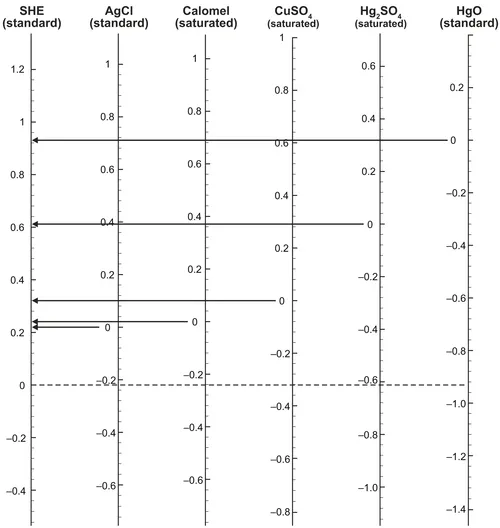
Figure 1.1 Comparison of potentials from different reference electrodes. Reproduced with permission from Roberge.
The ranges of electrochemical potential and pH in which the products of corrosion are either dissolved ions—for example, Fe2+ or Cr3+—or solid oxides or hydroxides are given in the “Atlas of Electrochemical Equilibria” (Pourbaix, 1974) for each metal in aqueous solutions. The solid products may protect the metal from further rapid corrosion and are then known as “passive films.” The simplified “Pourbaix diagrams” for iron and zinc given in Figure 1.2 indicate the regions of potential and pH in which the metals are immune from corrosion, will actively corrode, or will form passive films.
The dashed lines labeled (a) and (b) in each diagram in Figure 1.2 represent the equilibria for the reactions:
1. 2H+ + 2e− = H2
2. O2 + 2H2O + 4e− = 4(OH)−
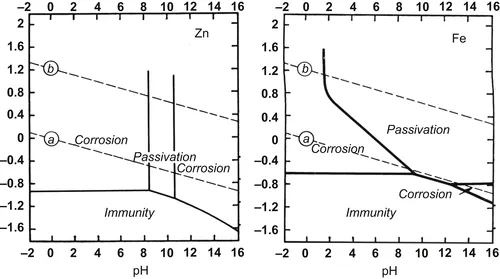
Figure 1.2 “Pourbaix diagrams” for zinc and iron, showing regions of pH and potential in which each metal is passive; that is, the corrosion products are solid and protect the metal from active corrosion (Pourbaix, 1974).
The dissolution or oxidation of a metal (e.g., M → M2+ + 2e−) constitutes the anodic half-cell reaction, and the electrons released are immediately consumed, usually by one o...
Table of contents
- Cover image
- Title page
- Table of Contents
- Related titles
- Copyright
- List of contributors
- Woodhead Publishing Series in Civil and Structural Engineering
- Preface
- Part One. Theoretical concepts of corrosion of steelin concrete structures
- Part Two. Different reinforcing materials and concrete
- Part Three. Measurements and evaluations
- Part Four. Protection, modeling and future trends
- Index
Trusted by 375,005 students
Access to over 1.5 million titles for a fair monthly price.
Study more efficiently using our study tools.
Frequently asked questions
Yes, you can cancel anytime from the Subscription tab in your account settings on the Perlego website. Your subscription will stay active until the end of your current billing period. Learn how to cancel your subscription
No, books cannot be downloaded as external files, such as PDFs, for use outside of Perlego. However, you can download books within the Perlego app for offline reading on mobile or tablet. Learn how to download books offline
Perlego offers two plans: Essential and Complete
- Essential is ideal for learners and professionals who enjoy exploring a wide range of subjects. Access the Essential Library with 800,000+ trusted titles and best-sellers across business, personal growth, and the humanities. Includes unlimited reading time and Standard Read Aloud voice.
- Complete: Perfect for advanced learners and researchers needing full, unrestricted access. Unlock 1.5M+ books across hundreds of subjects, including academic and specialized titles. The Complete Plan also includes advanced features like Premium Read Aloud and Research Assistant.
We are an online textbook subscription service, where you can get access to an entire online library for less than the price of a single book per month. With over 1.5 million books across 990+ topics, we’ve got you covered! Learn about our mission
Look out for the read-aloud symbol on your next book to see if you can listen to it. The read-aloud tool reads text aloud for you, highlighting the text as it is being read. You can pause it, speed it up and slow it down. Learn more about Read Aloud
Yes! You can use the Perlego app on both iOS and Android devices to read anytime, anywhere — even offline. Perfect for commutes or when you’re on the go.
Please note we cannot support devices running on iOS 13 and Android 7 or earlier. Learn more about using the app
Please note we cannot support devices running on iOS 13 and Android 7 or earlier. Learn more about using the app
Yes, you can access Corrosion of Steel in Concrete Structures by Amir Poursaee in PDF and/or ePUB format, as well as other popular books in Technology & Engineering & Architecture Methods & Materials. We have over 1.5 million books available in our catalogue for you to explore.