- 161 pages
- English
- ePUB (mobile friendly)
- Available on iOS & Android
eBook - ePub
Introduction to Digital Signal Processing
About this book
Introduction to Digital Signal Processing covers the basic theory and practice of digital signal processing (DSP) at an introductory level. As with all volumes in the Essential Electronics Series, this book retains the unique formula of minimal mathematics and straightforward explanations. The author has included examples throughout of the standard software design package, MATLAB and screen dumps are used widely throughout to illustrate the text.
Ideal for students on degree and diploma level courses in electric and electronic engineering, 'Introduction to Digital Signal Processing' contains numerous worked examples throughout as well as further problems with solutions to enable students to work both independently and in conjunction with their course.
- Assumes only minimum knowledge of mathematics and electronics
- Concise and written in a straightforward and accessible style
- Packed with worked examples, exercises and self-assesment questions
Information
1
The basics
1.1 CHAPTER PREVIEW
In this first chapter you will be introduced to the basic principles of digital signal processing (DSP). We will look at how digital signal processing differs from the more conventional analogue signal processing and also at its many advantages. Some simple digital processing systems will be described and analysed. The main aim of this chapter is to set the scene and give a feel for what digital signal processing is all about – most of the topics mentioned will be revisited, and dealt with in more detail, in other chapters.
1.2 ANALOGUE SIGNAL PROCESSING
You are probably very familiar with analogue signal processing. Some obvious examples of this type of processing are amplification, rectification and filtering. With all analogue processing, signals enter a system, are processed by passing them through circuits containing capacitors, resistors, inductors, op amps, transistors etc. They are then outputted from the system with a different shape or size. Figure 1.1 shows a very elementary example of an analogue signal processing system, consisting of just a resistor and a capacitor – you will probably recognize it as a simple type of lowpass filter. Analogue signal processing circuits are commonplace and have been very important system building blocks since the early days of electrical engineering.
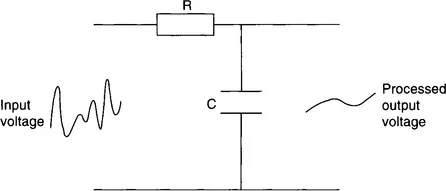
Figure 1.1
Unfortunately, as useful as they are, analogue processing systems do have major defects. An obvious one is that they have to be physically modified if the processing needs to be changed. For example, if the gain of an amplifier has to be increased, then this usually means that at least a resistor has to be changed. What if a different cut-off frequency is required for a filter or, even worse, we want to replace a highpass filter with a lowpass filter? Once again, components must be changed. This can be very inconvenient to say the least – it’s bad enough when a single system has to be adjusted but imagine the situation where a batch of several thousand is found to need modifying. How much better if changes could be achieved by altering a parameter or two in a computer program …
Another problem with analogue systems is that of ‘repeatability’. It is very unlikely that two analogue systems will have identical performances, even though they have been made in exactly the same way, with supposedly the same value components. This is mainly because of component tolerances. Analogue devices have two further disadvantages. The first is that their components age and so the device performance changes. The other is that components are also affected by temperature changes.
1.3 AN ALTERNATIVE APPROACH
So, having slightly dented the reputation of analogue processors, what’s the alternative? Luckily, signal processing systems do exist which work in a completely different way and do not have these problems. A major difference is that these systems first sample, at regular intervals, the signal to be processed (Fig. 1.2). The sampled voltages are then converted to equivalent binary values, using an analogue-to-digital converter (Fig. 1.3). Next, these binary numbers are fed into a digital processor, containing a particular program, which will change the samples. The way in which the digital values are modified will obviously depend on the type of signal processing required – for example, do we want lowpass or highpass filtering and what cut-off frequency do we require? The transformed samples are then outputted, via a digital-to-analogue converter, to produce the reconstituted but processed analogue output signal.
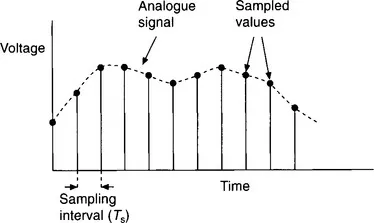
Figure 1.2
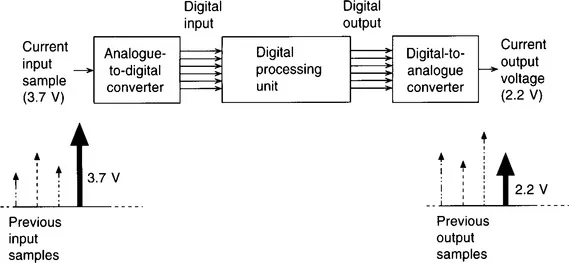
Figure 1.3
Because computers can process data so quickly, the signal processing can be done almost in ‘real time’, i.e. the processed output samples are fed out continuously, almost in step with the corresponding input samples. Alternatively, the processed data could be stored, perhaps on a chip or CD-ROM, and then read when required.
By now, you’ve probably guessed that this form of processing is called digital signal processing. Digital signal processing (DSP) does not have the drawbacks of analogue signal processing, already mentioned. For example, the type of processing required can be modified very easily – if the specification of a filter needs to be changed then new parameters can simply be keyed into the DSP system, i.e. the processing is programmable. The performance of a digital filter is also constant, not changing with either time or temperature. DSP systems are also inherently repeatable – if several DSP systems have been programmed to process signals in a certain way then they will all behave identically. DSP systems can also process signals in ways impossible for analogue systems.
To summarize:
• Digital signal processing systems are available t...
Table of contents
- Cover image
- Title page
- Table of Contents
- Copyright
- Series Preface
- Dedication
- Preface
- Acknowledgements
- Chapter 1: The basics
- Chapter 2: Discrete signals and systems
- Chapter 3: The z-plane
- Chapter 4: The design of IIR filters
- Chapter 5: The design of FIR filters
- Answers to self-assessment tests and problems
- References and Bibliography
- Appendix A: Some useful Laplace and z-transforms
- Appendix B: Frequency transformations in the s- and z-domains
- Index
Trusted by 375,005 students
Access to over 1.5 million titles for a fair monthly price.
Study more efficiently using our study tools.
Frequently asked questions
Yes, you can cancel anytime from the Subscription tab in your account settings on the Perlego website. Your subscription will stay active until the end of your current billing period. Learn how to cancel your subscription
No, books cannot be downloaded as external files, such as PDFs, for use outside of Perlego. However, you can download books within the Perlego app for offline reading on mobile or tablet. Learn how to download books offline
Perlego offers two plans: Essential and Complete
- Essential is ideal for learners and professionals who enjoy exploring a wide range of subjects. Access the Essential Library with 800,000+ trusted titles and best-sellers across business, personal growth, and the humanities. Includes unlimited reading time and Standard Read Aloud voice.
- Complete: Perfect for advanced learners and researchers needing full, unrestricted access. Unlock 1.5M+ books across hundreds of subjects, including academic and specialized titles. The Complete Plan also includes advanced features like Premium Read Aloud and Research Assistant.
We are an online textbook subscription service, where you can get access to an entire online library for less than the price of a single book per month. With over 1.5 million books across 990+ topics, we’ve got you covered! Learn about our mission
Look out for the read-aloud symbol on your next book to see if you can listen to it. The read-aloud tool reads text aloud for you, highlighting the text as it is being read. You can pause it, speed it up and slow it down. Learn more about Read Aloud
Yes! You can use the Perlego app on both iOS and Android devices to read anytime, anywhere — even offline. Perfect for commutes or when you’re on the go.
Please note we cannot support devices running on iOS 13 and Android 7 or earlier. Learn more about using the app
Please note we cannot support devices running on iOS 13 and Android 7 or earlier. Learn more about using the app
Yes, you can access Introduction to Digital Signal Processing by Robert Meddins in PDF and/or ePUB format, as well as other popular books in Technology & Engineering & Signals & Signal Processing. We have over 1.5 million books available in our catalogue for you to explore.