There are few figures and leaders of recent American history of greater social and political consequence than Jesse Jackson, and few more relevant for America's current political climate. In the 1960s, Jackson served as a close aide to Dr. Martin Luther King, meeting him on the notorious march to legitimate the American democratic system in Selma. He was there on the day of King's assassination, and continued his political legacy, inspiring a generation of black and Latino politicians and activists, founding the Rainbow/PUSH Coalition, and helping to make the Democratic Party more multicultural and progressive with his historic runs for the presidency in the 1980s.
In I Am Somebody, David Masciotra argues that Jackson's legacy must be rehabilitated in the history of American politics. Masciotra has had personal access to Jackson for several years, conducting over 100 interviews with the man himself, as well as interviews with a wide variety of elected officials and activists who Jackson has inspired and influenced. It also takes readers inside Jackson's negotiations for the release of hostages and political prisoners in Cuba, Iraq, and several other countries. As Democratic politics sees a return to radicalism and the rise of a new generation of committed advocates of racial and economic justice, I Am Somebody: Why Jesse Jackson Matters is a critical book for understanding where America in the 21st Century has come from and where it is going.
Featuring a foreword by Michael Eric Dyson.
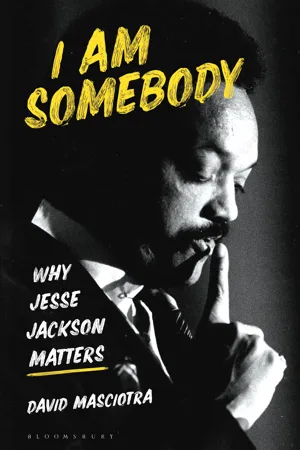
- 232 pages
- English
- ePUB (mobile friendly)
- Available on iOS & Android
eBook - ePub
About this book
Information
Chapter 1
Remove Not Your Ancient Landmarks
“The sore is still raw,” Jesse Jackson said with a tear in his eye as he began to describe the murder of America’s greatest moral and political leader, Martin Luther King Jr.—a gruesome and history-halting event that took place more than forty years before our conversation in Jackson’s private office at the Rainbow/PUSH headquarters in Chicago, Illinois. The civil rights organization operates out of an architecturally grand synagogue on the South Side of Chicago, with the nickname, “Dr. King’s Workshop.”
“What was so different about that sermon,” Jackson remarked in reference to King’s final public speech, which he gave begrudgingly at the Bishop Charles Mason Temple in Memphis, Tennessee, “is I saw grown men crying. There was a pathos to his message, to his presentation.” Jackson’s eyes enlarged as if he was looking upon the tragic drama of King’s prophecy for the first time, “It was a transitional speech—‘I’m fearing no man,’ ‘My eyes have seen the glory of the coming of the Lord,’ ‘I may not get there with you.’” The leader, just as in the gospel, was more aware of the proximity to Golgotha than his disciples. “We all knew of the threat of death,” Jackson said, “It was always with us. But he was more intimately aware. He felt the pressure. He felt the burden of leadership. He felt it on his back.”
The cry for justice in America is always a whisper in a storm. It can, on some sweet occasions, find amplification, but it often is blown into oblivion.
“The next day was relaxed in the hotel room,” Jackson began to recall. “And I remember coming across the courtyard in the afternoon as we were preparing to leave for dinner. He said to me, ‘Jesse, we’re going to Rev. Kyles home for dinner, and you don’t even have on a tie.’ I said, ‘Doc, the prerequisite for eating is an appetite not a tie.’ He laughed, and said, ‘You’re crazy.’” King’s eyes met those of Ben Branch, a musician and civil rights activist, whose rendition of “Precious Lord” on the saxophone had deeply moved King just weeks earlier. “I want you to play my favorite song tonight,” King offered as request. “I will Doc,” Branch assured him, articulating the last words King would ever hear.
“That’s when it hit,” Jackson said, bringing his hands together in a thunderous clap. “It knocked him against the door.”
“I then took the longest ten steps of my life,” Jackson said softly and slowly, as if his words must move at the same pace of his feet on that fateful day in the home of the blues, “I called Coretta Scott King, and I couldn’t quite say what I saw. I told her that he was shot in the shoulder.”
As Jackson spoke to King’s wife, she was already a widow. The bullet fired from the rifle of James Earl Ray, an undistinguished white supremacist, killed King on impact. His blood began to empty onto the balcony. Jackson moved up the stairs, embraced King’s lifeless body, and in a spiritual exercise and execution of the Christian belief and Baptist refrain, “There’s power in the blood,” allowed his vital fluid to soak his sweater. He would leave that mark on his body during his television appearances throughout the next twenty-four hours.
Precious Lord, take my hand
Lead me on, let me stand
I'm tired, I’m weak, I’m lone
Through the storm, through the night
Lead me on to the light
Take my hand precious Lord, lead me home
“The pathology, the sickness, the neuroses of Memphis, of this society is what really pulled the trigger,” Jackson told a television reporter less than a day after King’s heart beat for the last time, “The white people do not know it, but their best friend is dead.”1
White America rarely, if ever, truly detects friendship, and what promises improvement for the universal American experience. Racism, in addition to all the words a mourning Jackson used to describe it on April 5, 1968, is what Toni Morrison calls, “a fantasy.”2 So lost in the spell of its own hypnosis, white America cannot recognize the obvious veracity of what Jackson explained to me as the “residual benefits of the civil rights movement.” “Before the Voting Rights Act,” Jackson said, “white women could not serve on juries. College students could not vote on campus. There was no bilingual voting.” With characteristic rhetorical verve, Jackson also delineates the social, political, and financial rewards of tearing down the “cotton curtain”—“You could not have the Tennessee Titans behind the cotton curtain, the Carolina Panthers, the Atlanta Braves. The players would not have been able to ride on the same bus together. You couldn’t have a BMW plant in South Carolina behind the cotton curtain. Furthermore, you couldn’t have had presidents Carter, Clinton, or Bush. The shame of segregation and lynching would have prevented their politics from going national.”
In the lobby of Rainbow/PUSH, there is a lifelike mock-up of Jackson and King standing together on the balcony of the Lorraine Motel. The description underneath the image anoints King as the “architect of American democracy.” The much-ballyhooed brain trust of the Founding Fathers could not envision a system of self-governance without slavery and with an unlimited franchise. King could. Few Americans realize that the Soviet Union’s most popular and effective propaganda tactic to divert attention away from American criticism of its routine human rights violations was the slogan, typically attached to visual depiction, “And you are hanging blacks.”3 The FBI, most elected officials, and the majority of white Americans saw King as subversive, when in reality he was America’s most powerful defender, just as Jackson, suffering through similar slander, remains an advocate for the genuine article America, what Walt Whitman called, “Centre for equal daughters, equal sons . . . Perennial with the Earth, with freedom, law, and love.”4
The tragic sweep of America’s failure to support King’s transition from civil rights advocate to economic justice crusader emerged in full proportion a month after his assassination. It was the late leader’s dream to converge on the National Mall of Washington DC with a poor people’s march. He hoped it would triumph just as the 1963 march on Washington where he gave the most famous of all his speeches—“I have a dream”—and gained a momentous victory for black freedom under American apartheid. To prepare for the demonstration, thousands of impoverished and dispossessed citizens of the world’s richest nation constructed a shantytown in the capital, calling it “Resurrection City.” It was Occupy Wall Street, but only in earlier and grander form. Residents of Resurrection City elected Jesse Jackson as their mayor. The grief emanating out of King’s untimely death coalesced with the relative lack of success of the Poor People’s Campaign, and as Resurrection City was preparing for collapse, its constituents looked to their mayor to “give them something,” to use Jackson’s simple phrase.
“We were all depressed,” Jackson said. “I had no money to give them. I could not get them back home. We did not change any laws. I looked in their tired faces, and said, ‘You still have worth. You may be hungry, but you are somebody.’ Then, I asked them to say it, ‘Say, I am somebody.’”
Jackson alchemized as inspiration an old poem by Rev. William Holmes Borders, Sr. to, in the absence of anything material, provide the least of his brethren with those qualitative gifts that can never disappear without consent—hope, faith, and self-respect.
The Jesse Jackson story is encapsulated in the words of his most famous refrain. It is a mission to assert his own identity, integrity, and agency—his own somebodiness—in the service of forcing America to honor the somebodiness of everyone living within its multiracial, multicultural, multireligious milieu. King’s death had left Jackson, and all of the aides and activists “disoriented,” to use his own word, and in a biblical rhythm, an assortment of apostles would have to spread the gospel, meaning “good news for the poor,” without their founder, leader, and director. The subsequent journey would include milestones and missteps, triumph and tragedy, mountainous heights and cavernous lows. At King’s funeral, Jackson assured his fallen friend and teacher that he would “never stop fighting.” From the man in the coffin, he had already received his necessary training and education.
Architecture leads to construction, and every construction project begins with a stake in the ground mapping the point of origin for development. Racism and white supremacy formed the stake in the ground from which Jackson could begin his dedication to authentic activation of American democracy. He came of age not only black, suffering under the oppression, limitation, and terror of Jim Crow, but also poor. To intimately experience both state-sponsored racial abuse and state-enabled and -ignored deprivation, is to gain expertise in the gaps of contradiction separating what America trumpets as its persona and practice, and how it actually behaves, from the local to the federal level of governance, and from the loan office at the neighborhood bank to the gilded and gated entryways of Wall Street.
Far removed from America’s central junction box of political or corporate power, Jackson once requested his driver to take us down a bumpy road in Greenville, South Carolina. Giving further instruction for the driver to pull to the curb, he pointed out the house where he was born and raised. “A small house, we didn’t have much, but there was a lot of love,” he said. In his 1988 speech at the Democratic National Convention, he offered poetic reflection on his humble roots—“Wallpaper as decoration? No, as windbreaker.” Jackson assured me that this was not merely oratorical panache, but an accurate description of the desperate tactics a family takes to vainly fight the cold in a house constructed with thin walls when the furnace is faulty, and the savings account is empty. Because he was born to a teenage mother, out of wedlock, he also endured taunts and harassment from his peers. “I am somebody,” is not merely a refrain Jackson asks audiences to repeat for their own edification, but a mantra containing hard-earned truth he had to battle and toil to internalize.
“Our money was counterfeit,” Jackson said. “We could not shop in the grocery store, could not stop in a hotel.” He described his stepfather—his mother would later marry—having to sit behind Nazi POWs at an Army base during the Second World War, because they were white, and he was black. The white advantage of Jim Crow, briefly, extended even to the foot soldiers of the Third Reich. “The first time I was arrested was for trying to check a book out of the library,” Jackson offered as testimony of his own baptismal fire into civil rights activism and leadership. On break from North Carolina A&T, a historically black university where he studied sociology, he looked for a necessary text in the black library, and unable to find it, the librarian assured him that her friend, a librarian in the white library, would assist him. Naïve and grateful, Jackson rushed over to the other side of town. The librarian told him that she would hold the book for him, but that he could not check it out at that moment. “Why?” I asked, “I’m here, and I need it for a project this weekend.” A police officer who happened to be in the library did not give the librarian time to answer the question. Forcefully grabbing Jackson by both arms, he manhandled him out of the door, and threw him down on the pavement. “I sat down on a bench and cried,” Jackson said.
He and a group of seven friends, eventually earning the moniker of the Greenville Eight, decided to practice civil disobedience in an attempt to challenge the stratification of library resources and the discrimination of public accommodations. “Our pastor told us to remain calm and respectful no matter what anyone calls us or how anyone treats us,” Jackson recalled before laughing, “When the police showed up at the library and threatened to arrest us, we ran back to the church. I said, ‘Pastor, they were going to arrest us!’ He said that’s what is supposed to happen. So, the next day we went back and did it again.”
To prevent further activism, and to guard against any possible pressure for integration, the Greenville City Council temporarily closed not only the black branch of the library but also the main branch. The closure of both libraries acted as a symbol for how the politics and policies of white supremacy, in a rich irony, inflict damage upon white institutions, and the poor and working-class white citizens who rely on their largesse. Studies often indicate that support for social welfare programs, even among white constituents who would benefit from them, plummets when there are also black beneficiaries. “A house divided against itself will not stand,” Abraham Lincoln famously warned when fearing that a civil war would result in the death of America.
“The Civil War never ended,” Jackson declared in a conversation not long ago. Up until July of 2015, the Confederate Flag—a banner celebrating slavery and segregation, and a calling card of the Ku Klux Klan—flew from public buildings in Jackson’s home state of South Carolina. As contemptible as it was to officially sanction a symbol of hatred, as long as the Confederate Flag flew from government buildings, the state of South Carolina did offer truth in advertising. Jesse Jackson grew up not so much in the United States of America, but under occupation of the Confederacy. He not only endured the legal torment and torture of an apartheid regime but also lived under threat of terror, as all illegitimate governments rely on violence, both its direct use and the whisper of its underlying possibility, to maintain its power and order. It is not merely the matter of a police officer accosting a teenager attempting to check a book out of the library, but the terrorism of lynching. “4,400 blacks were lynched in the United States,” Jackson said. “The KKK was not an outlier. They enlisted support of the white gentry, the police—often lynchings were advertised in the newspaper.” Jackson remembers the frisson of fear he felt as a child when news spread around black quarters of Greenville that a “missing” African American man who was teaching illiterate blacks to read, and attempting to mobilize others in an effort to challenge racial oppression, was not lost or missing at all. He had been lynched.
Speaking on the streets of Charleston after the funeral service for black churchgoers who were massacred in a hate crime in 2015, Jackson said,
We’re on Calhoun Street, named after a slaveholder, and it runs right into Meeting Street, where they sold our people. This place is dripping with a kind of indecency, a kind of barbarism. I mean, slavery, 246 years, was real. And the extension of slavery was even worse, in many ways, because at least slavemasters tried to protect the health of their slaves enough for them to work and reproduce. But after slavery, when slavocracy lost to democracy and kept the political and military power, 4,400 blacks were lynched, 163 lynched in this state without one indictment, often carried out by judges and police.5
No one was ever arrested, much less charged or convicted, for the murder of the Greenville activist of Jackson’s childhood.
Jesse Jackson became a force for democratic transformation in American society, partly because he never actually experienced authentic democracy as a citizen, voter, or resident of South Carolina. “Under slavocracy, the slave owner kept the slaves alive because they were worth something to him. Lynching was the dark side of democracy,” Jackson said during our discussion. “If there were 10 slaves, but only one slave owner, the slaves had more votes, and were therefore politically dangerous.” It is for this reason of practical interest that lynching reached its peak not during slavery, but subsequent to the Emancipation Proclamation. Historian Douglas Blackmon documents and depicts in his book, Slavery By Another Name, how even after slavery ended, black life became criminal—loitering laws, for example, made it illegal for more than one black man to congregate on a corner—and black convicts became prison laborers. Meanwhile, various schemes and tricks of suppression prevented black Americans from voting, thereby rendering them subjects to political occupation, rather than participants within democracy.6 “It is good that the flag has come down, but the flag agenda must come down with it,” Jackson declared in response to South Carolina removing the Confederate emblem from its buildings. The “flag agenda” amounts to anything that preserves separation to protect the economic advantage of the ruling class, or as Jackson put it, “In 1870, we were supposedly free with the right to vote, but the infrastructure was still in place to destroy us.” It was within that infrastructure that Jackson spent his formative years, and against its muscular engineering that he pushed for liberation.
Jackson might now live with the full protections of American citizenship, but the policies of his home state, and many others including those not originally within the Confederacy, prove that not only is the Civil War ongoing, as Jackson asserts, but it is also withou...
Table of contents
- Cover
- Half-Title
- Dedication
- Title
- Epigraph
- Contents
- The Root of Jesse
- Acknowledgments
- About the Author
- INTRODUCTION : EYES ON THE PRIZE
- Chapter 1 REMOVE NOT YOUR ANCIENT LANDMARKS
- Chapter 2 THE APOSTLE OF ECONOMICS
- Chapter 3 DAVID AND GOLIATH
- Chapter 4 PROPHECY
- Chapter 5 HOW YA LIKE ME NOW?
- Chapter 6 STRANGER IN MY OWN HOMETOWN
- Chapter 7 THE THREAT OF PEACE
- Chapter 8 THE SIGN OF DEMOCRACY
- Chapter 9 AN AMERICAN BLUESMAN
- Chapter 10 KEEP HOPE ALIVE
- Notes
- Index
- Copyright
Trusted by 375,005 students
Access to over 1.5 million titles for a fair monthly price.
Study more efficiently using our study tools.
Frequently asked questions
Yes, you can cancel anytime from the Subscription tab in your account settings on the Perlego website. Your subscription will stay active until the end of your current billing period. Learn how to cancel your subscription
No, books cannot be downloaded as external files, such as PDFs, for use outside of Perlego. However, you can download books within the Perlego app for offline reading on mobile or tablet. Learn how to download books offline
Perlego offers two plans: Essential and Complete
- Essential is ideal for learners and professionals who enjoy exploring a wide range of subjects. Access the Essential Library with 800,000+ trusted titles and best-sellers across business, personal growth, and the humanities. Includes unlimited reading time and Standard Read Aloud voice.
- Complete: Perfect for advanced learners and researchers needing full, unrestricted access. Unlock 1.5M+ books across hundreds of subjects, including academic and specialized titles. The Complete Plan also includes advanced features like Premium Read Aloud and Research Assistant.
We are an online textbook subscription service, where you can get access to an entire online library for less than the price of a single book per month. With over 1.5 million books across 990+ topics, we’ve got you covered! Learn about our mission
Look out for the read-aloud symbol on your next book to see if you can listen to it. The read-aloud tool reads text aloud for you, highlighting the text as it is being read. You can pause it, speed it up and slow it down. Learn more about Read Aloud
Yes! You can use the Perlego app on both iOS and Android devices to read anytime, anywhere — even offline. Perfect for commutes or when you’re on the go.
Please note we cannot support devices running on iOS 13 and Android 7 or earlier. Learn more about using the app
Please note we cannot support devices running on iOS 13 and Android 7 or earlier. Learn more about using the app
Yes, you can access I Am Somebody by David Masciotra in PDF and/or ePUB format, as well as other popular books in Politics & International Relations & American Government. We have over 1.5 million books available in our catalogue for you to explore.