"Sound theatre is a performance art of special purity, cousin to music."
A meditation on the nature of sound how it shapes and colours our daily experiences. Sound Theatre is a series of short missives, both whimsical and profound, that collectively form an intimate portrait of the award-winning playwright and his artistic philosophy, providing a great insight into writing drama for the radio, a unique and much cherished medium.
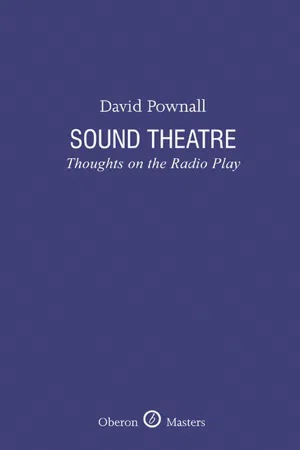
- 96 pages
- English
- ePUB (mobile friendly)
- Available on iOS & Android
eBook - ePub
About this book
Information
Chapter I
IT’S THE FIRST reading of the radio play – generally agreed by everyone concerned, except the author, to be a matter of limited importance. But for the maker of the piece it is a big moment – the first time he’s heard the play run together outside his own head. The studio-wise actors will be holding back, not commiting themselves to a full performance before they’ve heard what their colleagues are going to come up with. If there’s a starry name in the cast there may be some suggestive incoherence while the ego gets into the shadow of the part. The director is concentrating on whether he has cast the voices accurately. Is there enough differentiation? Do any of them sound like each other? At the back of his mind is an anonymous pair of ears prone to confusion.
The director has read the play many times, probably more than the author. He knows that the model of interpretation in his mind will only work if the mix of voices is right. No one picks up on the author’s anxiety. This can be so acute that some playwrights don’t attend recordings, preferring to trust to luck. This is not a good idea. Always, always be there, even if you sit in the control room for three days without saying anything. I only ever missed one recording of a play of mine, and that was because I was on the other side of the world. Upon my return I rang the director and asked how everything had gone. What I was told sent a chill down my spine. The actors had had a wonderful time with the play. And how.
In terms of tension, at the recording of a radio play the author starts in at the level of a stage dress rehearsal. Immediately after the first reading what was whole is broken up into scenes and sections and probably not recorded in order. You know that after this run-through there will be no strung-together homogeneity in the experience until the play is broadcast. The interpretation in studio can tilt and slide to one side – maybe not the side you favour. If it does, what are you going to do about it? Never let a critical thought go unsaid, but be sure you can back it up. So, put up or shut up.
* * *
Radio theatre depends on getting inside the head and staying there. But the body and its personal atmospheres are not forgotten. The sound of breathing, the colours of accents, vocal delivery, the quirks of emphasis, these run parallel in importance to words themselves. To a skilled radio actor, the microphone is a transplant bolted into the bones of his head.
Some of the best directors of radio theatre were stage actors. They tend to focus on performance more than soundscape. Whatever will be achieved in realising a play will come from the state of the actor in studio during the very brief time available to realise the play – two days for an hour-long recording. This isn’t much time for an actor to get his teeth into a part, so technique is important. It is possible that the actor will have only read the play properly on the way to the studio. At the first reading – which is the supreme moment for the playwright – any superficiality of approach will show and the pressure will be on.
An actor with a voice that is recognised as a beautiful instrument, may surf through the reading, riding on reputation. The director and the playwright will clock the fact. How, in the time available, can this be remedied? In the evening an actor may be working at a theatre, doing a big part. He’s saving himself, eking out his energy. That’s easier to deal with. The microphone picks up energy levels. The right kind of pressure has to be put on the actor without him knowing it.
* * *
The studio manager on the control panel is very experienced. Everything she hears affects her, which means she has ideas and opinions that cross into the territory of the director. What the actors say and how they say it is as much sound to the studio manager as the effects. She considers her job to be recording the very best sound available. She cannot divide her world into proper spheres of responsibility and leave the director to his. When an actor is getting it wrong it is as painful to her as a fault on the equipment. She also has a technician’s ulterior disrespect for the whole idea of directing. During the last few hours of the day’s work resentment surfaces and erupts. She has to be slapped down. Her sensitivity in keeping control of what is being recorded suffers. The director criticises her, refusing to avoid the confrontation. Eventually, after error upon error, he asks her to go out into the corridor and they have a row that makes a nonsense of the studio soundproofing. They return to the control room and resume recording. Within a quarter of an hour the whole episode is history.
* * *
The third scene is not going well. We’re down to the inflexion of one line. The actor can’t get it right. The director has explained what he wants several times but hasn’t got through. The line has already been recorded several times and scrapped. When played back to him, the actor can hear what’s wrong – but the way to do it properly escapes him. Somehow he can’t get his mind round the intonation that’s needed. To hit that right note with perfect judgement can be difficult, causing embarrassment to the most experienced.
We’re well behind on the recording schedule. That will have to be made up somehow. Because of the severity of the budget, overtime is out of the question.
Now the actor is getting tired of being put on the spot. Everyone is aware of a crisis looming – the control room, the green room and the studio itself. There is an atmosphere.
Atmospheres are of critical importance to a radio play. The playwright specifies what is needed – sitting-room atmos, pub atmos, underwater atmos, country lane atmos, pigsty, pillar-box, perambulator, palace atmos, but never a tension atmos outside what the work requires. It will always be picked up. Both the human and technical equipment is hyper-sensitive.
As a problem the one line seems diminutive, a few words. Why not move on, gloss over it? But Martin, the director is a terrier. He never gives up because he knows it will flaw the piece. What he won’t do is speak the line himself as he wants it done – even though he was once an actor and has a wealth of experience. If a performance is tilted by heavy advice on interpretation, the emphasis of the part will shift and the whole sound impression of a human character will become uneasy and ill-defined.
Essential directorial design comes at the time of casting – putting the right voice in the part, backed by the right acting skill. That’s when the director hears the play in his head. This is the conception that looms over every sound recorded. Over twenty years of making plays with Martin, watching him rock backwards and forwards as the sound is recorded, eyes shut, head in hands, you know that he’s listening to two versions of the scene simultaneously, one in his mind, the other in his ear. The first is assessing the second, comparing.
The actor in trouble is getting resentful. He’s getting too much attention. To give everyone time to ease up, a tea break is called. The actor knows this is for his benefit. He’s being given time to think the whole thing through. He goes into the corridor with his script and stares at the line, concentrating. He understands it. He knows the character. Why can’t he say it as it needs to be said? If he was saying it badly on stage it could be disguised with business, the fault made not so obvious. But here, because the word is all we have, and every word matters, there’s no prop to be toyed with as cover, no mask to wear, no hiding place.
The actor is alone with his voice. Today might be the time when extraneous problems are pressing down, allowing the voice below the voice to emerge, the voice of the youth, the boy, the voice before the theatre made its claim. The best radio actors are exceptionally clever with impersonation – give them a short while and they’ll come up with anything you want. The speed and skill displayed can be astonishing. But under stress the original voice sometimes emerges – perhaps in a dialect that was the raw material preceeding the elocution lessons and voice classes at drama school.
When received pronunciation slips away and the western side of Peterborough or dockside Newcastle emerges, it is a choice moment of language, a complex inner music that a playwright enjoys. After all, it is a story with potential – the comedy of pretension or the tragedy of loss of identity. When I worked in newly-independent Zambia during the Sixties I watched a tragic version unfold. As the country became free, a young African newsreader with a superb cut-glass English accent began his career on television. His beautiful voice and poise – and Savile Row suit – became wildly popular, even amongst the tough party organisers and strong-arm men. He somehow carved a special place for himself in the national consciousness. Here, look at this, he was saying to the ex-colonial masters, we can do anything you can do, we can even be you.
Out of the blue, he committed suicide.
* * *
The old actor is telling one of his stories, dropping the names of luminaries from the great days of twentieth-century theatre. It’s the end of the tea break. The director – who knew them all as well – looks at his watch. He needs to get on. The recording schedule has been knocked about by delays – particularly the one line that must be got right. He gently interrupts the old actor’s story. Time to get back to work. As the director goes in search of the man with the problem, he knows in his heart that the line will never be exactly as he wants it. He’s a perfectionist, and that’s a hard thing to be when the form punishes imperfection so harshly.
* * *
Two lead actors in something of mine were extraordinarly good as husband and wife tearing each other apart in a tortuous marriage. When the recording was over the man gave me a lift to a party we had both been invited to. I complimented him on his performance and how well he had worked with the actress, finding the emotional depths of the troubled relationship. “Thank you, David” he said. “We were greatly helped by having lived together for five years.”
* * *
The integrity of the text is still an item in radio drama. People worry about it, employ their powers to defend it. The special pleasure playwrights derive from working in the medium – an experience brief, intense and relatively trouble-free compared to the other technical forms derived from theatre – is based on this respect. No one mentions sanctity, but there is a feeling that should the text be mangled no good will come of it.
When ten minutes needs to be cut from a play because scenes have stretched while being recorded and it’s going to overrun the slot, the director turns to the playwright. The text has been timed – first by the one who wrote it, reading it through on his own against the clock, secondly on the computer word- and line-count, using the running-time of previous completed plays as a database, thirdly by the director in preparation for the recording, fourthly by the director’s PA at the first read-through with the cast.
As scene follows scene during the recording, organic shifts and changes occur. In spite of all the checks and estimates, the relationships between the voices pull the timing. The interaction between each actor’s personal pattern of expression, the shadowy pauses and rhythms, all add or subtract seconds that build into an amount confounding the estimates.
Out of experience, the playwright bears this inevitable need for alterations in mind. There are no laws governing the time a script takes to play. An eye is kept on certain scenes from the first read-through onwards. What the director sees as a good cut can be butchery to the playwright, who is on a different level, still bound by the structure originally put in place.
Cutting requires flair and fortitude at this stage. At the time of the edit, when the playwright is usually not present, the director needs to be able to make contact on the phone to discuss final tweaks and adjustments.
Also there is the opposite of cutting. The dead-room, where there is no atmosphere at all and the silence is profound, is a good place to send a playwright when another ten minutes of script is needed before the recording can finish. When first written, the play appeared to be in perfect balance....
Table of contents
- Cover
- Title page
- Copyright page
- Contents
- Chapter I
- Chapter II
- Chapter III
- Chapter IV
- Chapter V
- Chapter VI
- Chapter VII
Trusted by 375,005 students
Access to over 1.5 million titles for a fair monthly price.
Study more efficiently using our study tools.
Frequently asked questions
Yes, you can cancel anytime from the Subscription tab in your account settings on the Perlego website. Your subscription will stay active until the end of your current billing period. Learn how to cancel your subscription
No, books cannot be downloaded as external files, such as PDFs, for use outside of Perlego. However, you can download books within the Perlego app for offline reading on mobile or tablet. Learn how to download books offline
Perlego offers two plans: Essential and Complete
- Essential is ideal for learners and professionals who enjoy exploring a wide range of subjects. Access the Essential Library with 800,000+ trusted titles and best-sellers across business, personal growth, and the humanities. Includes unlimited reading time and Standard Read Aloud voice.
- Complete: Perfect for advanced learners and researchers needing full, unrestricted access. Unlock 1.5M+ books across hundreds of subjects, including academic and specialized titles. The Complete Plan also includes advanced features like Premium Read Aloud and Research Assistant.
We are an online textbook subscription service, where you can get access to an entire online library for less than the price of a single book per month. With over 1.5 million books across 990+ topics, we’ve got you covered! Learn about our mission
Look out for the read-aloud symbol on your next book to see if you can listen to it. The read-aloud tool reads text aloud for you, highlighting the text as it is being read. You can pause it, speed it up and slow it down. Learn more about Read Aloud
Yes! You can use the Perlego app on both iOS and Android devices to read anytime, anywhere — even offline. Perfect for commutes or when you’re on the go.
Please note we cannot support devices running on iOS 13 and Android 7 or earlier. Learn more about using the app
Please note we cannot support devices running on iOS 13 and Android 7 or earlier. Learn more about using the app
Yes, you can access Sound Theatre by David Pownall in PDF and/or ePUB format, as well as other popular books in Littérature & Théâtre britannique. We have over 1.5 million books available in our catalogue for you to explore.