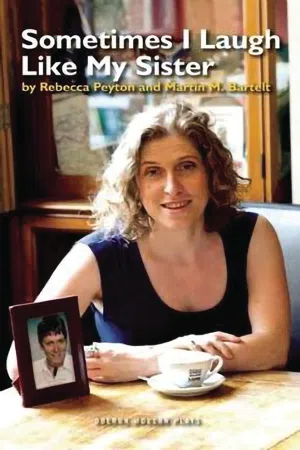
....a little show about death and other taboos..... Since her big sister, BBC journalist Kate Peyton, was murdered in Somalia, Rebecca has had rather a strange time. She welcomes us to her world in a passionately political, sharply comical and painfully personal account of life after Kate.
Crafting a moving and often comic tapestry of private moments from a public tragedy, Rebecca tells her own story of a courageous journalist and a loving big sister, whom she misses.
- 64 pages
- English
- ePUB (mobile friendly)
- Available on iOS & Android
eBook - ePub
Sometimes I Laugh Like My Sister
About this book
Information
Once the audience is seated, the actor enters.
A year or so after Kate was killed a friend of hers came to stay with me in London and we went out drinking, we went to the Frontline Club, it’s a club which was set up in memory of journalists who have died doing their job. The first time I went there I was stunned to see a picture of my sister. There was that picture, the picture I have in my key ring. Months and months after she’d died, there was that picture, in a frame, in a cabinet at the Frontline Club. There she is, just another journalist who has died, important to other journalists, but she’s my sister, she’s my big sister, who used to have a bath while I sat on the edge and I banged on about…everything. My big sister who wouldn’t get up in the morning…although you could possibly tempt her out of bed with a cup of tea. But however much I talk to you about my sister, I can never explain her to you. How do you describe the taste of blueberries to someone who has never eaten blueberries?
Kate was given only four and a half days to prepare to go to one of the – in February 2005 arguably the most dangerous country in the world. Kate said to us that she felt she had to go to prove her commitment to her job. Just before she was asked to go to Somalia she had been told her contract renewal was in question as her commitment was in doubt – she had recently turned down two trips to Iraq… So she agreed to go, though she really didn’t want to. Of course, she was an Africa Producer, she chose her life. To quote one of her colleagues, ‘You operate on a continent whose recent conflicts include Darfur, Zimbabwe, Congo, Rwanda, Angola. Often you are dependent on local producers to set up things for you, far away and with unreliable telephone communication. Language, logistics and communication are difficult, sometimes impossible, and often do not work out. There are always tight budget restraints. And you are expected to come up with spectacular story ideas that haven’t been thought of before. You frequently work with difficult, self-centred correspondents who don’t understand the limitations of the environment. And when things go wrong it’s the producer who gets the blame. And there is no fame in it – your face rarely appears on TV. This reduces your power in relation to correspondents, simply because they are better known. You are on call twenty-four hours a day, seven days a week. You travel all the time. You burn out easily.’ That was Kate’s life. The knowledge that she had serious misgivings about the trip on which she died means I sometimes forget that there was so much she loved about her job.
Anyway – we had quite a night at the Frontline Club: lots of journalists, lots of drinking, lots of opinions. All these friends and colleagues of Kate’s, so many new stories to hear about her. At the same time, so many questions about that trip to Somalia, everyone aware that this was not her kind of story. She’d interviewed the Rain Queen in South Africa, people living with HIV/AIDS, she had a great focus on women. Then a Somali expert with decades of experience in war zones tells me he would have needed three months to prepare for that trip, rather than the four and a half days Kate was given. And then another foreign correspondent saying he never would have gone, particularly in her circumstances: with only one other colleague – a freelancer – both of them new to the place, and with only a truckload of guys with guns they picked up at the airport for security. And then a BBC correspondent saying that we should let it go, that to continue to ask questions about Kate’s deployment was to threaten the future of the BBC’s foreign bureaux. Then an ex-BBC journalist asking when we would be suing the BBC, insisting that we should. My head was spinning… Yes, we’d taken on a lawyer, Kate’s friends, her colleagues, from various news organisations had repeatedly told us to do so. They told us stories about how unpleasant things had become between news organisations and their dead employees’ families…but we weren’t wanting to shut down, destroy anything. We wanted our questions answered, we had questions, and it was becoming clear that the only way to get answers out of the BBC was to get our lawyer to ask their lawyers. Not really the way we wanted to do things…
And, it turned out, lots of these guys wanted our questions answered too, but not enough to put their expert opinion on the record. In fact, as my brother and I began researching for the inevitable inquest into Kate’s murder we met loads of journalists, many of them really encouraging, saying that something needed to be done about the pressures under which journalists can find...
Table of contents
- Cover
- Title page
- Copyright page
- Dedication page
- Contents
- Introduction
- Prologue
- Biographical Notes
- Sometimes I Laugh Like My Sister
Trusted by 375,005 students
Access to over 1.5 million titles for a fair monthly price.
Study more efficiently using our study tools.
Frequently asked questions
Yes, you can cancel anytime from the Subscription tab in your account settings on the Perlego website. Your subscription will stay active until the end of your current billing period. Learn how to cancel your subscription
No, books cannot be downloaded as external files, such as PDFs, for use outside of Perlego. However, you can download books within the Perlego app for offline reading on mobile or tablet. Learn how to download books offline
Perlego offers two plans: Essential and Complete
- Essential is ideal for learners and professionals who enjoy exploring a wide range of subjects. Access the Essential Library with 800,000+ trusted titles and best-sellers across business, personal growth, and the humanities. Includes unlimited reading time and Standard Read Aloud voice.
- Complete: Perfect for advanced learners and researchers needing full, unrestricted access. Unlock 1.5M+ books across hundreds of subjects, including academic and specialized titles. The Complete Plan also includes advanced features like Premium Read Aloud and Research Assistant.
We are an online textbook subscription service, where you can get access to an entire online library for less than the price of a single book per month. With over 1.5 million books across 990+ topics, we’ve got you covered! Learn about our mission
Look out for the read-aloud symbol on your next book to see if you can listen to it. The read-aloud tool reads text aloud for you, highlighting the text as it is being read. You can pause it, speed it up and slow it down. Learn more about Read Aloud
Yes! You can use the Perlego app on both iOS and Android devices to read anytime, anywhere — even offline. Perfect for commutes or when you’re on the go.
Please note we cannot support devices running on iOS 13 and Android 7 or earlier. Learn more about using the app
Please note we cannot support devices running on iOS 13 and Android 7 or earlier. Learn more about using the app
Yes, you can access Sometimes I Laugh Like My Sister by Rebecca Peyton,Martin M. Bartelt in PDF and/or ePUB format, as well as other popular books in Literature & British Drama. We have over 1.5 million books available in our catalogue for you to explore.